The portrait might look like a golden retriever. It might look like a cat. It might even look like a very nice cat, the kind of cat who would have excellent credit if cats participated in financial systems. But if it does not look like your specific pet, it misses the point.
This is the thing mass-produced pet portrait products tend to get wrong, not through laziness but through the structure of what they are. A template-based product is built to process volume. It takes your photo and applies a visual system to it, adjusting colors, adding textures, producing something that looks plausible from a distance. The result is an image of a pet in a style. Whether it is an image of your pet, specifically, is a separate question, and one that template-based systems are structurally not equipped to answer.
Understanding why requires understanding what “custom” actually means for a portrait, and what “mass-produced” actually produces.
What Templates Do
A template-based portrait product works from a library of preset compositions, styles, poses, and visual treatments. You upload a photo; the system maps your photo onto the template. The pet’s colors and general shape are extracted and applied to a pre-built visual structure. The result looks consistent because it is consistent: every golden retriever processed by the same template will share the same underlying proportions, pose conventions, and stylistic treatment.
This consistency is the product’s strength as a business model. It allows high volume, fast turnaround, and predictable output. The visual quality can be quite good at the category level. A professional-looking golden retriever portrait, well-styled, clean, with competent color treatment.
The problem is the gap between the category and the individual. Your golden retriever has a particular tilt to the head that is characteristic. One ear sits differently than the other. The eyes have a specific warmth and expression that his owner finds immediately recognizable and anyone else might describe as “alert” or “happy” without quite naming what makes it his expression rather than a golden retriever’s expression. These details are not captured in the template, because the template was not designed with your dog’s specific properties in mind. It was designed to handle golden retrievers as a category efficiently.
The failure mode shows up at the detail level. The slightly asymmetrical white blaze on the face. The particular color of the nose leather. The exact shape of the underbite that his vet jokes about. The toy in the portrait, the one that has lost most of its original shape and remains legally a toy only by force of custom. These are not details that a template processes. They are details that only appear when the work is built around your specific reference rather than your pet’s category.
What “Custom” Actually Means
The word “custom” gets used loosely, and it is understandably suspicious to people who have been burned by products that used similar language to mean something considerably less. A lot of “custom” pet products are a template with your photo dropped into a slot.
In plain terms, a genuinely custom portrait is built around your individual pet. The composition, the light, the color temperature of the coat, the handling of the eyes, the decision about which background helps and which distracts: all of it is decided for your specific animal rather than applied from a preset. Two orders for the same breed, in the same style, should not come out interchangeable. If they would, the work was not really custom.
This matters because the decisions are not neutral. They are interpretive. Working from your reference photo means asking the same question portrait makers have always asked: what is actually important here, and how do you make the viewer see it? The answer for your pet, with their specific face, coloring, and expression, is not the same as the answer for any other pet. That individualization is the entire job.
The Revision Question
Here is a practical test that separates genuine custom work from processed products: what happens when you ask for a specific change?
With a template-driven product, “revision” usually means reprocessing the output with modified parameters, or producing a new version that is slightly different from the last. The portrait you were looking at and responding to is not being corrected. A new image consistent with slightly different settings is being produced. These are not the same thing.
With genuine custom work, revision means going back to the specific portrait, reading your note, and adjusting that image. “His eyes are a little too serious, he was goofier than this” is a note that can be acted on directly. The eyes in the portrait get changed to better reflect the expression in the reference. The portrait is refined toward the specific individual rather than regenerated in a new direction.
This distinction matters because meaningful revision depends on accumulated understanding of one specific portrait. A note like “warmer overall” or “soften the expression” only has a useful answer in relation to the particular image that exists. Custom work can look at what was made and understand what adjustments serve the portrait’s goal.
Every Pet on Canvas portrait includes unlimited revisions before final approval, because revision is part of making custom work actually custom. The first proof establishes the portrait. The revisions tune it toward the specific individual you actually know.
How to Tell the Difference When Shopping
You are looking at portfolio images. The product claims to be custom. How do you evaluate what you are actually seeing?
Start with the eyes. Eyes are the most demanding element in portrait work, and they are also the most perceptually important: human and animal visual systems pay disproportionate attention to eyes, which means errors there read as wrongness faster than errors anywhere else. Template-based portraits tend to produce either flat, lifeless eyes or hyper-processed glassy ones. Eyes in genuine custom work have layered color, intentionally placed catchlights (the small bright reflection that signals a living eye), and small asymmetries that feel real rather than rendered. Zoom in. If the eyes look like the same treatment applied uniformly across every example, they probably are.
Look at fur texture across the coat. Uniform texture is a sign of automation. Considered work changes direction, density, edge quality, and opacity based on what the fur is actually doing at each location: the short, dense fur on the muzzle lies differently than the longer guard hairs on the back, which differs from the soft undercoat at the chest, which differs from the wispy fur at the ear edges. Work built around the specific animal handles these differently at each location. A process that applies texture uniformly does not.
Look at whether portraits of different breeds and species feel meaningfully different from each other, not just in subject but in how they are handled. A portfolio of genuine custom work should show variety in surface treatment between a long-haired Persian and a short-haired Siamese, between a fluffy golden retriever and a sleek Weimaraner. A template library produces portraits where the surface treatment is the same regardless of coat type, because the style is the constant and the pet is the variable.
Look for what you might call the interesting details. The toy held in the portrait, not a generic toy but a specific object with specific wear patterns. The collar with a particular tag. The asymmetrical marking. The slightly anxious expression that the owner knows means “someone is about to vacuum.” These are details that only appear when the specific reference was actually attended to.
Their presence is not proof of anything by itself; it is a sign that something specific was being attended to. Their absence is worth noting.
What a Photo Does, and What a Portrait Does Differently
You already have photos. Many of them, probably, including several versions of the same expression because sometimes that is just the correct expression and you kept photographing it anyway.
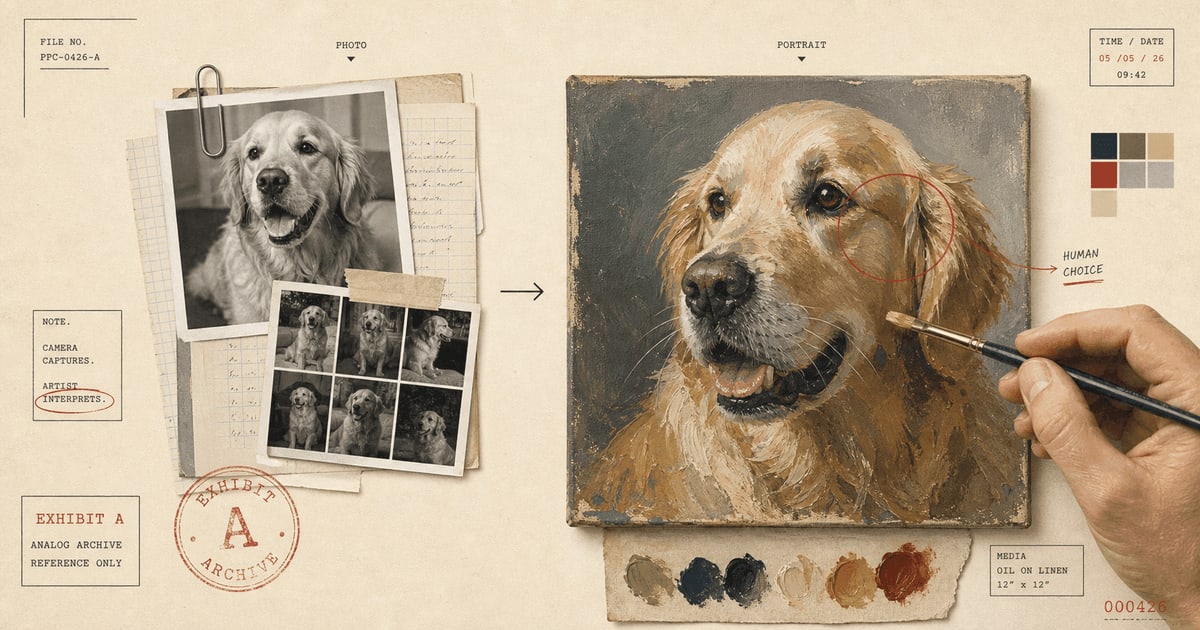
A photo records what the camera saw at a specific moment under specific conditions. The background was whatever was behind the pet at that moment. The lighting was whatever light happened to be present. The composition was whatever fit the frame without much deliberation. This is not a flaw. Photos are valuable precisely because they capture what actually happened without editorial intervention. They are documents.
A portrait starts from the photo but makes something different from it. The background can be replaced or simplified. The composition can be tightened. The color balance can be corrected for the phone camera’s tendency to shift warm tones cool under fluorescent light. The expression can be taken from one photo and the markings from another if the clearest reference for each is in a different shot. The specific qualities that make the photo of your pet emotionally meaningful to you can be foregrounded rather than buried under everything else in the frame.
This is not the portrait correcting the photo’s failures. The photo was not trying to make a portrait. The portrait is asking a different question: not what was there, but what matters about what was there.
Mass-produced products process this question at the category level. Your pet’s category, their breed, their species, their general coloring, gets processed into a visual system. The result is polished and plausible, a portrait of a pet that looks like your pet the way a good description of someone looks like them. Enough to be useful. Not enough to be a portrait.
Custom work answers the question at the individual level. The result should be recognizable to people who know your pet, not just people who recognize the breed.
The test, ultimately, is simple. Put the portrait in front of someone who knows your pet. Do they recognize the portrait as being of the specific animal, or do they say “oh, it looks nice” and mean the style?
Browse the portfolio if you want to see the difference across breeds and styles. The process starts here when you have the reference photo you want turned into something more than a photograph.
Welcome perk
Free expedited delivery on your first portrait
Get your digital proof in 1-2 business days instead of 2-3, free on your first portrait. Normally a $10 upgrade.
No spam. Just the perk and the occasional new style or guide.
Check your inbox for your code.