There is a dog on a leash in a fresco from the Roman city of Pompeii, painted sometime before the city’s destruction in 79 AD. The dog is large, short-haired, muscular, and wearing a collar. The inscription beneath it reads Cave Canem: beware of the dog. The fresco was at the entrance of a house, visible to anyone approaching the door.
The point was not decoration. The dog was there because dogs at the entrance made the house harder to enter without permission. Whether the dog in the fresco was an actual resident of the house or a generic warning image is a question archaeologists have debated; the mosaics at the House of the Tragic Poet and the House of the Dioscuri suggest both traditions existed. But the guard dog as concept, the dog whose job was to be present and intimidating at the threshold, was common enough in Roman culture that property owners thought a painted warning was worth the expense.
That is the dog as a technology of security: stationed, trained, valuable because of what it could do, and valuable also because the threat of what it could do discouraged problems from arising.
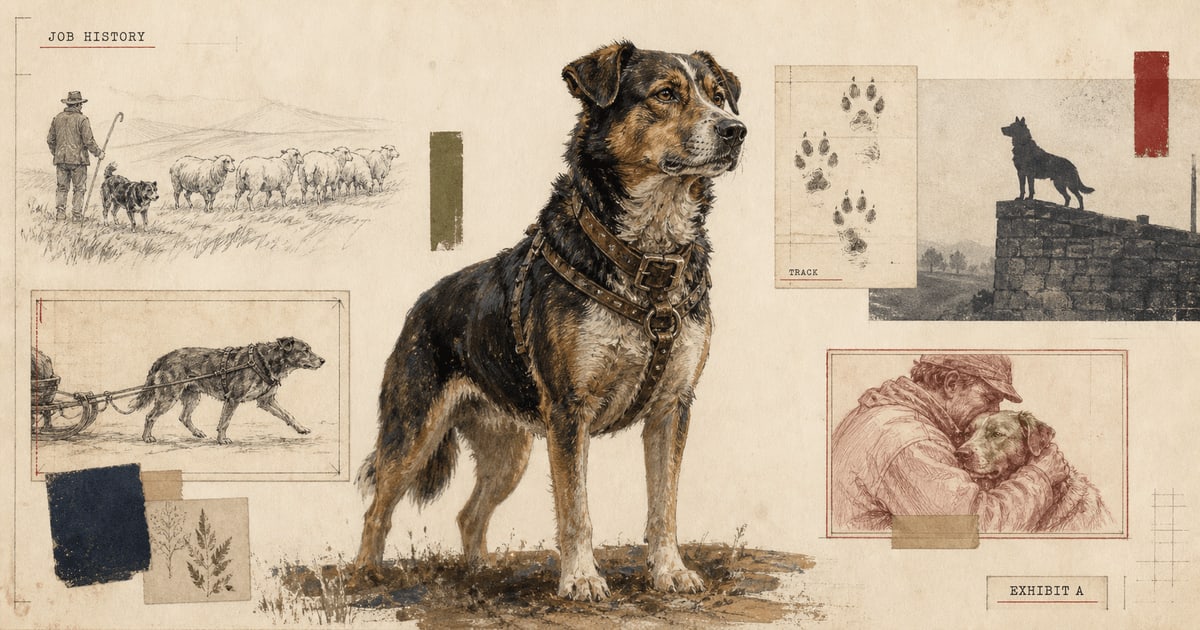
Most of the dog’s job history follows this logic. The dog is useful because it does something, notices something, or signals something that the human cannot do as well alone.
What the Archaeology Shows About Early Dog Jobs
Ancient dog remains tell job histories through their bones.
A study published in PNAS in 2021 by Angela Perri and colleagues examining dog remains from the Americas found skeletal evidence of heavy load-bearing in some individuals, consistent with dogs used for hauling before horses arrived on the continent. Dogs pulling travois, sled-type loads, were documented in multiple North American Indigenous cultures. Some dogs had arthritis patterns concentrated in joints typical of working load-bearing animals. The work was written into the skeleton.
At Ashkelon in Israel, the fifth-century BC dog cemetery excavated by Lawrence Stager in the 1980s contained over a thousand dog burials, each animal interred carefully on its side. The site is near what appears to have been a healing sanctuary associated with Phoenician culture. Several researchers have proposed that the dogs were connected to healing practices, since dogs licking wounds was a documented therapeutic belief in the ancient Mediterranean. If that interpretation is correct, the dogs at Ashkelon were working as healing animals, a job that would later evolve into the therapy dog role in modern healthcare settings.
Rock art from northern Saudi Arabia, dating to roughly 8,000 to 9,000 years ago, shows what appear to be hunting scenes featuring animals on leashes. The leashed animals have been interpreted by Maria Guagnin and colleagues at the Max Planck Institute as domestic dogs, making these some of the earliest depictions of a working dog-human relationship. The dogs are shown coordinating a hunt, positioned to drive or corner prey, working with humans rather than simply accompanying them.
These are three different continents, three different periods, three different jobs. The common feature is the dog integrated into human economic and practical life in a way that required some form of coordination.
A Body Shaped by Work
The modern dog’s physical diversity reflects the breadth of those job histories.
The coursing greyhound was bred across millennia in North Africa and the Middle East for speed, sight, and the ability to chase down prey over open ground. Ancient Egyptian tomb paintings show greyhound-type dogs in hunting scenes. Roman mosaics depict them. Medieval European manuscripts describe their care and training in detail. The modern greyhound is so physically optimized for running that when one is sitting on a couch, which is where most modern greyhounds spend most of their time, you can still see the entire functional logic of its body: deep chest for lung capacity, flexible spine for extension, narrow frame for minimal aerodynamic resistance. The job is still there.
The Border Collie’s herding instinct is so strongly selected that individuals who have never seen a sheep will attempt to herd children, bicycles, or houseguests, using the same crouching stalk-and-eye behavior developed over centuries of working sheep on the hills of Scotland and northern England. The collie’s “eye,” that fixed stare used to hold stock in position, is a modified predatory behavior that was selected and refined through hundreds of years of shepherds choosing the dogs who could hold a flock without breaking into a chase.
The Dachshund was developed in Germany specifically to follow badgers into burrows. The low, long body that looks like the result of a poorly considered design exercise is actually an extremely specific tool: it fits into badger dens while carrying enough chest capacity and jaw strength to be useful when it gets there.
These bodies are not decorative accidents. They are engineering. And because the bodies carry the history of the work, a portrait that understands the body understands the dog.
The Jobs That Have Not Changed
Some dog jobs have remained structurally constant even as their specific content shifted.
The alarm function is the oldest and possibly the most durable. The dog’s hearing range extends beyond human frequency, and its sensitivity to sound and smell allows it to register threats and changes in the environment before humans can. This was useful at the edge of a camp 14,000 years ago and is still useful at the door of an apartment in a city. The alarm dog does not need to be aggressive or large. A Chihuahua waking a family at 3 AM because a stranger is in the hallway is performing exactly the function that made dogs worth keeping in the first place.
The herding function has been partially displaced onto children, cats, and the schedule of the household. Many owners of herding breeds report that the dog enforces mealtimes, bedtimes, and departure routines with an efficiency that no human in the household has managed to replicate. The dog does not know what a schedule is. It knows that events happen in sequence and that when the sequence deviates, intervention is required.
The hunting dog’s flushing and retrieving instincts remain intact in many breeds regardless of whether hunting is practiced. A Labrador who has never seen a field will still carry objects gently in its mouth, present them to people, and remain calm in water. The instincts were not switched off by moving the breed indoors. They became the dog’s behavioral vocabulary for expressing affection and attention.
These are real jobs. They are not lesser because they do not involve livestock or prey. The dog waking someone who is sleeping through a medical event, the dog whose presence in an apartment makes a person feel safe enough to sleep, the dog who gets a person outside daily and becomes, without anyone planning it, the only reason that person has a physical activity routine: those are jobs with consequences.
Why the Job Belongs in the Portrait
The job history matters in a portrait because it lives in the body and the expression.
A German Shepherd in alert posture, weight forward, ears up, eyes tracking something at distance, looks like what it is: an animal running centuries of security software on a body built for it. That is a different portrait from a German Shepherd asleep in a patch of sun. Both are accurate. Neither is more or less dignified. But they are different pictures of the same job, one showing the work and one showing the recovery.
When an artist understands that a particular dog’s posture comes from breed history, the choices they make are different. The planted feet of a livestock guardian make sense against an open background. The coiled readiness of a terrier looks strange if the body is made to look relaxed. The soft mouth of a retriever carrying a toy is a gesture that carries specific meaning.
For a commissioned portrait, telling the artist about the dog’s role in the household, not the official breed description but the actual role, is some of the most useful information you can provide. The watch-the-window dog. The greet-every-visitor dog. The desk-companion dog. The retired working dog carrying the muscle memory of a previous life. These notes guide the pose, the background, the light, and the expression.
The dog does not need to be shown at work. But the work should be present in the way the dog stands.
Sources
- Angela Perri et al., “Dog domestication and the dual dispersal of people and dogs into the Americas,” PNAS, 2021.
- Maria Guagnin et al., “Pre-Neolithic evidence for dog-assisted hunting strategies in Arabia,” Journal of Human Evolution, 2017.
- Lawrence E. Stager, “Why Were Hundreds of Dogs Buried at Ashkelon?” Biblical Archaeology Review, 1991.
- Anders Bergstrom et al., “Origins and genetic legacy of prehistoric dogs,” Nature, 2020.
- Greger Larson and Dorian Q. Fuller, “The Evolution of Animal Domestication,” Annual Review of Ecology, Evolution, and Systematics, 2014.
- Adam Boyko, “The domestic dog: Man’s best friend in the genomic era,” Genome Biology, 2011.
Welcome perk
Free expedited delivery on your first portrait
Get your digital proof in 1-2 business days instead of 2-3, free on your first portrait. Normally a $10 upgrade.
No spam. Just the perk and the occasional new style or guide.
Check your inbox for your code.