
A friend’s cat died last week, and you have been looking at the message thread for a day and a half, trying to think of something to send that is not a sad-face emoji.
The hard part is not finding the perfect words. It is that by now most of the people around your friend have already moved on, and your friend can feel it.
Grief researchers have a name for this. In 1989 the psychologist Kenneth Doka called it disenfranchised grief: grief that is not openly acknowledged, socially validated, or publicly mourned. Pet loss is one of the clearest examples there is. There is no bereavement leave for a dog. Nobody organizes a meal train when a cat dies. People who would never say “it was only a grandparent” will happily say “it was only a cat,” and the person grieving learns fast to keep it to themselves.
That silence is the thing a good gift can actually push against. Which is also why the most common instinct is the wrong one.
The instinct is to help them move on. For most of the twentieth century that was the official theory of grief too. Healthy mourning meant breaking the bond and letting go, and continuing to hold on was treated as a kind of failure. Then in 1996 three researchers, Dennis Klass, Phyllis Silverman, and Steven Nickman, looked closely at what grieving people actually do and found close to the opposite. People do not cut the relationship off. They carry it forward in a changed form. They called this a continuing bond, and it is now understood as a normal, healthy part of grieving rather than something to be fixed.
Put those two findings together and the job gets clear. The best thing you can give someone who lost a pet does the opposite of helping them forget. It tells them the animal was real, their grief is real, and they are allowed to keep loving a dog or cat who is no longer here.
Here is what that looks like in practice.
Say the pet’s name
Most people, trying to be gentle, go abstract. “So sorry for your loss.” “Thinking of you during this hard time.” It is kind, and it is also the same thing you would say about a coworker’s uncle you never met.
Use the pet’s name. “I’m so sorry about Biscuit.” “I keep thinking about Murphy.” The name does something the generic version cannot. It tells your friend you knew this was a specific animal with a specific face, not a category called “pet.” Most grieving owners are aching to talk about their animal and have nobody giving them an opening. Saying the name is the opening.
Be specific, and bring a memory if you have one
If you knew the pet at all, say the thing only you would say. The way that dog lost his mind when the mail came. The cat who sat on exactly the page of the book you were reading. You are not reaching for something profound. You are showing that the animal left a mark on someone outside the house, which is a real and surprisingly rare comfort.
If you did not know the pet, you can still be specific about your friend. “I know how much she was part of your day” lands better than anything you could buy.
Show up more than you try to fix
The urge to make it better is strong, and it is the one to resist. No sentence fixes this, and reaching for one usually backfires. You do not have to fix it. You have to be one of the few people who did not look away.
Drop off food. Send the text with no expectation of a reply. Ask about the pet by name a month later, when everyone else has gone quiet and the loss has somehow gotten lonelier instead of smaller. Presence, repeated, is worth more than the perfect gesture done once.
The gifts that actually land
When people do want to give something, the ones that work share a quality. They treat the pet as someone worth remembering, not a problem to smooth over.
A handwritten note that names the pet and one memory. It costs nothing and gets kept for years.
A donation to a shelter or rescue in the pet’s name. It turns the loss into something that helped another animal, and most organizations send a small acknowledgment your friend can hold onto.
A photo they already love, printed properly instead of left to drift down a camera roll.
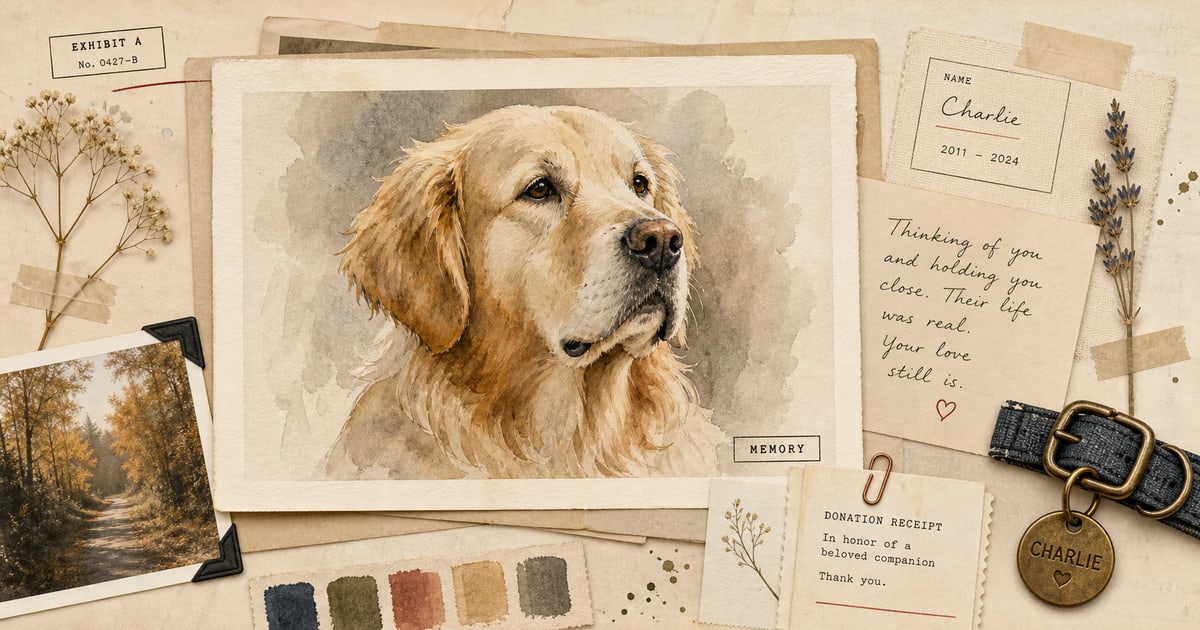
A custom portrait of their pet. People underestimate this one, and it is worth understanding why it works. A portrait is a continuing bond made literal: it takes the relationship and gives it a place on the wall. We wrote a short guide to giving a pet portrait as a sympathy gift, including how to get a usable photo without putting the grieving person on the spot, since that is the part most people get stuck on. If the pet was your own, the pet memorial portrait page is written for that instead.
Food, presence, a named donation, a real photograph, a portrait. None of them fix anything. All of them say the same thing: this mattered, and so do you.
A note on timing
You do not have to do any of this in the first week. There is no deadline on grief, and there is no deadline on kindness either. A gift that arrives a month or two later, after the cards have stopped and the house is at its quietest, often lands harder than one that shows up in the first rush. If you think you missed the moment, you did not. Send it now.
What not to say
A few lines that feel like comfort and are not:
“At least he lived a long life.” A long life makes the loss bigger, not smaller. There was more of it to love.
“He’s in a better place.” Maybe so, but your friend’s better place was the one with the dog in it.
“You can always get another one.” You would not say this about a person, and your friend does not experience it that differently. There is no spare.
And the most common mistake, which is not a line at all: saying nothing, out of fear of saying the wrong thing. Saying the wrong thing clumsily is almost always better than the silence. Grieving people remember who showed up. They rarely remember the exact words.
You cannot give someone their pet back, and you cannot shorten what they are about to go through. What you can do is refuse to treat the loss as small. You can say the name. You can remember the animal out loud. You can give them something that says the years were real and worth keeping.
That is most of what anyone can do for grief, the human kind or this kind. It turns out to be a lot.
Sources
- Doka, K. J. (1989). Disenfranchised Grief: Recognizing Hidden Sorrow. Lexington Books. Overview
- Klass, D., Silverman, P. R., & Nickman, S. L. (1996). Continuing Bonds: New Understandings of Grief. Taylor & Francis. Publisher
- Cordaro, M. (2012). Pet Loss and Disenfranchised Grief: Implications for Mental Health Counseling Practice. Journal of Mental Health Counseling, 34(4), 283-294. Abstract
Welcome perk
Free expedited delivery on your first portrait
Get your digital proof in 1-2 business days instead of 2-3, free on your first portrait. Normally a $10 upgrade.
No spam. Just the perk and the occasional new style or guide.
Check your inbox for your code.