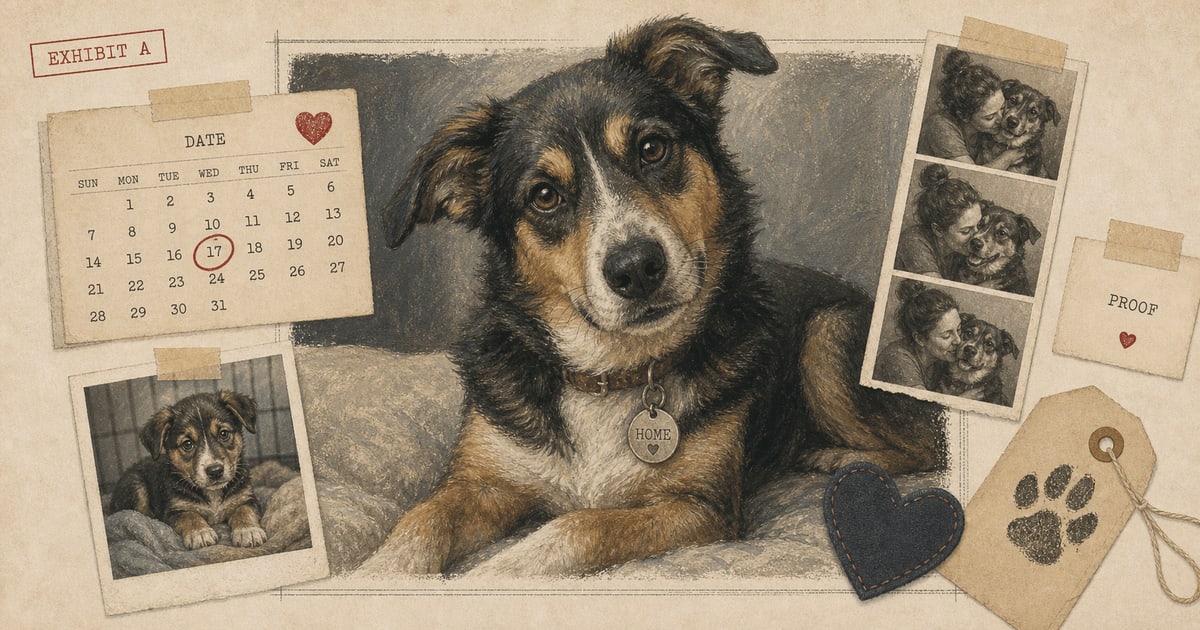
In the late 1990s, the phrase “gotcha day” appeared in online rescue communities as a way to mark the adoption anniversary for shelter animals. The birthday of a rescue dog or cat is usually an estimate, assigned at intake by a shelter staff member based on teeth, weight, and behavior. It is a guess, often a good guess, but a guess. The adoption date is on record: the day the paperwork was signed, the crate went into the car, and the animal became part of a specific household with specific people.
For commissioned portraits, this distinction matters more than it might seem. A birthday portrait commemorates the animal’s general existence. A Gotcha Day portrait commemorates the specific relationship. For people who adopted their pets, that distinction is often the whole point.
Why the Adoption Date Lands Differently
The psychology here is straightforward, even if it is underappreciated.
Human beings mark relationships more reliably than they mark biographical facts about the other party in the relationship. Wedding anniversaries are remembered more consistently than spouse birthdays. Friendships are often dated from first meetings or shared experiences rather than from any personal biographical milestone of the friend. The adoption anniversary follows the same pattern: it is the beginning of the relationship, not the beginning of the animal.
For a rescue pet whose early life included circumstances the owner would rather not memorialize, a shelter-assigned birthday can feel disconnected or even troubling to commemorate. The adoption date does not have that problem. Whatever came before it is not the subject of the day. The subject is the household that formed.
There is also the simpler practical point: the adoption date is the day the photos in your phone start. Everything you have of this animal, every image, every video, every memory you can locate in a specific room of a specific house, begins on or after that date. The portrait you commission belongs to that body of evidence.
Timing an Order Around the Date
Work backwards from the adoption anniversary to set a realistic order window.
For a digital portrait (the file only, no physical print): the proof takes 2 to 3 business days once the studio has your photos, a round of changes adds about 2, and the final file is emailed when you approve it. That is about 5 business days, so a week before the date is comfortable. The $10 expedited proof takes 1 to 2 business days, which brings it to about 4.
For a canvas portrait: the same proof and round of changes, then about 6 to 7 business days of U.S. production and delivery after you approve. That is about 12 business days, closer to two and a half weeks once the weekends are counted. Three weeks before the adoption anniversary is the comfortable order date. Two weeks is tight.
If you are inside two weeks and want something on the day: order the digital portrait, print it at a local print shop, and frame it. A canvas of the same portrait afterwards is a separate order with its own proof, so decide which one the anniversary really needs.
What the Brief Should Include
The artist brief for a Gotcha Day commission differs slightly from a standard portrait brief, and the difference is worth naming.
The adoption story, briefly. A sentence or two about how the pet came home carries the portrait’s context. “Pulled from a rural shelter at 12 weeks, the last of a litter of nine” or “owner-surrender at age 6, spent four months in foster care before adoption” gives the artist a different sense of the animal than a generic biography. This shapes the approach, however subtly.
The anniversary and what it marks. The specific adoption date and how many years are being celebrated. Some commissions incorporate this as a small inscription in the artwork itself. Most do not. Either way, the artist should have the information.
The look that anchored the bond. This is the hardest thing to articulate and the most useful thing to include. Almost every adopted-pet owner can identify a specific expression or posture from the early days of the relationship: the way the dog finally exhaled and put its head on your knee at the end of the first week, the way the cat came out from under the bed and sat at the door on the fourth day, the look the animal gave you that said the evaluation was over and this was home now. That expression is what the portrait should find. It is not always the most technically perfect photo. Sometimes it is a blurry one taken in bad light at 11 at night.
For general guidance on what to include in a commission brief, see what to tell the artist when ordering a pet portrait.
Selecting Reference Photos
An adopted pet who has been in the home for a while means there is a photo archive to work from. A few things to consider when selecting from it.
Photos from the early weeks carry a particular kind of interest. The animal often looks slightly different: thinner, wilder-eyed, more guarded, or paradoxically more alert because everything was still novel. Some owners commission what they explicitly call “as they first looked” portraits, capturing the animal at the age of arrival rather than at the age they are now. This is legitimate and often moving.
Current photos produce the most immediately recognizable portrait, which is what most owners want. The pet people see every day is the pet they want on the wall.
Milestone anniversary commissions, say five years or ten years, sometimes incorporate a side-by-side treatment: the animal as they arrived, and the animal as they are now. This requires two references and a larger surface, but the before-and-after read of the same animal across time can be striking.
For any reference, the technical requirements remain the same: clear, well-lit view of the face, eyes visible and in focus, taken at the pet’s eye level rather than from above. Multiple angles give the artist more to work with.
Gotcha Day Portraits as Gifts
When the portrait is being commissioned by someone other than the primary owner, a few additional things matter.
Confirm the exact adoption date. Do not estimate. For the person receiving the gift, this date is not an abstraction; they know it the way parents know a child’s birth date. Getting it wrong is noticed.
If you do not have access to the recipient’s photo archive, ask directly. There is no graceful way to solicit reference photos without the recipient understanding that something is being planned, so the pretense of concealment is usually counterproductive. Most people who would appreciate a Gotcha Day portrait will be pleased to participate in choosing the reference, and some prefer it: they know their pet’s face better than anyone and can identify the photos where the expression is most like the animal at its best.
Plan for the portrait to be ready slightly before the anniversary rather than on the day. Shipping dates involve real variability, and a portrait that arrives two days early is a better outcome than one that arrives two days late.
The broader gift considerations, including packaging, timing, and presentation, are in the custom pet portrait gift ideas guide.
Multi-Pet Households
Gotcha Day works somewhat differently when the household includes multiple pets with different adoption dates or with a mix of adopted and non-adopted animals.
The simplest approach is the most direct: commission a separate portrait for each pet, each tied to its own date, whether birthday or adoption anniversary. Over time, the household accumulates an individual record of each animal.
For households where one recent adoption changed the character of the household, commissioning a group portrait on that adoption anniversary makes a different kind of statement. The portrait marks the moment the current configuration became itself.
Some owners commission only a portrait of the adopted pet on Gotcha Day and address the other pets separately on their own dates. This is the approach that honors each animal’s specific history without forcing a combined narrative.
There is no correct version. The correct version is the one that matches what the household wants on the wall.
Why the Medium Often Matters More Here
Portraits commissioned for emotionally significant dates tend to involve more deliberate choices about medium and tone than standard portraits. A few patterns worth noting.
Pencil sketch is frequently chosen for Gotcha Day portraits of rescue animals who arrived in difficult circumstances or who have since aged significantly. The medium’s restraint suits a portrait that wants to be reflective rather than celebratory.
Watercolor is frequently chosen for younger animals, active animals, and portraits where the color of the pet is part of the emotional content. A brindle rescue dog whose coat was the first thing you fell in love with at the shelter: that’s a watercolor subject.
The choice is not required to carry symbolic weight. Pick the medium that looks right for the pet and the room. But if you are uncertain, the tone you want the portrait to hold on the wall is a useful filter.
When you are ready to commission, the order page and pricing page cover the full process. The Gotcha Day portrait is one of the more coherent uses of the form: it marks a specific moment, in a specific household, with a specific animal who might have gone home with someone else. That is worth a portrait.
Sources
- Samuel D. Gosling and Sei Jin Ko, “Sneak Peeks Into Your Personality and Relationships: What Do First Impressions of a Person’s Possessions Tell Us?” in Personality and Social Psychology Bulletin 28(11), 2002, on how humans narrate relationship origin points and why specific dates acquire commemorative weight.
- American Society for the Prevention of Cruelty to Animals (ASPCA), pet ownership and adoption statistics, 2022 annual report, on adoption rates for dogs and cats and the prevalence of shelter-assigned birth dates for rescue animals.
- Pauline C. Beattie and J.M. Thompson, “How Accurate Is Age Estimation in Dogs by Veterinary Professionals?” in Veterinary Record, 2020, on the reliability and methods of age estimation in shelter intake assessments.
Welcome perk
Free expedited delivery on your first portrait
Get your digital proof in 1-2 business days instead of 2-3, free on your first portrait. Normally a $10 upgrade.
No spam. Just the perk and the occasional new style or guide.
Check your inbox for your code.