
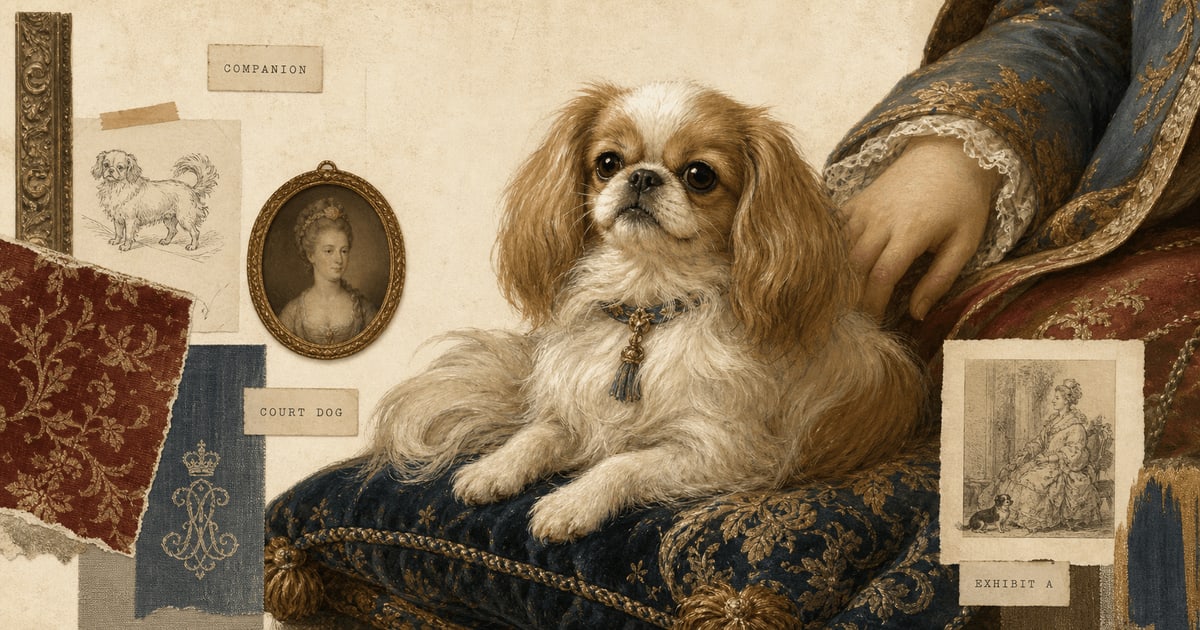
In 1570, Caius of Cambridge published De Canibus Britannicus, the first systematic classification of English dog breeds, and he had a lot of strong opinions about the small ones. He called them “Spaniells gentle,” also named “comforters,” and he was not flattering. Caius wrote that these dogs were kept by women of high station who pressed them against their stomachs to transfer the animal’s warmth and supposedly draw out illness. The dog, in Caius’s view, was being wasted on symptom management when it could have been out hunting something. But his disapproval is the record, and the record is this: by the mid-sixteenth century, small companion dogs were so common among aristocratic women that a physician felt compelled to classify them, list their uses, and complain.
That is a long way from a Chihuahua in a sweater, but the underlying relationship is not so different.
The lap dog has always carried more meaning than its size suggests. It has been a health device, a status object, a fashion accessory, a comfort technology, and a household personality capable of dominating a room that contains furniture worth more than most people’s annual wages. None of those roles are recent inventions. They all trace back further than most people expect.
Royalty Was Not Embarrassed About This
The impulse to keep small dogs close runs through royal and aristocratic history in a way that is almost universal once you start looking. Mary, Queen of Scots, famously had a Skye Terrier who reportedly refused to leave her body after her execution in 1587. Henry III of France kept a cage of small dogs around his neck on formal occasions. Catherine the Great of Russia kept a small companion dog named Zemira, and when the dog died, it was buried in a formal ceremony. Louis XIV of France maintained a menagerie, but it was the small spaniels in his private quarters that appeared in correspondence and portrait commissions.
These are not isolated eccentricities. They are a pattern.
The pattern says that small companion dogs occupied a specific social niche close to power: intimate, personal, visible in private spaces where formal animals had no business being. A hunting dog proved your land and your sport. A small companion dog in the lap proved you had an inner life, and that the inner life was comfortable enough to require company.
The dog was warmth, but the dog was also social text.
Medieval and Renaissance portraits understood this. When painters like Hans Holbein, Paolo Veronese, and Titian placed small dogs alongside subjects, the dog was not compositional filler. Small dogs appeared at the feet or laps of women in domestic and court scenes, and their placement signaled loyalty, refinement, and an intimacy that large hunting dogs could not convey. The choice of a small white spaniel versus a large greyhound said different things about the same wealthy person.
China Had Its Own Tradition
The Western European history is well documented, but parallel development was happening elsewhere. The Pekingese is among the oldest known toy breeds, associated with the imperial court of China for at least several centuries before European contact. Written accounts describe Pekingese being carried in the sleeves of court officials and kept as treasured animals in the Forbidden City, accessible only to the imperial family and certain nobles. They were not kept out of mere sentiment. They functioned as status objects, symbols of imperial favor, and small warm bodies in drafty stone corridors.
When the Summer Palace was looted by British and French forces during the Second Opium War in 1860, they found five Pekingese, the last survivors, and brought them back to England. One was given to Queen Victoria, who named her Looty. Within a few decades, the breed had entered British aristocratic households and was being shown in competitive conformation events.
The Shih Tzu has a similar backstory: bred in Tibetan monasteries, given as tributes to the Chinese court, kept as imperial companions for centuries before the outside world paid much attention. The Maltese arrived in the Mediterranean world even earlier. Ancient Greek and Roman sources describe small white lapdogs traded around the Mediterranean, kept by wealthy women, and occasionally buried with their owners.
The breed names and the cultural specifics differ. The social logic is the same: in courts and aristocratic households across multiple civilizations, small dogs occupied a privileged intimate space that larger working dogs never entered.
The Warmth Was Literal, Not Metaphorical
John Caius was not wrong about the stomach-warming theory. Medieval and early modern medicine was full of therapeutic applications for animals: live pigeons applied to plague buboes, puppies laid across aching limbs. Small dogs were specifically noted for their body heat. They ran warm. They fit against the human torso. They would hold still long enough to be useful, at least in principle, which is more than you can say for most other therapeutic options of the period.
That literal warmth has a medical history beyond folklore. Small dogs have higher metabolic rates per unit of body mass than large dogs, meaning they genuinely do radiate heat proportionally. Whether they cured anything is a different question. But the use of a small dog as a portable heat source for someone ill, elderly, or cold in a stone building with no central heating was not medically irrational given what people knew and had available. The distinction between “warm because warm” and “warm because curative” was not obvious in a world without thermometers and germ theory.
This is also why small companion dogs appear so frequently in accounts of illness, aging, and grief. They were prescribed. Physicians in multiple countries, across several centuries, wrote recommendations for small companion dogs as comfort for the sick and bereaved. The therapy probably worked in ways they did not understand: the presence of a small warm animal reduces cortisol, lowers heart rate, and provides tactile comfort, all of which have been confirmed by modern research. The mechanism was wrong, but the instinct was correct.
The Scale Changes the Relationship
A working dog at a distance can be respected without being known. A lap dog cannot. The physical scale forces intimacy in both directions: the dog is in the personal zone, and the person is obligated to pay close attention.
You notice the breathing. You learn which eye droops slightly in the afternoon. You know the exact sound the dog makes when it wants to be moved six inches to the left. You know the particular frequency of the sigh that communicates deep moral disappointment with your failure to share the biscuit.
That enforced attention is one reason small companion dogs generate such specific personal histories. Their individuality is not abstract. It is accumulated through hundreds of tiny close-range interactions. A large dog can be loved deeply from a few feet away. A small dog is always in the frame.
This is why lap dog grief is often so detailed and so spatially specific. People do not just miss the animal. They miss the weight, the smell, the exact amount of body against the ribs. The absence is tactile.
Commission a custom portrait of a small dog and the spatial detail often matters more than people expect. The lap itself is sometimes the whole story. The blanket, the chair, the particular folded position. A portrait that captures the close-range reality of a small companion dog can preserve something that a wider shot never quite holds.
What Modern Lap Dogs Inherited
The small companion dogs on the market today carry several thousand years of this history in their bodies, whether or not their owners know it. The Cavalier King Charles Spaniel descends from the court spaniels visible in seventeenth-century English portraits. The Pug came to Europe through Dutch traders who encountered them in China. The Maltese, arguably, has been in continuous cultivation as a companion dog since ancient Greece.
These are not random animals who happened to be small. They are the products of deliberate human preference for animals suited to indoor life, close contact, and domestic companionship. They were shaped for laps: compact, warm, mild-tempered, socially alert without being aggressive, content in small spaces, reliably oriented toward their person.
Modern rescue dogs often end up in this category too. Any dog who has decided that the nearest warm human is the proper center of the universe has inherited the lap dog logic, regardless of their genetic background.
The comedy of scale that made small dogs useful to portrait painters for five centuries has not gone away. A tiny dog painted with the formal gravity of a Flemish masterpiece is funny and serious at the same time. The humor comes from the scale. The weight comes from the real history of what that dog’s ancestors meant to the people who held them.
If you have ever watched a four-pound dog conduct a thorough security review of a house and then retire to a single spot with the air of someone who has completed important work, you understand the lap dog’s oldest and most durable job: taking itself seriously in a world that keeps finding that hilarious.
Sources
- Johannes Caius, De Canibus Britannicus (1570), translated by Abraham Fleming as Of English Dogges (1576). Available via Early English Books Online.
- Katharine MacDonogh, Reigning Cats and Dogs: A History of Pets at Court Since the Renaissance. St. Martin’s Press, 1999.
- Susan Kathleen Walker, “Small Dogs in European Portrait Painting, 1450-1750”, Studies in the History of Gardens and Designed Landscapes, 2008.
- American Kennel Club, “Pekingese History”.
- American Kennel Club, “Maltese History”.
- Sandra Swart, “Dogs and Colonialism: The Management of Canine Bodies in Twentieth-Century South Africa,” Journal of Southern African Studies, 2003.
- Erica Fudge, Pets. Acumen Publishing, 2008.
- Victoria and Albert Museum, “Pet portraits at the V&A”.
Welcome perk
Free expedited delivery on your first portrait
Get your digital proof in 1-2 business days instead of 2-3, free on your first portrait. Normally a $10 upgrade.
No spam. Just the perk and the occasional new style or guide.
Check your inbox for your code.