
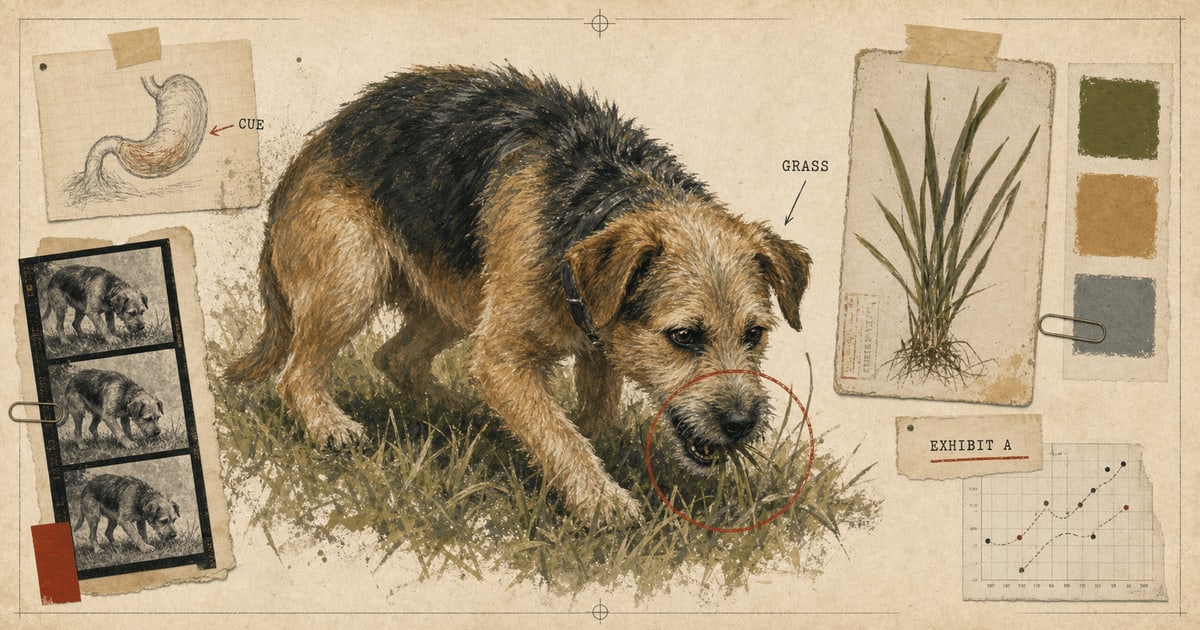
In 2008, Karen Sueda, Benjamin Hart, and Kelly Cliff published the largest systematic study of grass-eating in dogs to date. They surveyed 1,571 dog owners whose pets ate plants regularly. The results were awkward for the theory most people repeat confidently every time their dog grazes: 68 percent of dogs ate grass on a daily or weekly basis, meaning it is not an unusual behavior at all. Of the dogs that ate grass, fewer than 10 percent appeared ill beforehand. Fewer than 25 percent vomited afterward.
If grass-eating is primarily a response to nausea, you would expect these numbers to be nearly inverted. You would expect the behavior to cluster around dogs that are obviously unwell. It does not. It is distributed evenly across healthy dogs, across ages, across breeds, across seasons. The self-medication story is appealing and badly supported.
This matters because the folk explanation has been circulating so long that most people accept it without question. Dog eats grass, dog vomits, dog feels better. The story is tidy, the behavior gets explained, and everyone moves on. Except that in the majority of grass-eating episodes, no vomiting occurs at all, and most of the dogs eating grass were feeling fine to begin with.
The actual biology of a dog that eats plants
Dogs are not obligate carnivores. This point is underappreciated by people who feed raw meat diets on the theory that they are returning dogs to a wolf’s natural state. Wolves eat rabbits, and when a wolf eats a rabbit, it eats the rabbit’s stomach contents: half-digested plant matter, grass seeds, whatever the rabbit had last cropped. Plant material is a routine component of the wild canid diet, just usually pre-processed.
The genomic evidence for this is unambiguous. Domestic dogs have between four and thirty copies of the AMY2B gene, which codes for salivary amylase, the enzyme that begins breaking down starch in the mouth. Wolves have only two copies. The expansion of this gene in domestic dogs is one of the clearest molecular signatures of adaptation to an omnivorous, starch-heavy diet alongside humans. Erik Axelsson and colleagues published this finding in Nature in 2013, and it fundamentally repositioned the “dogs are basically wolves” framing. Dogs are not basically wolves. They are a separate lineage shaped by ten thousand years of living on the margins of human agriculture.
John Bradshaw, in Dog Sense, argues that domestic dogs evolved primarily as scavengers eating human food waste, not as hunters. That is a mixed, opportunistic diet. A dog with this evolutionary background treats grass as one item in a wide-open menu of potentially edible things, not as emergency medicine.
Why a dog might choose grass specifically
Three explanations have real standing, none of them requiring the dog to be sick.
Fiber content and gut motility is the least dramatic and possibly most accurate. Plant matter provides bulk that supports normal digestion. Dogs do not need to consciously understand nutrition for this to work. If eating grass produces a digestive state that feels better than not eating grass, the behavior gets reinforced. No nausea required.
Sensory interest is underrated as an explanation. Dogs are animals whose primary interface with the world is their nose and mouth. Grass in spring has a distinct smell: wet, sweet, faintly fermented from soil bacteria. Fresh shoots are a different texture than anything a dog encounters in its food bowl. The AMY2B expansion tells us dogs can taste and metabolize sugars; spring grass is sweet. An animal with a flexible omnivorous palate and strong sensory curiosity grazing on something interesting is not a mystery that requires a medical explanation.
Instinct and learned behavior may both play roles. Studies by Sueda and colleagues found that plant-eating was more common in younger dogs and dogs that had observed other dogs or people eating plants. Some grass-eating may be socially transmitted. Puppies learn a lot of dietary preferences by watching what adults eat, which is a reasonable heuristic in the wild and occasionally produces grass-grazing dogs in domestic settings.
The nausea subset
Here is what is probably true: there is a subset of dogs for whom grass-eating and vomiting co-occur, and for those dogs, it is possible that grass-eating is triggered by gastric discomfort. Dogs who eat grass urgently, in large quantities, with obvious intent, and then vomit quickly, are behaviorally distinct from dogs who graze casually on a walk and continue without incident.
The honest framing is that both phenomena can exist. A behavior that is usually benign can sometimes be serving a different function. The mistake is applying the nausea-relief explanation to all grass-eating, when the data suggest it applies to a small minority of episodes.
Even in the urgent-eating cases, it is not settled whether the grass causes vomiting or merely precedes it. A dog whose stomach is already churning may eat grass because it is available and the dog is feeling off; the grass may then add physical bulk that accelerates vomiting. Whether the dog “intended” this is a question the evidence cannot answer.
What to actually watch for
The grass itself is rarely the problem. The problems are what may be on it.
Pesticides, herbicides, and synthetic fertilizers are the primary concern. A dog grazing on a neighbor’s lawn, on a golf course, on a park that has been recently treated, is ingesting whatever was applied. The AVMA publishes guidance on this, and “call poison control” is the relevant action if you see a dog eating heavily from a recently treated lawn and then becoming symptomatic.
Foxtails and similar plant awns are mechanical hazards rather than chemical ones. These barbed grass seeds are designed, evolutionarily, to catch on fur and skin for dispersal. In dogs they can lodge in nostrils, ears, paw pads, and between toes, and migrate through tissue. A dog walking through mature foxtail stands in summer needs a thorough check afterward, especially in the ears and between the toes.
Toxic plants growing at the edge of a grass area are easy to overlook. Sago palm, yew, oleander, and autumn crocus are among the plants that are genuinely dangerous to dogs in small quantities. A dog eating indiscriminately may not distinguish between grass and whatever is growing through it.
The occasional grazing dog in an untreated yard is doing something ordinary. Sudden, urgent, large-quantity grass-eating in a dog that is otherwise behaving strangely is a veterinary call.
What the research gap looks like
Sueda’s 2008 study remains the best dataset we have, and its methodology has real limitations. Owner surveys capture what owners notice and report. People notice dramatic episodes: their dog ate grass and then vomited dramatically. They do not notice, or may not report, the many times their dog grazed briefly and continued normally. This selection effect means the vomiting connection is almost certainly overrepresented in the data even though it was lower than expected.
Whether grass-eating varies meaningfully by breed, season, time of day, diet composition, or gut microbiome has not been studied in any controlled way. Whether dogs preferentially select specific grass species is unknown. Whether the behavior changes in dogs switched from kibble to a higher-fiber diet is unknown. The story is less settled than most pet health websites suggest.
That uncertainty is not alarming. It just means the confident explanation most people reach for (“the dog is self-medicating”) is doing more work than the evidence supports. A dog that eats grass is probably doing something ordinary, for reasons that are probably multiple and possibly mundane, and is almost certainly fine.
The more interesting question is why humans so badly want a medical explanation for what is, in all likelihood, just a dog being omnivorous.
Sources
- Sueda, K. L. C., Hart, B. L., and Cliff, K. D. “Characterisation of plant eating in dogs.” Applied Animal Behaviour Science 111, no. 1-2 (2008): 45-53.
- Axelsson, E., Ratnakumar, A., Arendt, M. L., et al. “The genomic signature of dog domestication reveals adaptation to a starch-rich diet.” Nature 495 (2013): 360-364.
- Bradshaw, J. Dog Sense: How the New Science of Dog Behavior Can Make You a Better Friend to Your Pet. Basic Books, 2011.
- Coppinger, R., and Coppinger, L. Dogs: A Startling New Understanding of Canine Origin, Behavior & Evolution. Scribner, 2001.
- American Veterinary Medical Association. “Common household hazards for pets.”
- American Kennel Club. “Why Do Dogs Eat Grass?”
Welcome perk
Free expedited delivery on your first portrait
Get your digital proof in 1-2 business days instead of 2-3, free on your first portrait. Normally a $10 upgrade.
No spam. Just the perk and the occasional new style or guide.
Check your inbox for your code.