Every great pet portrait starts as a bad photo that someone took because their dog was doing something irresistible on a Tuesday afternoon. You were not set up. You were not ready. The kitchen light was on and the angle was whatever angle a standing human produces when pointing a phone at a floor-level event. The photo is a miracle of timing and a disaster of everything else.
That is where most reference photos come from, and it is fine. But there are certain things that make a photo genuinely useful for a portrait artist, and understanding why those things matter is more useful than a checklist. Once you understand the mechanics, you start seeing what your own photos are missing.
Why Natural Light Is Not Just a Preference
Artificial light sources are narrowband. A standard LED bulb emits a limited slice of the visible spectrum, and your camera sensor does its best to compensate with something called white balance correction. That correction works reasonably well for casual documentation, but it introduces color shifts that are invisible to you in the moment and very visible to an artist trying to paint accurate fur tones.
The difference between a dog’s coat photographed under LED kitchen light and the same dog photographed in indirect daylight can be significant: the first may read as cool gray-brown, the second shows the actual red-gold in the base coat, the blue-black in the shadowed guard hairs, and the warm cream on the chest. An artist painting from the first photo is essentially working from a lie. They might still produce a beautiful portrait, but it will not be a portrait of your specific dog’s specific coloring.
Natural daylight contains the full visible spectrum. That is not a spiritual statement. It means the light reaching the fur reflects back accurately, the camera records it accurately, and the artist has honest color information to work from. Overcast daylight is ideal because the clouds diffuse the light source across the whole sky, eliminating harsh shadows and producing the soft, even illumination that photographers have coveted for portraits since photography existed. Bright open shade accomplishes something similar.
There is also the matter of catchlights. Look at the eyes in any well-executed portrait, whether of a person or a pet, and you will see a small bright reflection. That tiny glint is the light source reflected in the wet corneal surface of the eye. It is called a catchlight, and it is perceptually significant: our visual system uses it as one of the cues that signal a living eye versus a dead or artificial one. Photographer and portraitist conventions around catchlights are centuries old for this reason. Eyes without catchlights read as flat, fixed, slightly wrong. Eyes with catchlights read as alive.
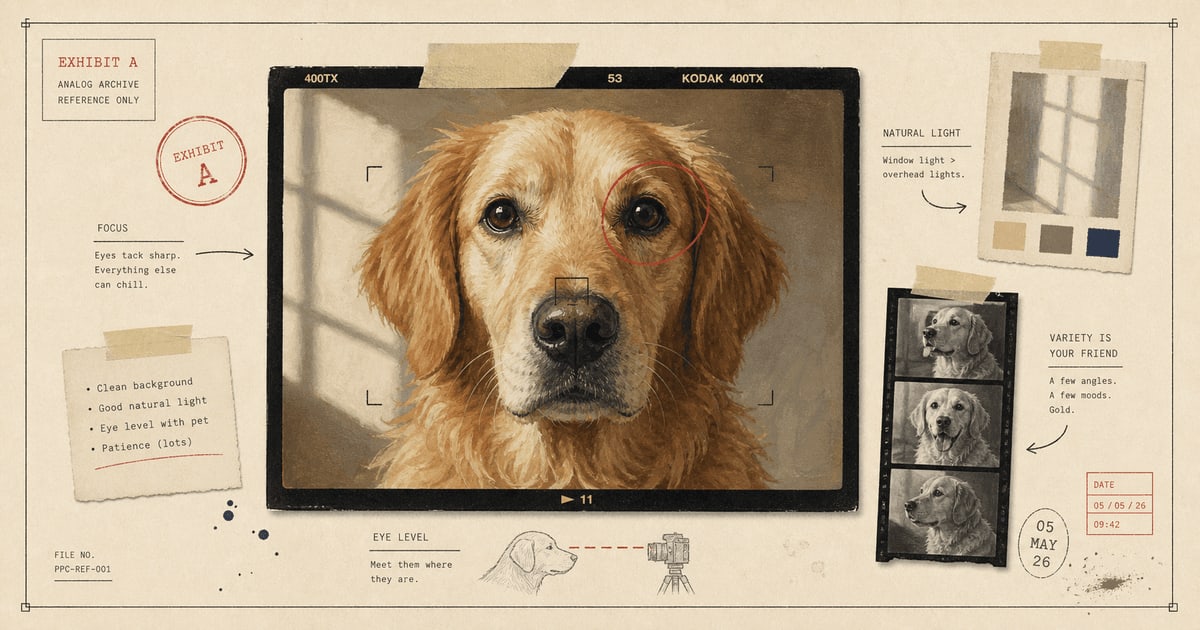
Natural daylight, especially from a window at 45 degrees to the face, produces catchlights reliably. A ceiling light does not. Flash produces a catchlight, but it is harsh and usually positioned directly on the optical axis, resulting in the same problem as red-eye in humans. An artist can add or adjust catchlights in the painting stage, but they have to know where the light was coming from to make them look plausible. A reference photo taken in soft window light gives them that information for free.
The Geometry of Eye Level
There is a reason portrait photographers and filmmakers obsess over camera height relative to the subject. It is not aesthetic preference. It is visual psychology.
When a camera is positioned above the subject, looking down, two things happen simultaneously. First, the proportions of the face shift in a way that tends to compress the head, enlarge the nose, and reduce the eyes. Second, and more importantly, the angle reproduces the social geometry of a dominant viewer looking at a subordinate subject. This is not conscious. It is processed automatically, in the same neural pathways that read social posture, and it tends to make the subject look smaller and less significant than a level gaze would.
Most pet photos are taken from standing height because we are standing and the pet is not. The result is a technically adequate record of a pet who looks smaller, more compressed, and viewed from above. That is fine for documentation. For a portrait, it produces a slightly incorrect version of what your pet actually looks like from a face-level interaction.
The reason eye-level photos feel different is that they reproduce the geometry of meeting someone as an equal. This is why the moment you crouch down to a dog’s level and photograph straight at them, the image suddenly looks like a portrait rather than a snapshot. The proportions correct themselves. The eyes are in the right place in the frame. The face fills the space with actual presence.
So kneel. Sit. Lie on the floor if the floor is where the dog is. It is undignified and it produces significantly better reference photos.
The Eyes Are the Only Part That Cannot Be Reconstructed
Everything else in a pet portrait can be improved, adjusted, or reconstructed from partial information. The background can be replaced. The coat color can be warmed or cooled to correct for bad lighting. The composition can be tightened. The artist can even use multiple photos to combine the best expression with the clearest markings.
The eyes cannot be reconstructed from nothing. If the eyes are blurry, shadowed, or closed, the artist does not have enough information to paint them accurately, and a portrait with inaccurate eyes is a portrait of a generic version of your pet. The eyes are where individual recognition lives. A golden retriever has brown eyes. Your golden retriever has your golden retriever’s eyes, with whatever particular quality, depth, or brightness they actually have.
Tap your phone screen directly on the eye before shooting. On most phones, this forces the autofocus to lock there and also adjusts the exposure so the face is correctly lit rather than silhouetted against a bright window. Take multiple shots. Pets blink, look away, and reconsider their participation in the project at unexpected moments. Out of ten photos, two or three will have eyes that are genuinely sharp and expressive. Those are the ones that matter.
Dark-coated pets require particular attention here. Black and very dark brown coats absorb light rather than reflecting it, which means you need substantially more light than you think you do to get detail in the face. In low light, a black dog’s face becomes a dark shape with eyes that might be present or might not, depending on luck. Move them into bright shade or near a large window and shoot with the light source in front of and slightly above the face.
Flash: Why the Convenience Is Not Worth It
Built-in flash (the kind on your phone or a point-and-shoot camera) fires from a position very close to the lens axis. The light travels out, hits the subject, and bounces straight back into the sensor. The result is flat, shadowless illumination that removes the depth information an artist uses to understand form.
Portrait painters and photographers understand form through shadows. The soft shadow beneath the cheekbone tells the artist where the face turns away. The slightly darker area in the corner of the eye socket tells them where the skull recedes. These shadows are not flaws in the image. They are the information that makes the face three-dimensional. Flash removes them, and the portrait artist is left working from a flat map instead of a three-dimensional reference.
Flash also tends to make fur look slightly greasy or unnaturally shiny, because the direct light at the lens angle creates specular highlights on every hair shaft simultaneously. Natural light at an angle creates texture instead of shine.
If the room is too dark to photograph without flash, move the pet. Near a window, outside into open shade, anywhere that the light is ambient and directional rather than frontal and artificial.
Sending Multiple Photos
The best reference sets usually include three or four photos, not one, but also not the full camera roll from the past three years.
A clear front-facing photo covering the head and chest is the anchor. Add a three-quarter angle if you have one, because this often shows facial structure and markings more clearly than a full frontal. Include a photo that captures the expression you actually want in the portrait, which may not be the technically sharpest photo. And if your pet has distinctive markings, paws, a tail, or a body shape that matters to the portrait, a full-body reference helps the artist understand the whole animal.
The expression photo is worth thinking about carefully. Sometimes the photo that captures your pet’s personality most accurately is not the one with the sharpest focus or the cleanest background. That is fine. Send both. Write a note. “This one is sharper but this one looks like her” is genuinely useful information.
For Memorial Portraits
If your pet has passed and the only photo you have is old, taken on a lower-resolution camera, or technically imperfect, send it anyway. The artist will work with what you have. A 2014 phone photo taken under yellow kitchen light is not ideal, but it is not nothing. It still contains the specific animal, the face, the expression, the thing that made you take the photo at all.
Better photos produce portraits with more accurate detail. But the portrait’s purpose does not depend on technical perfection. It depends on the artist being able to see your specific pet in the reference, and that is usually possible even with an imperfect photo.
If you do have the chance to take new photos before the time comes, take them. Outside. Eye level. In soft morning or late-afternoon light. Eyes sharp and facing the camera. You will be glad you have them.
The Short Version
Go outside or to a large window. Get on the floor. Tap the eye before you shoot. Take ten photos and send the three or four best ones. That is most of it. The rest is understanding why those things matter, which is now information you have.
When you are ready, upload your photo and choose a style. Digital portraits start at $24.99, with proofs in 2 to 3 business days. The photo determines what is possible. The artist determines what it becomes.
Welcome perk
Free expedited delivery on your first portrait
Get your digital proof in 1-2 business days instead of 2-3, free on your first portrait. Normally a $10 upgrade.
No spam. Just the perk and the occasional new style or guide.
Check your inbox for your code.