Nobody prepares you for how quiet the house gets.
You find yourself stepping over a water bowl that is not there anymore. You reach down to pet something that is not there anymore. Grief for a pet is real. People who minimize it are not helping. So let us skip the part where anyone has to justify it and talk about what actually helps.
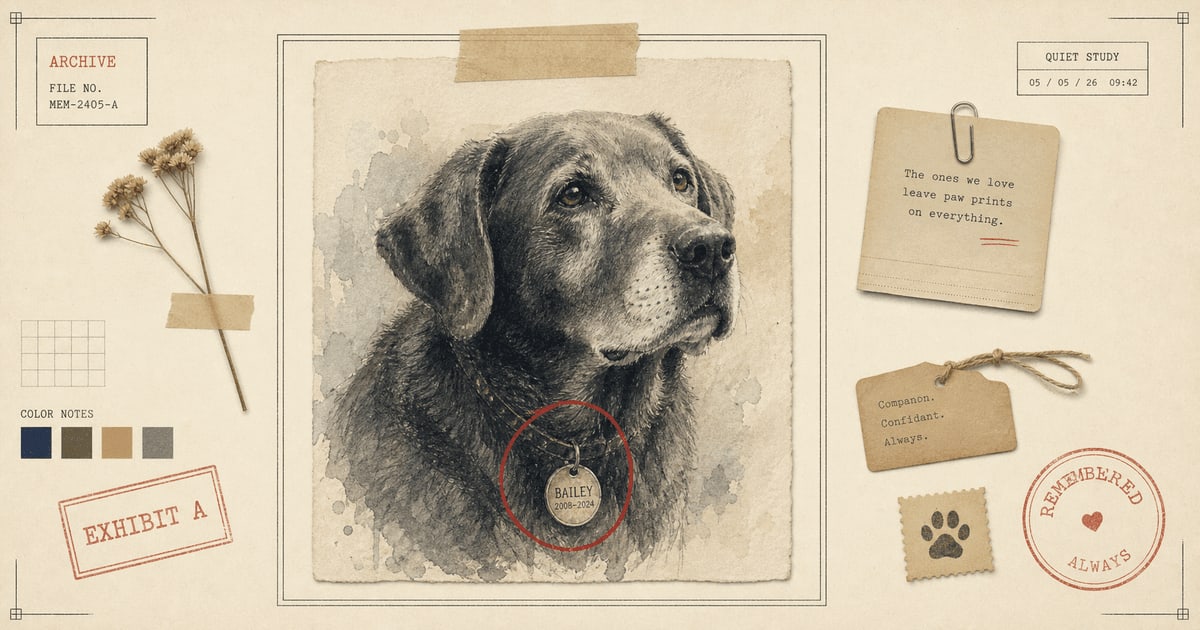
A memorial portrait is one of the most meaningful things you can do with the photos you have left. Not because it fills the silence. Nothing does that right away. But because it takes the most alive version of your pet and turns it into something that stays.
Here is what to know about commissioning one.
Why People Commission Memorial Portraits
There is a practical reason and a real reason. The practical reason is that photos get buried in camera rolls and do not always survive phone upgrades the way physical art does. The real reason is that a portrait is an act of attention. Someone studied your pet: their eyes, their fur, the specific shape of their nose, and made something that says this individual mattered.
People hang them in living rooms, offices, and hallways. They give them as gifts to families who just lost a beloved dog or cat. They commission them months or even years after the loss, when they are finally ready to look at the photos again. There is no wrong time. Grief does not run on a schedule.
For why the loss lands so hard, see Why Pet Grief Can Feel Like Losing a Family Member. If you would like support before deciding anything, pet loss resources has hotline numbers.
The First Thing to Do: Gather Your Photos
If your loss is recent, do this before you are ready to do anything else. Go through your phone, your old phones, your email, your social media. Download every good photo you have of your pet while you still remember where they all are. This matters.
You are looking for photos where your pet feels alive in the frame. Eyes open, expression clear, coat or fur visible in decent light. Candid shots often work better than posed ones because they capture personality rather than just appearance. The photo does not need to be perfect. It needs to feel true.
For a portrait, you want the face well-lit and in focus. The background does not matter much. A good artist can work around clutter or a distracting setting. But soft, natural light is almost always better than flash, which flattens features and washes out color.
Gather several options. The more you give the artist to work from, the better they can understand who your pet actually was.
If You Have Only One or Two Photos
Start with the photo where the eyes and most of the face are easiest to see. A recent picture is not automatically the best one. Look for the expression you recognize and any marking that helps distinguish your pet. A cluttered room or an awkward crop can matter less than a clear face.
When you have a few images, give each one a job. One may show the expression; another may show the coat color or a marking in better light. Send the original file if you can find it, not a screenshot of a screenshot. If one photo is all you have, send it and say so. Add a note about what the image does not show, such as the true coat color or the side of the face the camera misses. The studio reviews reference photos and confirms anything it needs before work begins.
Check the full-size image, not only the tiny preview in a camera roll. Look at the eyes, muzzle, ear shape, and any marking the family knows by sight. If those are visible, a dim room or a busy sofa may be workable. If the face is mostly shadow or turned away, search for another angle. A second photo does not need to match the pose; it can show a feature the first one hides.
Keep the original file when you send a crop. A close face can help with expression, while a wider frame may show the pet’s stance or coat pattern. The background rarely carries as much information as the face. A photo does not need to look ready for a frame to be useful.
An older photo is useful when the face is clear, even if the colors have shifted. Indoor light can turn white fur yellow, and flash can flatten the shadows around the eyes. Write down what the camera gets wrong: the coat was darker, the eyes were amber, or one ear sat lower. If you have two images, one may show the expression while the other gives a better view of the coat. Send both and label them so the distinction is clear. The order note tells the studio which image shows the expression and which gives the clearest color, leaving less to guess.
For a closer look at choosing a single reference, see What If You Only Have One Photo of Your Pet?.
Choosing the Right Art Style for a Memorial
Not every style is equal for memorial work. Some lend themselves to it naturally.
Watercolor softens edges and blends color, leaving room for the expression to carry the portrait. It can suit a quieter tribute without adding a symbolic background.
Pencil sketch keeps attention on line, face shape, and expression. When color is hard to read in the photo, a pencil style can keep the focus on the features you recognize.
Oil painting can feel more formal. Pop art can fit a pet whose face and manner seemed to fill the room. Choose the style that matches the mood you want to remember.
A brighter style can still be a memorial. Can an anime portrait be a memorial? looks at that question.
Portrait, Painting or Other Memorial Art
People ask for this in a few ways: a memorial portrait, a memorial painting, memorial pet art. Here they all mean the same thing. The portrait is digital art made from your photo. It can take the look of a watercolor, an oil painting or a pencil sketch. It arrives as a high-resolution file, or printed on a gallery-wrapped canvas that is ready to hang.
A name, the years, or a short line can go into the portrait at no extra charge. Pet headstones are a good place to look for the words, and What to Write on a Pet Memorial collects real ones from the oldest pet cemeteries in the US and UK.
Pets who belonged together can share one portrait, even if they died years apart. Each extra pet adds $20. Two Pets Who Died Years Apart, in One Portrait covers the photos each pet needs.
A portrait is one kind of memorial. Paw prints, a tree, an urn or a corner of a shelf are others. See Pet Memorial Ideas Beyond a Portrait and Planning a Small Memorial at Home. The History of Pet Memorials traces how people have marked them.
What to Expect from the Process
At Pet on Canvas, each portrait is custom made from your photo; choose a style, format, and pet count, then add your pet’s name or an optional note in the order form.
After checkout, upload 2-5 clear photos, or one if that is all you have; digital portraits start at $24.99 and canvases at $49.99.
Standard proofs arrive in 2-3 business days, or 1-2 with the $10 expedited option; standard U.S. canvas production and delivery usually takes 6-7 business days after approval, so start your memorial portrait order early if a date matters, since both timelines are estimates, not guarantees.
The memorial portrait examples and prices page shows the styles side by side.
What to Put in the Order Notes
Use the note for the parts the photo cannot settle. Write the pet’s name, any marking that needs to stay visible, and the expression you recognize. If the light changes the coat color, say what color the family remembers. When you send several photos, identify which one shows the face best and which one gives the clearest color. A short note about a detail you would notice first is more useful than a long account of every year together.
Timing: When Should You Commission?
Whenever you are ready. That might be the week after your loss. It might be two years later. Both are valid.
Some people find that commissioning a portrait shortly after the loss gives them something to focus on: a way to do something for their pet, a concrete act of love when everything else feels helpless. Other people need distance before they can look at photos without it unraveling them. Neither approach is wrong.
Do not wait because you think it is too late. It is not too late. The portrait does not care how much time has passed. Your pet is still in those photos, still exactly themselves, still worth honoring.
For what grief research says about timing, see When to Commission a Portrait After a Loss.
A Word on Giving a Memorial Portrait as a Gift
If you are ordering for someone else, ask which photo they recognize and whether they want to help choose the style. A family may have one expression in mind that an outsider would not know to look for. If the gift is a surprise, ask a relative or mutual friend to find the original image and check that it is all right to use.
Before ordering, decide who will review the proof and make sure the right person can see it. If the person is not ready to look through photos, wait until they are.
For another look at choosing a memorial gift, see Pet Sympathy Gifts. What to Give Someone Who Lost a Pet goes through what else helps.
Welcome perk
Free expedited proof on your first portrait
Your proof in 1-2 business days instead of 2-3, free on your first portrait. Normally $10.
The code, then an occasional new style or guide.
Check your inbox for your code.