
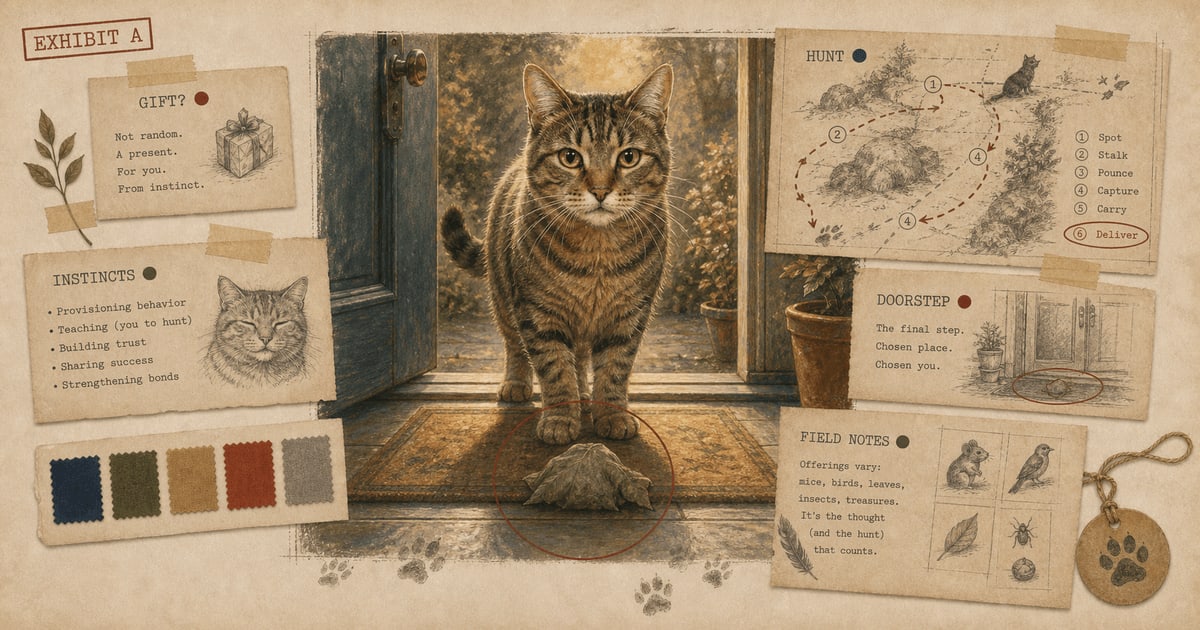
A cat appears at the door with something in its mouth. Sometimes it is a mouse. Sometimes a lizard. Sometimes a moth that did nothing to deserve this. The cat drops it, sometimes near you, sometimes on a rug, sometimes in a shoe. Then the cat looks up as if waiting for a response.
The folk explanation is that the cat is teaching you to hunt because you are obviously bad at it. This is charming and almost entirely wrong. The ethology is more mundane and more interesting: cats carry prey to safe locations because that is what small predators do, the home is the cat’s safest location, and the social-bond literature suggests that delivery to a specific person is more about your role in the cat’s territory than about your hunting deficiencies.
The short answer: prey delivery is a normal extension of the feline predatory sequence, performed in the place the cat treats as a secure cache, not a tutorial.
What Small Cats Do With Prey in the Wild
Most wild small felids hunt alone and do not eat where they kill. The relevant fieldwork on free-ranging domestic and feral cats summarized in Sarah Brown and John Bradshaw’s The Behaviour of the Domestic Cat (CABI, 2nd ed., 2012) and in Bradshaw’s Cat Sense (Basic Books, 2013) describes a consistent pattern: capture, kill, carry, then consume in a sheltered spot. The carry phase exists because a cat eating an exposed kill is a cat that can be displaced by something larger, including other cats.
This means the act of moving prey is not a special behavior reserved for showing humans. It is part of the standard sequence. The cat brings the kill somewhere it associates with safety and lack of competition. For an indoor-outdoor cat, that place is almost always the home.
The home satisfies several of the cat’s criteria at once: a known scent profile, predictable lack of rival cats, controlled access, soft surfaces, sometimes a food source already present. Bringing the mouse to the kitchen is, from the cat’s point of view, the obvious move.
The “Teaching” Hypothesis Is Weak
The teaching idea comes partly from observations of mother cats bringing dead or injured prey back to kittens. This is well documented. Mothers progressively bring less-killed prey as the kittens age, allowing them to practice on something they can actually handle. International Cat Care describes this as part of normal kitten development.
The leap from “mother cats teach kittens” to “your spayed adult cat is teaching you” does not survive scrutiny. The teaching pattern depends on a specific reproductive context, a specific developmental window in the kittens, and a specific recognition of those kittens as dependent young. Adult-to-adult or adult-to-human prey delivery does not fit any of those conditions.
Bradshaw is direct about this in Cat Sense: the maternal teaching interpretation has been extended past the evidence. It is the kind of folk-ethology that sounds right because it makes the cat sound generous.
The Social-Bond Angle
There is a more defensible reading. Domestic cats do form differentiated social bonds with humans, and some cats clearly prefer specific people. Kristyn Vitale, Alexandra Behnke, and Monique Udell’s 2019 study in Current Biology used a modified Strange Situation procedure (originally developed for human infants) and found that cats display secure-versus-insecure attachment patterns to their caregivers at proportions similar to those reported in children and dogs.
If a cat treats a specific person as a secure base and a stable element of its territory, depositing prey near that person is consistent with depositing prey in a secure place. The cat is not necessarily making a gift in the human sense. The cat is using its territory the way cats use territory, and you are part of the map.
This is honest about what the evidence shows: differentiated bonds, yes; symbolic gifting, not established.
The Conservation Reality
Any honest post about cat predation has to acknowledge the scale. The 2013 study by Scott Loss, Tom Will, and Peter Marra in Nature Communications, “The impact of free-ranging domestic cats on wildlife of the United States,” estimated that free-ranging domestic cats kill roughly 1.3 to 4.0 billion birds and 6.3 to 22.3 billion mammals annually in the contiguous US. The midpoint estimates that get reported as headline numbers (around 2.4 billion birds) come from that paper.
These numbers are debated at the edges, but the order of magnitude is not seriously contested. The American Bird Conservancy and most wildlife agencies treat free-ranging cats as a significant pressure on songbird populations in particular.
This is not a moral judgment against cats. Predation is what cats are built to do. It is a fact about the consequences of outdoor access at population scale, and it is worth holding in mind alongside the question of why your specific cat keeps bringing you specific corpses. The behavior is normal. The aggregate impact is real. Keeping cats indoors, providing structured predatory enrichment (wand toys, food puzzles, hunting simulators), or using a leash or catio addresses both the welfare side and the wildlife side.
What to Do When It Happens
The practical guidance from International Cat Care and most behavior consultants is consistent: do not punish the cat. Punishment does not extinguish a deeply-rooted predatory pattern, and it does damage to the relationship you actually want with the animal.
Remove the prey item calmly. If the prey is alive, the kindest move is usually a quick dispatch by an adult who knows how, because releasing an injured small mammal back into the yard is not the mercy it feels like.
If the deliveries are frequent and you want to reduce them, the only intervention with real evidence behind it is reducing outdoor access. Various bib-style anti-hunting collars have been studied with mixed results. None of them changes the underlying motivation.
Tie-In: Painting a Confident Hunter
A cat carrying prey or recently fed from a hunt has a specific body language: head high, tail held in a confident neutral or low arc, eyes wide and bright, ears forward. This is the cat at the top of its own competence curve. If you have ever caught a photo of your cat in that state, it is worth saving. Hunter-mode photos make distinctive portrait references because the posture is so unlike the sleeping or grooming poses most owners have on their phones.
We have written before about what to tell the artist when you submit a photo, and a hunting-context shot is exactly the kind of reference that benefits from a sentence of explanation. The painting is then about the alert posture, not just the face.
Sources
- Bradshaw, John, Cat Sense: How the New Feline Science Can Make You a Better Friend to Your Pet (Basic Books, 2013).
- Brown, Sarah L. and Bradshaw, John W. S., The Behaviour of the Domestic Cat (CABI, 2nd ed., 2012).
- Vitale, K. R., Behnke, A. C., Udell, M. A. R., “Attachment bonds between domestic cats and humans”, Current Biology, 2019.
- Loss, S. R., Will, T., Marra, P. P., “The impact of free-ranging domestic cats on wildlife of the United States”, Nature Communications, 2013.
- International Cat Care, “Hunting Behaviour in Cats”.
Welcome perk
Free expedited delivery on your first portrait
Get your digital proof in 1-2 business days instead of 2-3, free on your first portrait. Normally a $10 upgrade.
No spam. Just the perk and the occasional new style or guide.
Check your inbox for your code.