
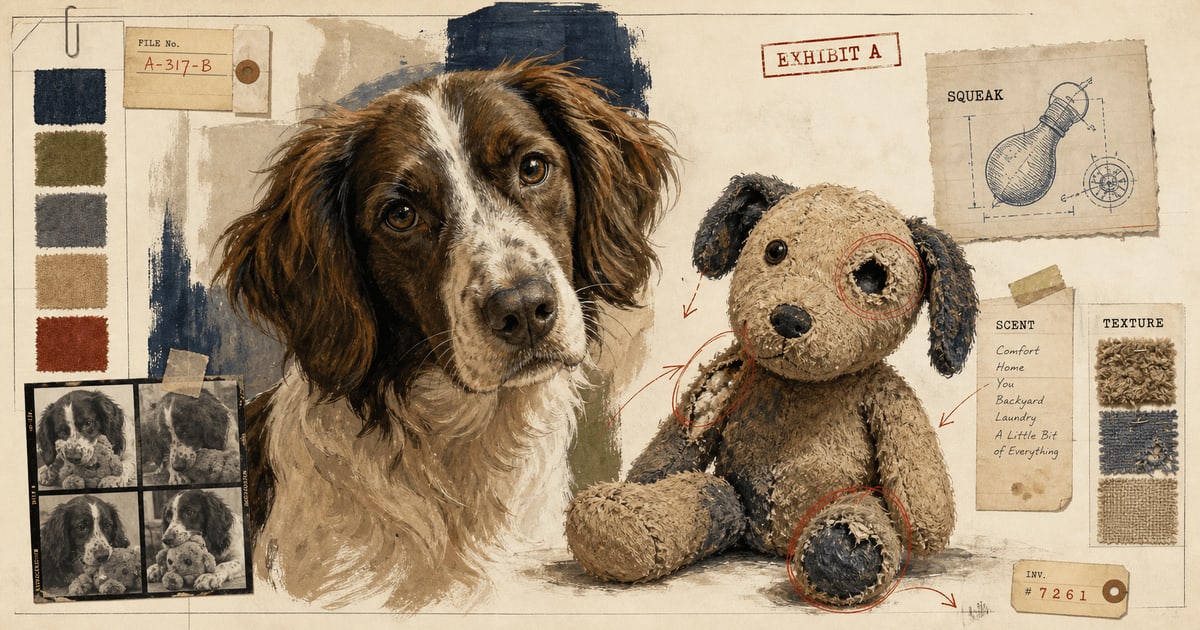
There is a toy in most households that should have been retired months ago. It has the stuffing of something that went through a combine harvester. One ear is gone. The squeaker stopped working in February. The fabric has achieved a color not present in the original design. It smells like the inside of a dog’s enthusiasm, which is its own distinct category.
And it is the only thing the dog wants.
You can bring home a tasteful, veterinarian-adjacent, ergonomically constructed replacement from the shelf that cost fifteen dollars and came with a small tag explaining its benefits. Your dog will sniff it with the polite skepticism of someone reviewing a resume from an applicant who has no references. Then they will return to the object that looks like it survived a flood.
This is not irrational behavior. The favorite toy is not random, and the dog is not wrong. Understanding what makes a toy a favorite is understanding a small but complete piece of how dogs interact with the world.
The Toy Has to Answer Back
A 2015 review of adult dog play by Bradshaw, Pullen, and Rooney published in Behavioural Processes looked at what actually drives toy preference and extended play in dogs. The finding that holds up best across contexts: dogs prefer toys that are interactive, meaning toys that respond to them. A toy that moves when grabbed, makes noise when bitten, changes shape under pressure, or can be shaken, torn, tugged, or carried responds to the dog’s input. The game continues because there is feedback.
A rubber ball that does not deform is a less interesting object than a plush toy that squishes, makes noise, and has loose parts to investigate. This is not about intelligence. It is about what keeps a motor pattern running. The predatory sequence that drives play, which includes orient, stalk, chase, grab, shake, and dissect, needs a target that participates. A favorite toy participates.
This also explains the attachment to specific toys over time. The wrecked rabbit has been through hundreds of play sessions. It has been shaken, tossed, retrieved, buried in the couch cushions, rescued, chewed, and carried from room to room. Every session added to a feedback history. The dog has evidence that this object is worth engaging with. The new toy has no evidence at all. It is an unproven proposition in a world where there is already a toy with a strong track record.
Scent Is Not a Detail, It Is the Object
Dogs do not experience objects the way humans do.
When you look at the wrecked rabbit, you see a rabbit. Fabric, color, shape, general state of affairs. When the dog investigates it, they are reading something more like a complete history. The toy carries the scent of the house in its fibers. It carries the dog’s own saliva from hundreds of sessions. It carries traces of wherever it has been left, whatever it has been near, whoever has handled it.
A 2024 study by Howard, Gunter, and Feuerbacher in Applied Animal Behaviour Science tested toy preferences in shelter dogs and found that dogs spent significantly more time engaging with stuffed toys than with harder toys, and that adding a familiar or preferred scent to a toy increased engagement. The study was done in a shelter environment, which introduces variables, but the direction of the finding fits what is known about olfactory salience in dogs: an object that smells like something familiar and positive is more compelling than one that does not.
Washing the favorite toy is necessary eventually, and the reaction to a freshly washed favorite toy is often the behavioral equivalent of a disappointed sigh. The toy still has its shape, its squeak, its texture. But it has lost its record. It smells like laundry detergent instead of the household, the dog’s own mouth, and the specific combination of organic information that the dog had filed under “mine.”
The toy comes back into favor within a day or two, as the dog re-scents it. But the brief withdrawal is real, and it tells you something about what the dog valued.
The Squeak as Event
Squeaky toys are disproportionately popular, and the reason is not complicated: they provide immediate, precise feedback.
The dog bites. The toy makes noise. One input, one output. That is a tight loop, and tight loops are how learning gets reinforced. Every squeak is a small reward that has nothing to do with the human in the room. The toy generates its own consequence.
There is also a social dimension that gets less attention. When a dog produces a squeak from a toy and a human laughs, says the dog’s name, chases after them, or starts a game, the toy has become a social lever. It reliably triggers human interaction. The dog is not calculating this in a deliberate way, but the association is real and it compounds with repetition. The toy that squeaks plus the human who responds equals a game that the dog can initiate on their own terms. That is significant. Dogs have limited options for starting social interactions with their humans, and an object that reliably starts one becomes valuable independent of the play itself.
There is also the question of what the squeak sounds like. Several veterinary behaviorists have noted that the high-frequency sound of a toy squeak bears some resemblance to the sounds made by small prey animals. This does not mean every dog is in a primal trance when they hear the squeaker. It does mean the sound arrives on a frequency that the dog’s auditory system may process as more salient than ambient noise. Whether that is part of the appeal varies by individual. Some dogs stop playing with a toy the moment the squeaker breaks and clearly lose interest. Others continue playing with the de-squeaked carcass with full commitment, suggesting the squeak was never the main attraction.
Play History and the Object’s Meaning
Beyond texture, scent, and sound, the favorite toy carries something harder to name but easy to observe: accumulated play history.
The toy has been present for a particular sequence of experiences. It was there when the family played together on a Tuesday evening. It was in the dog’s mouth when the children came home from school. It was retrieved and re-retrieved across several hundred identical sessions that were nonetheless each experienced by the dog as a new event. The toy is threaded through the texture of the dog’s daily life in a way that makes it part of the household rather than an object in it.
There is a reason dogs sometimes carry their favorite toy to the door when someone arrives, a behavior that connects back to the displacement research by Niko Tinbergen and documented more recently in a 2023 PLOS ONE paper by Kuhne and colleagues. High-arousal moments, like a human arriving home, produce a burst of emotional energy that needs somewhere to go. The dog grabs the nearest available object that fits their mouth and carries it, because an occupied mouth is calmer than an unoccupied one and because the toy is specifically the object with the most history attached to it. It is not random. It is the thing that has always worked.
Why the Disgusting Toy Belongs in the Portrait
Not every portrait needs a prop. A clean bust of a dog’s face, rendered in watercolor or oil with strong light and a clear background, can stand entirely on its own. The face carries the animal.
But if your dog has a signature toy, the kind that appears in your camera roll approximately every third photo whether you planned it or not, it is worth considering. An artist painting a dog holding a specific wrecked rabbit is not painting a dog with an accessory. They are painting a specific relationship between a specific animal and a specific object, and that relationship is biographical information.
The missing ear. The flattened snout. The general collapse of the squeak mechanism. These are not flaws in the reference material. They are the portrait’s evidence that this toy was genuinely used, genuinely loved, genuinely present in the actual life of the actual dog. A portrait including the brand-new replacement toy communicates nothing. A portrait including the thing the dog has been carrying for three years communicates everything.
The practical photography approach is simple: take one main photo with the dog relaxed and the toy visible near them, then take one close-up of the toy by itself in natural light. The separate toy photo gives the artist color, texture, and wear-pattern reference without requiring the dog to hold a pose, which dogs agree to do approximately never.
Tell the artist in the order notes whether you want the toy subtle, which often means it appears as a shape in the composition without commanding attention, or prominent, which makes it a clear second subject. Either works depending on the portrait.
The toy does not need to look new. That is the whole point.
Digital portraits start at $24.99, with proofs in 2 to 3 business days and unlimited revisions. Start here.
Sources
- John W. S. Bradshaw, Anne J. Pullen, and Nicola J. Rooney, “Why do adult dogs ‘play’?”, Behavioural Processes, 2015.
- Skyler Howard, Lisa M. Gunter, and Erica N. Feuerbacher, “Are smelly toys more fun? Shelter dogs’ preferences for toys, scents, and scented toys”, Applied Animal Behaviour Science, 2024.
- F. Kuhne et al., “Appeasement function of displacement behaviours? Dogs’ behavioural displays exhibited towards threatening and neutral humans”, PLOS ONE, 2023.
- Alexandra Horowitz, Inside of a Dog: What Dogs See, Smell, and Know, Scribner, 2009.
Welcome perk
Free expedited delivery on your first portrait
Get your digital proof in 1-2 business days instead of 2-3, free on your first portrait. Normally a $10 upgrade.
No spam. Just the perk and the occasional new style or guide.
Check your inbox for your code.