
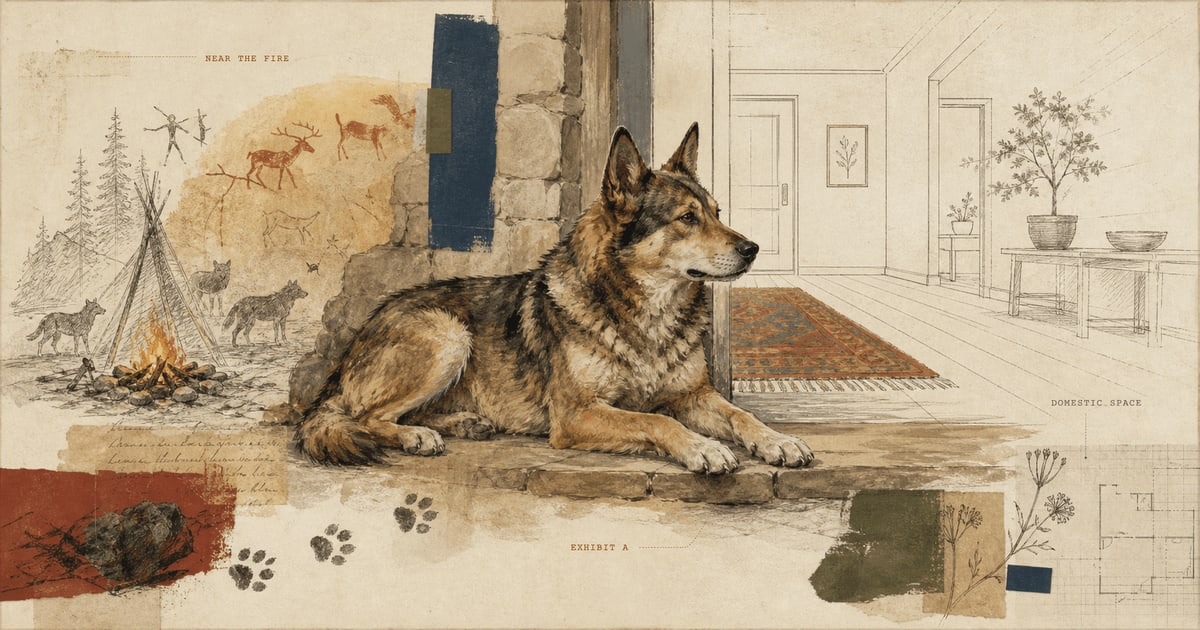
The oldest confirmed domestic dog burial in Germany, at a site called Bonn-Oberkassel near Düsseldorf, dates to roughly 14,000 years ago. It contained two humans, an older man and a woman, and one dog. The dog had been severely ill, probably with canine distemper, and showed bone damage consistent with surviving the disease for weeks. Researchers concluded that the humans had kept the dog alive through the illness, feeding and caring for it during a period when it contributed nothing practical. The dog appears to have died shortly before or around the same time as its human companions and was included in the burial.
This is not a story about a useful working animal. This is a story about someone keeping a sick animal alive because they wanted to, and then being buried with it.
By 14,000 years ago, that story was already old.
The genetic evidence for dog domestication pushes back further, probably between 15,000 and 40,000 years ago depending on the model, the samples, and how you define the moment when a wolf population started becoming something else. The range is wide because ancient DNA from that period is difficult and rare and because the process was not an event but a drift. There was no moment when a prehistoric human opened the cave and said, “You, wolf, you’re in.” There was a long complicated overlap of proximity, selection, mutual benefit, and the slow accumulation of genetic distance from wild wolf populations.
But by the time of Bonn-Oberkassel, domestication had proceeded far enough that the dog had a social identity in the group, that identity was worth maintaining through illness, and the relationship was important enough to structure a burial. None of that is about practical utility. All of it is about something that would later be called companionship.
How the Relationship Probably Started
The domestication debate has real scholarly contention at its edges, but the broad middle is fairly settled. Dogs likely diverged from a wolf population that began associating with human settlements because humans were producing food waste. Camps left bones, scraps, and refuse. Wolves who could tolerate being near humans, who had lower flight responses and less aggression toward people, could exploit that resource more effectively than wolves who could not. Over generations, less-fearful wolves reproduced more successfully around human settlements, and the population around those settlements diverged from wild wolves in behavior first, then in genetics.
This is called commensal domestication, and it is probably the most accurate description of how dogs went from wolves to something else. Humans may have accelerated the process through active selection, particularly once they noticed that some of these animals were useful for hunting, guarding, or herding. But the first step was probably the wolf’s decision, not ours.
The key early study by Brian Hare and colleagues at Harvard, published in Science in 2002, showed that domestic dogs are extraordinarily good at reading human social cues, particularly pointing gestures, and that wolves raised by humans with identical socialization are not comparably skilled. Hare’s interpretation was that dogs evolved the capacity to read human communication specifically, not merely a generalized social intelligence inherited from wolves. Other researchers have debated the details, but the underlying finding, that dogs are unusually tuned to human gestures and intentions, has held up across subsequent work.
That attunement was not an accident. It was almost certainly selected for, probably over thousands of years of dogs and humans adjusting to each other.
The Transition to Indoor Life
The modern indoor dog, dog on the couch, dog with its name in the family calendar, dog whose food preferences are a topic of sustained household conversation, is a recent phenomenon in absolute terms. For most of the domestication timeline, dogs lived near people but not fully inside human domestic space. They were camp dogs, village dogs, working dogs, animals whose social bond with humans was real but whose physical access to the sleeping space, the hearth, the bed was selective and variable.
The shift toward indoor pet keeping accelerated in the nineteenth century in Europe and the United States, driven partly by urbanization, partly by rising middle-class incomes that made keeping non-working animals affordable, and partly by changing ideas about the boundary between nature and home. Katherine C. Grier’s Pets in America traces this transition in detail: the gradual move of dogs from the yard or barn into the house, then from the kitchen into the main rooms, then from the floor to the furniture, each step contested by someone in the household and eventually won by the dog.
By the early twentieth century, veterinary industry trade publications were running advertisements for indoor dog accessories: beds, coats, toys, biscuits. The idea of a dog as an indoor family member had become commercial. It had become a market.
What Indoor Living Does to the Relationship
An animal kept outside can be valued and even loved without being fully known. You see it at feeding time, at work, at arrival and departure. The contact is episodic.
An animal inside the house is different. You know the sound of its feet on different floor surfaces. You know which sigh means sleeping and which sigh means calculated moral pressure. You step over it in the dark without thinking because its position on the floor is part of your mental map of the house. You save a piece of the routine for it. The house starts to include the dog as a structural feature the way it includes the furniture.
This is part of why indoor pet grief is so spatially specific and so persistent. People do not just miss the dog in the abstract. They miss the dog in the hallway. They miss the weight at the foot of the bed. They miss the creature who made every room slightly more difficult to navigate and considerably more alive.
The dog’s presence was distributed across the whole physical environment of the home: this corner, that chair, this patch of sun on the kitchen floor, this spot by the door where the dog waited every day at the same time. When the dog is gone, all of those locations are still there, unchanged, newly empty.
That is not a modern phenomenon either. It was true the moment humans started letting dogs sleep inside.
The Social Cognition Is the Story
One reason dogs fit so well inside human homes is that they are genuinely reading the household, not just tolerating it. Research published after Hare’s original study has documented that dogs track human gaze, respond to human pointing in ways that chimpanzees do not, adjust their behavior based on human emotional cues, and appear to have some understanding of human attention states, knowing when they are being watched versus when they are not.
This is unusual in animals. Most species do not spend much energy modeling the mental states of members of other species. Dogs do it continuously and apparently automatically, because doing it was adaptive for many thousands of years.
The practical result is that a dog in a house is not merely present. It is attending. It knows who is upset, who is about to leave, who has food, who is available for attention, and where in the household routine everyone is at any given moment. The dog often knows before the humans do that someone is about to have a bad day. The humans notice this and interpret it as affection. It is affection, but it is also very old social software running on very reliable hardware.
None of this was designed by anyone. It emerged from a long process of selection in which the dogs who read humans most accurately were the ones that thrived in human company. We shaped them into excellent readers of us, and then we let them into the house, and then we could not imagine the house without them, which was probably their plan all along.
If your dog treats the living room as a professional assignment they take seriously, the portrait should reflect that seriousness. The best references often catch the dog in the act of attending: watching the door, tracking a sound, alert to something no one else noticed. That look, the one that says this animal knows exactly what is happening in the room, is thousands of years old.
Sources
- Anders Bergstrom et al., “Origins and genetic legacy of prehistoric dogs,” Nature, 2020.
- Liane Giemsch et al., “New Dates for the Bonn-Oberkassel Dog Burial,” Journal of Human Evolution, 2015.
- Brian Hare et al., “The Domestication of Social Cognition in Dogs,” Science, 2002.
- Juliane Kaminski and Sarah Marshall-Pescini, eds., The Social Dog: Behaviour and Cognition. Elsevier, 2014.
- Mietje Germonpré et al., “Fossil dogs and wolves from Palaeolithic sites in Belgium, the Ukraine and Russia: Osteometry, ancient DNA and stable isotopes,” Journal of Human Evolution, 2009.
- Katherine C. Grier, Pets in America: A History. University of North Carolina Press, 2006.
- Greger Larson et al., “Rethinking dog domestication by integrating genetics, archeology, and biogeography,” PNAS, 2012.
Welcome perk
Free expedited delivery on your first portrait
Get your digital proof in 1-2 business days instead of 2-3, free on your first portrait. Normally a $10 upgrade.
No spam. Just the perk and the occasional new style or guide.
Check your inbox for your code.