A black dog presents two real technical problems for portraiture, and they are connected. The first is photographic: cameras meter the scene for average brightness, and a black dog tells the meter to over-expose, blowing out the background and still leaving the dog as a flat shape. The second is painterly: rendered without care, a black coat becomes a featureless void with eyes floating in it.
Both problems have well-understood solutions used by every working portrait artist who paints dark subjects. The short version: never use pure black, build the coat from cool and warm darks with strong undertones, place highlights structurally rather than decoratively, and treat the eyes as the strongest contrast point in the painting.
Why cameras fail black dogs
This is “black dog syndrome” in pet photography. Auto-exposure systems average the scene’s brightness toward middle gray (technically about 18% reflectance). A black dog is far below middle gray, so the camera pushes exposure up, brightening the background to the point that the dog is rendered as a silhouette with no detail in the coat.
The fix on the camera side is exposure compensation: dial in -1 to -2 stops of underexposure to preserve the coat’s darkness and let the background sit darker too. Spot metering off the dog’s body also helps, but most phone cameras average across the frame.
The lighting fix is more important than the exposure fix. Direct overhead light or on-axis flash flattens the coat into a single value with no form. What you want is:
- Side lighting: window light from one side, the dog facing roughly toward the window. The side closer to the window catches highlights along the muzzle, brow, shoulder, and hip. The far side falls into shadow. The coat now has dimension.
- Front skylight: outdoor shooting under open sky (no direct sun) gives soft, even, top-front light that picks out the dog’s structure without harsh contrast.
- Backlight or rim light: late afternoon sun behind the dog creates a glowing edge around the silhouette. Good for drama, harder to get the face exposed correctly.
What to avoid:
- Direct overhead sun at noon (the coat goes flat black, the eyes go into deep shadow)
- On-axis flash (kills all form, gives the dog “demon eye” reflections)
- Heavy backlight without fill (you get a black blob)
Our reference photo guide covers more of the lighting basics. For a black dog specifically, the rule of thumb is: shoot at the warmer end of the day (early morning, late afternoon), use side or front-side light, expose for the dog’s eyes, and accept that the background may look slightly underexposed.
Why pure black paint fails
Tube black (carbon black, ivory black, lamp black) is too cold and too uniform to read as fur. A coat painted in pure black has no temperature variation, no undertone, and no depth. The eye scans across it looking for information and finds none. The result reads as a hole in the painting, not as an animal.
What working artists do is mix their blacks from chromatic darks. A few common approaches:
- Ultramarine blue + burnt umber: a cool dark with brown undertone. Versatile, leans warm or cool depending on the ratio.
- Ultramarine blue + burnt sienna: a slightly redder dark, good for dogs with a brown or red cast under the black (some black Labradors, many Doberman mixes have this).
- Raw umber + ultramarine blue: a greenish-cool dark, useful for black coats with a slightly olive tone.
- Alizarin crimson + viridian or phthalo green: a near-black with strong color life. Good for accent shadows.
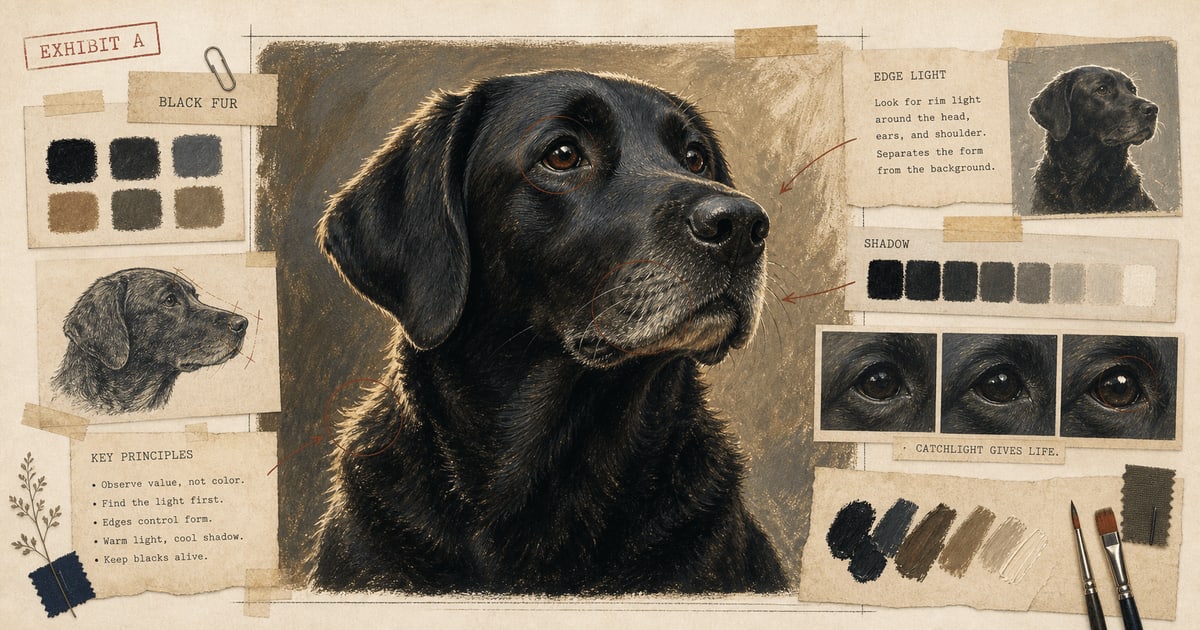
The principle is that “black” in a real coat is composed of countless small variations: blue-black on the shoulder where it catches sky light, brown-black in the deep shadow under the jaw, slightly purple-black in the hollow behind the ear. Mixing the darks chromatically lets the painter put those variations into the coat instead of painting one flat value.
Where the highlights go
A black dog has very few highlights in absolute terms, but the few that exist are structurally critical. They are the only thing the eye can use to read the dog’s three-dimensional form.
The classical highlight placement on a black dog:
- Muzzle bridge: a narrow highlight running along the top of the muzzle, brightest near the eyes, fading toward the nose
- Brow ridge / occipital bone: highlight across the top of the skull, where the bone is closest to the surface
- Shoulder: a soft highlight along the front of the shoulder where the coat catches frontal light
- Top of the hip: similar to the shoulder, defines the hindquarter
- Spine line: a faint highlight along the top of the back if the lighting comes from above
- Chest: subtle highlight where the chest projects forward
These are not random. They follow the underlying skeleton and muscle. A painter who places highlights structurally creates a coat that reads as covering a real body. A painter who scatters highlights decoratively creates a coat that reads as flat with sparkle.
The highlight color is not white. On a black coat, highlights are usually a cool gray-blue (where sky light hits) or a warm gray-brown (where indoor or warm-toned light hits). Pure white highlights look like flash reflections.
The eyes carry the painting
On a light-coated dog, the painter has the entire face to work with: the muzzle color, the brow, the cheek, the ear. On a dark-coated dog, much of that information disappears into the coat. The eyes become the structural anchor of the whole composition.
This is why a successful black dog portrait almost always has carefully rendered eyes:
- Iris color picked out precisely (most black dogs have warm amber or brown eyes; some have hazel; rare individuals have green or blue)
- A defined catch-light from the light source, placed consistently with the rest of the painting’s lighting
- The white of the eye (sclera) handled subtly, often as a soft cream rather than pure white
- The pupil rendered as a deep, slightly soft edge, not a hard black dot
If the eyes are right, the painting works. If the eyes are wrong, no amount of fur detail will save it.
The darkest part of the dog is not the darkest part of the painting
This is the working rule that distinguishes a confident black-dog painting from a struggling one. If the coat is rendered at the absolute maximum dark the medium can produce, the painting has nowhere left to go. The eye reads the coat as the visual floor and the rest of the painting reads as relatively light.
Better practice: keep the coat dark but not absolute. Reserve the deepest dark for accents in the shadow side of the muzzle, the inside of the mouth (if visible), the pupil, the cast shadow under the chin or body. This gives the painting a deeper bottom note than the coat itself, which paradoxically makes the coat read as more luminous and three-dimensional.
The same principle in reverse applies to white animals: never use pure white for the highlight. We cover that in our companion post on painting white cats.
What to brief the artist on
If you are commissioning a portrait of a black dog, a few things worth mentioning in your order brief:
- The dog’s undertone, if you know it. Some black coats have a brown cast (especially in old age, when black fades to “rusty” brown). Some have a true blue-black. Some have a slight red undertone in direct sun.
- The eye color, specifically. Brown is the default but is not universal.
- Any white markings (chest blaze, toe tips, muzzle silver from age) that you want preserved. These are visually load-bearing on a black dog.
- The lighting in your favorite reference photo. The painted coat will look most natural under similar lighting in the final piece.
The bottom line
A black dog is one of the hardest subjects to photograph and one of the most rewarding to paint when handled well. The technique is not mysterious. Use chromatic darks, place highlights structurally, treat the eyes as the anchor, and keep the absolute darks in reserve. A well-painted black dog reads as fur and bone and warmth, not as a hole with eyes.
For reference photography on a black-coated subject, our photo tips and the order process walk through what we need to get the painting right the first time.
Welcome perk
Free expedited delivery on your first portrait
Get your digital proof in 1-2 business days instead of 2-3, free on your first portrait. Normally a $10 upgrade.
No spam. Just the perk and the occasional new style or guide.
Check your inbox for your code.