
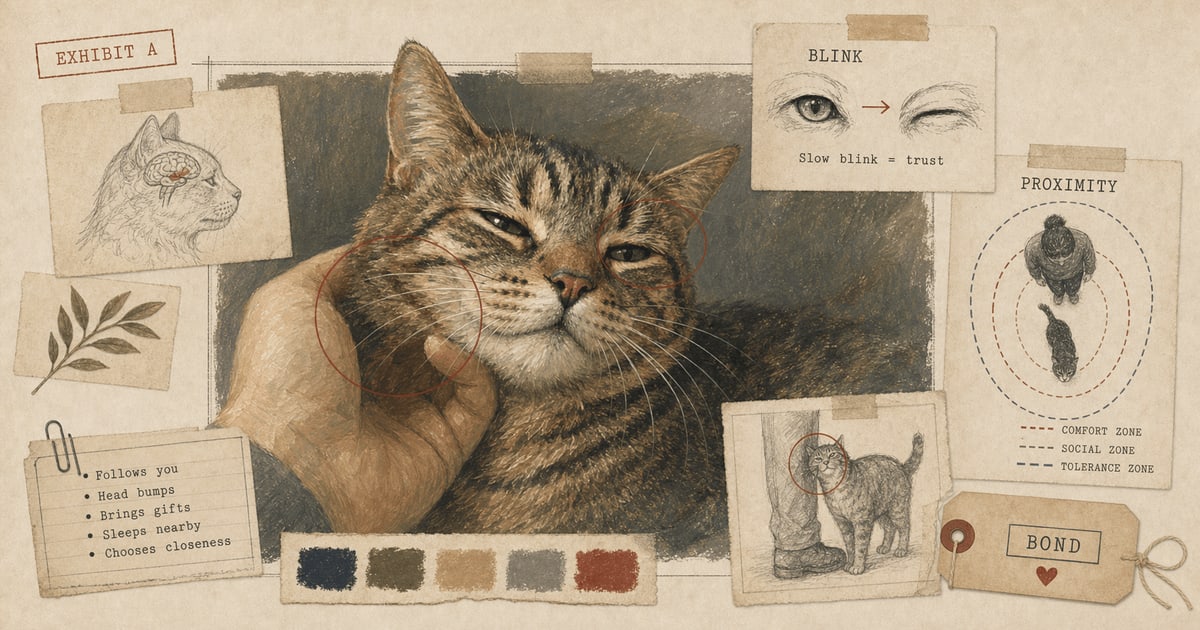
The stereotype is that cats are aloof and dogs are devoted. The stereotype is folk wisdom, not behavioral science, and a careful 2019 study at Oregon State University suggests it is wrong.
Kristyn Vitale, Alexandra Behnke and Monique Udell adapted Mary Ainsworth’s Strange Situation Test (originally developed for human infants in the 1960s and 70s) for cats. They ran 70 cats through the protocol. About 65% showed secure attachment patterns toward their owners. That proportion is roughly the same as the secure-attachment rate in human infants and in dogs tested with the same paradigm.
Cats form attachments. The bond is real, measurable, and structurally similar to the bonds that infants form with caregivers. The aloof-cat thing appears to be a thin cultural overlay on top of a species that is actually pretty committed to its people.
What the Strange Situation Test does
Mary Ainsworth designed the Strange Situation in the late 1960s to study how human infants react to a controlled stress: brief separation from a caregiver in an unfamiliar room. The protocol involves a series of episodes: caregiver and infant together, a stranger enters, caregiver leaves, caregiver returns, and so on. The infant’s behavior during the reunion is the diagnostic moment.
Ainsworth identified three primary patterns (a fourth, disorganized, was added later by Mary Main):
- Secure: distressed by separation, comforted by reunion, then returns to exploration. The caregiver functions as a “secure base.”
- Insecure-ambivalent: very distressed by separation, hard to soothe at reunion, clings and resists simultaneously.
- Insecure-avoidant: minimal distress at separation, ignores or avoids the caregiver at reunion.
Roughly 65% of human infants in low-risk samples show secure attachment. The remaining 35% split across the insecure categories.
What Vitale found in cats
Vitale’s team adapted the protocol for cats. The cat and owner sat in a room. The owner left for two minutes. The cat was alone, then the owner returned and the cat’s behavior in the reunion was scored.
The results, published in Current Biology in 2019: about 64.3% of the 70 cats showed secure attachment, 35.7% showed insecure attachment patterns (split between ambivalent and avoidant). The distribution was statistically indistinguishable from the distribution seen in human infants and in dogs.
A subset of the cats were enrolled in a six-week socialization training course between the first and second tests. The training did not significantly change attachment style. This suggests attachment style is relatively stable in cats, the same way it tends to be relatively stable in humans.
A separate 2007 study by Edwards and colleagues in the Journal of Veterinary Behavior used a slightly different protocol and found similar patterns: cats clearly discriminated between their owners and unfamiliar humans and showed behaviors consistent with attachment when separated and reunited.
What “secure attachment” means for a cat
For a cat, the secure pattern looks like: when the owner returns to the room, the cat greets briefly (often a chirp, a tail-up posture, a quick rub) and then resumes whatever the cat was doing. The owner is acknowledged and then the cat goes back to exploring or resting. This is the cat equivalent of an infant’s “I see you, you’re back, I’m fine now.”
Insecure-ambivalent cats may cling, vocalize excessively, or struggle to disengage. Insecure-avoidant cats may actively ignore the returning owner, sometimes turning away or leaving the room.
The 65/35 split should retire one bit of received wisdom: that cats are simply less emotionally engaged with their people than dogs are. They are emotionally engaged at the same rate. They express it differently, with shorter and less effusive reunion behaviors, which has misled humans for centuries.
Why this took so long to establish
Cat behavior is genuinely harder to study than dog behavior. Cats are less motivated by food rewards in unfamiliar environments. They often shut down behaviorally under stress (the technical term is “freezing” or “tonic immobility”), which can look like indifference but is closer to overwhelm. Many earlier studies treated cats like small dogs and got nothing back, which fed the aloof-cat literature.
John Bradshaw, in Cat Sense (2013), pointed out that cats are still in active domestication, perhaps 10,000 years compared to 15,000+ for dogs, and that the relationship between cats and humans is more variable cat-to-cat than dog-to-dog. Some cats are tightly bonded. Some are more solitary. Genetics, early socialization (the two to seven week sensitive window is critical), and individual experience all matter.
The bonding behaviors people miss
Cats signal bonding in ways that often do not register as bonding to a dog-trained eye:
- Slow blink: a cat-to-cat appeasement gesture that cats extend to humans.
- Tail-up greeting: friendly approach, originally a kitten greeting to its mother.
- Bunting: head-rub against you, depositing scent.
- Trill or chirp on entry: a vocalization mostly reserved for known social partners.
- Sleeping near or on you: requires the cat to drop predator-vigilance, which is significant.
- Following you room to room without seeming to: many bonded cats do this with plausible deniability.
The slow blink is interesting enough that we wrote about it separately. It is the gesture cats use to say “I see you and I am not threatening you” to other cats, and they extend it to people they trust.
Why this matters for portraits
If you are commissioning a cat portrait, you are commissioning a likeness of an animal that, evidence suggests, has formed a real attachment to you. The bond is not less than the dog version. It is structurally the same and expressed in lower-volume signals.
A good cat reference photo often captures one of the bonding behaviors above: the slow blink, the tail-up, the bunting, the relaxed loaf next to you. These are the gestures that show the cat. A staring-into-the-camera shot of a cat sometimes captures dignity but often misses the relationship.
Our cat portrait page and the broader portfolio include examples of poses that read as relational rather than performative. When you give us reference photos, include at least one shot of the cat doing one of these bonded behaviors near you. The portrait will be more like the cat.
What this changes
Not much, practically, for people who already know their cat is bonded to them. The value of the research is for the rest of the world: the people who confidently say cats do not really love their owners, and who built a stereotype that has shaped how cats are treated, rehomed, and described in popular media for a very long time. The data does not support it.
The cat sleeping on your laptop is not tolerating you. The cat is demonstrating secure attachment behavior toward its primary social partner, in a species that does not waste signals on people it does not care about.
Sources
- Vitale, K. R., Behnke, A. C., Udell, M. A. R., “Attachment bonds between domestic cats and humans,” Current Biology, 2019. DOI 10.1016/j.cub.2019.08.036
- Edwards, C., Heiblum, M., Tejeda, A., Galindo, F., “Experimental evaluation of attachment behaviors in owned cats,” Journal of Veterinary Behavior, 2007
- Ainsworth, M. D. S., et al., Strange Situation Procedure (developmental psychology framework, 1969-1978)
- Bowlby, J., Attachment (1969), foundational attachment theory
- Bradshaw, J., Cat Sense (2013), chapters on cat sociality and domestication
Welcome perk
Free expedited delivery on your first portrait
Get your digital proof in 1-2 business days instead of 2-3, free on your first portrait. Normally a $10 upgrade.
No spam. Just the perk and the occasional new style or guide.
Check your inbox for your code.