
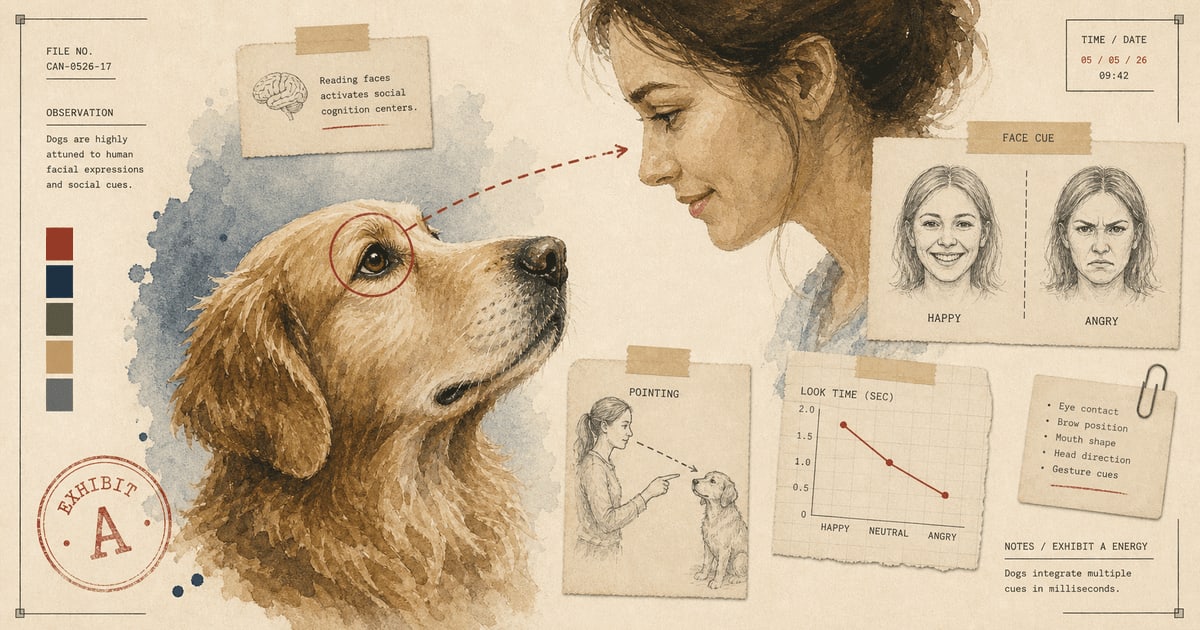
Dogs were trained using only the upper half of a human face. Later they were shown a new face they had never seen before, this time just the lower half. They still knew the difference between happy and angry.
That is the design of a 2015 study by Corsin Müller and colleagues at the Messerli Research Institute in Vienna, published in Current Biology, and it rules out the most boring explanation. The dogs were not memorizing one image. They were not responding to visible teeth as a simple trigger. They were using information from one part of a face and successfully generalizing it to a different part, from a different person, in a way that distinguished emotional expressions they had learned to associate with reward from those they had not.
The researchers trained dogs using either the top or bottom of faces showing happy or angry expressions, then tested with the opposite half on novel faces. Dogs discriminated above chance. The ones trained to approach happy faces were slower to learn when angry was rewarded, suggesting negative emotional information was harder to work against. Müller et al. interpreted this as consistent with dogs having functional responses to human emotional expressions, not just pattern-matching to a single memorized image.
That is the edge of what the study can claim, and it is already more than most people give dogs credit for.
The Hemisphere Question
In 2018, Marcello Siniscalchi and colleagues published research in Learning and Behavior looking at how dogs oriented their heads in response to human emotional faces. The finding was odd enough to be worth explaining.
Dogs don’t process all emotional information on the same side of the brain. There is evidence of hemispheric bias. When exposed to negative emotional stimuli, including fearful or angry human expressions, dogs tend to show a leftward orientation of the gaze, suggesting right-hemisphere dominance for processing negative emotional content. For more positive stimuli, the pattern shifts toward the left hemisphere.
This is not unique to dogs. Hemispheric lateralization of emotional processing appears across vertebrates. What makes it interesting in this context is that dogs are showing a neurological response specifically calibrated to human emotional information, not just general threat detection. They are processing your face the way they process something that has emotional valence for them, and the specific valence affects which hemisphere does the heavier lifting.
A separate line of Siniscalchi’s work, published in Scientific Reports in 2017, looked at lateralized cardiac and behavioral responses to human emotional vocalizations. Dogs hearing fear and sadness vocalizations showed right-hemisphere-dominant head turning and elevated heart rates. The body is responding, not just the brain registering a category.
None of this means dogs have a complete theory of your inner life. It means they are reading the signal with something more than casual attention.
What Dogs Do With the Information
Müller’s face discrimination study tells you dogs can distinguish emotional expressions. It does not tell you what dogs actually do with that distinction in daily life.
For that, you need to watch what happens afterward.
Research on how dogs use human social cues in uncertainty is useful here. A body of work going back to the early 2000s, including Hare, Call, and Tomasello’s studies on communicative pointing in Science in 2002, established that dogs are unusually good at using human communicative gestures to solve problems. A human points at a cup. The dog goes to that cup. Wolves reared with the same intensive human contact do not do this consistently. Something in the domestic dog’s development and possibly its genetics has tuned it toward human communication as a source of reliable information.
That tuning extends to emotional information. Dogs adjust their behavior based on owner emotional state in ways that suggest they are extracting meaning, not just detecting novelty. A 2011 study by Cook and colleagues found that dogs preferred interacting with a person who had behaved kindly in a prior interaction, even when that person was unfamiliar. Dogs weight human social behavior and appear to update on it.
The cross-modal dimension makes this more nuanced. Real emotional information in daily life is not a still photograph of a face. It is a face plus a voice plus body language plus context plus history. Research on cross-modal emotional processing in dogs, looking at whether they integrate audio and visual emotional signals in a coherent way, has found evidence that they do. A happy voice paired with an angry face produces a different response than a happy voice paired with a happy face. The dog is not just reading one channel.
The Oxytocin Loop and What Gaze Has to Do With It
In 2015, Miho Nagasawa and colleagues published a study in Science that has been widely described ever since in terms that get a little softer each time someone summarizes it. The study measured oxytocin levels in dogs and their owners before and after a thirty-minute interaction period, and found that the dogs who engaged in longer mutual gaze with their owners had elevated oxytocin afterward, as did those owners. Wolves hand-reared in similarly close conditions with humans did not show the same loop.
Nagasawa’s team interpreted this as a hijacking, in the best possible sense, of the oxytocin-mediated bonding loop that normally operates between human mothers and infants. Dogs, during coevolution, apparently developed the capacity to activate this system in humans through mutual gaze, which is exactly the signal that human infants use to trigger the same response in their mothers.
This is relevant to the emotional reading question because it explains part of the mechanism. Dogs who are good at reading and responding to human emotional states are probably better at maintaining the kind of sustained social attention that keeps the oxytocin loop going. The ability to read you is not a parlor trick. It is functional for the relationship.
The Association vs. Understanding Problem
This is where the science becomes genuinely hard and genuinely interesting.
There is a difference between recognizing that a certain configuration of facial features has previously been associated with negative outcomes for the dog and understanding that you are sad. The first is associative learning: the face pattern predicts what comes next, and the dog learns the prediction. The second implies some grasp of inner states, which is a much larger claim.
The Müller study cannot distinguish between these. The hemispheric lateralization research is suggestive but not conclusive. The Nagasawa gaze study describes a physiological loop but not a theory of mind.
The honest answer is that we do not know exactly where on the continuum from association to understanding dogs fall, and the question may not be answerable with current tools. What we do know is that the behavior looks like more than simple discrimination, that it is mediated by physiological responses in both the dog and the human, that it generalizes across novel faces, and that dogs actively use emotional information to make decisions.
Whether that is “reading emotions” in the fullest sense depends on what you mean by reading. If you mean detecting reliable signals from another individual’s face and using those signals to guide behavior, the answer is clearly yes. If you mean introspecting on those signals and forming a model of the other individual’s inner experience, the honest answer is: we don’t have the evidence to say.
The Limits Are Not What You Think
The temptation is to conclude that because dogs can’t fully understand human emotions in the philosophical sense, their apparent emotional sensitivity is somehow less real or less meaningful. That conclusion is backwards.
A dog who notices that you are off today, who stays closer, who drops a toy on your foot at an improbable moment, is doing something that is real and functional regardless of whether they have a complete theory of grief. They are responding to genuine signals in their environment. Those signals happen to be you.
The tool they are using for this is not language or abstract reasoning. It is millions of years of social mammalian cognition filtered through thousands of years of specifically human-dog coevolution. They are not bad at this. They are specialists at it, in the way that a person who has lived with you for years in close quarters becomes a specialist in the particular frequencies of your unhappiness, without necessarily being able to write a paper about it.
Your dog notices your face. The specific neural architecture of that noticing involves hemispheric lateralization, cross-modal integration, and an oxytocin-mediated feedback loop. Whether it constitutes understanding is a question for philosophers with more patience than any of us have. What it does constitute is attention.
Sustained, calibrated, lifelong attention to you specifically.
For a custom portrait, the most useful corollary of all this is that the photograph where your dog is clearly watching you carries different information than the one where they are looking at the camera. The face your dog makes while reading you contains relationship. It is usually the face the owner recognizes most immediately. A technically sharp photo where the dog is looking at nothing in particular tells the artist about anatomy. The photo where your dog is watching you tells the artist something harder to measure and considerably harder to fake.
Sources
- Corsin A. Müller et al., “Dogs Can Discriminate Emotional Expressions of Human Faces”, Current Biology, 2015.
- Marcello Siniscalchi et al., “Orienting asymmetries and physiological reactivity in dogs’ response to human emotional faces”, Learning and Behavior, 2018.
- Marcello Siniscalchi et al., “Lateralized behavior and cardiac activity of dogs in response to human emotional vocalizations”, Scientific Reports, 2017.
- Miho Nagasawa et al., “Oxytocin-gaze positive loop and the coevolution of human-dog bonds”, Science, 2015.
- Brian Hare, Michelle Brown, Christina Williamson, Michael Tomasello, “The Domestication of Social Cognition in Dogs”, Science, 2002.
Welcome perk
Free expedited delivery on your first portrait
Get your digital proof in 1-2 business days instead of 2-3, free on your first portrait. Normally a $10 upgrade.
No spam. Just the perk and the occasional new style or guide.
Check your inbox for your code.