
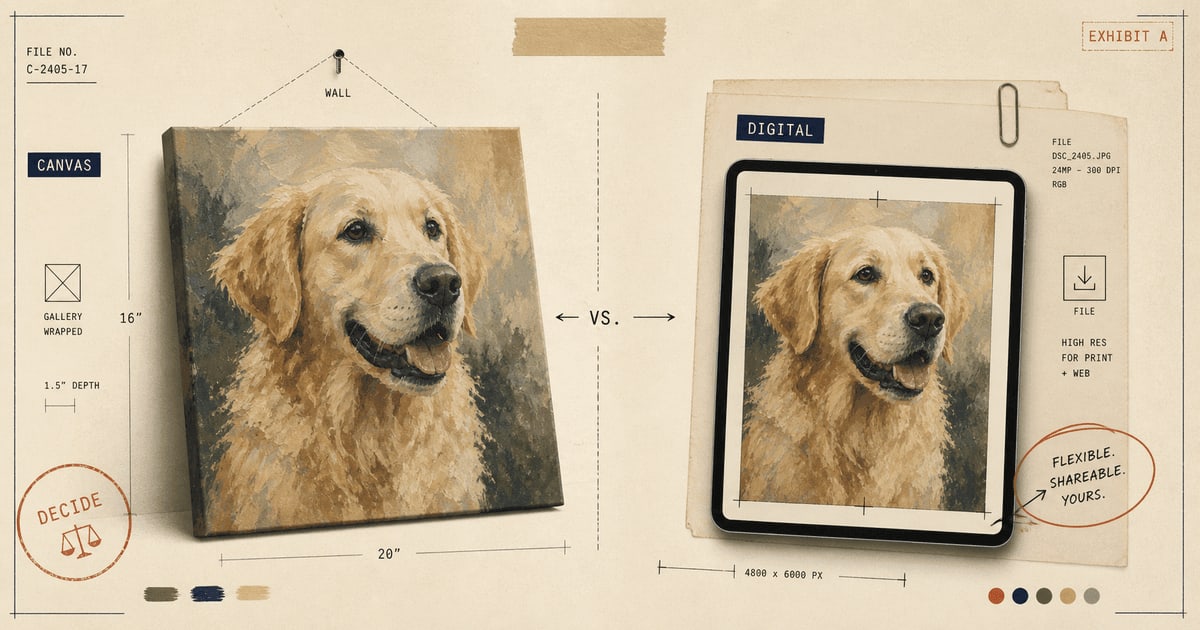
Canvas as a support for painting has been around since at least the 16th century. Before that, artists painted on wood, paper, plaster, and whatever else was available and flat. Canvas caught on because it was lighter than wood, more flexible, portable, and could be primed with gesso to take paint in a way that preserved the work for centuries. The Sistine Chapel is fresco. But the portraits of Venetian nobility that also survived the Renaissance were, increasingly, painted on canvas. The format outlasted the empires.
This is not a pitch for canvas over digital. It is context. Canvas has a long history as the material of portraits that were meant to be permanent, displayed prominently, and taken seriously. That history did not evaporate when the format became accessible to people who own pets. It accumulated.
What the Screen Does to an Image
When you look at a digital portrait on a screen, you are experiencing emitted light. The screen produces its own illumination, and the image is literally glowing at you from its surface. This is not a flaw. Screens are good at it. But it has a perceptual consequence that is worth understanding.
Emitted light competes with the ambient light of whatever room you are in. Viewing a portrait on a phone in bright sunlight versus a dark room produces almost entirely different experiences of the same image. The colors shift. The tonal range changes. The image that looked warm and detailed on your monitor may look washed out in sunlight, and vice versa. What you are experiencing on a screen is always a composite of the image and the screen’s own characteristics, brightness, color temperature, refresh rate, gamut, and the ambient light around you.
The other effect is context. A screen image is experienced in the same visual space as every other screen image. The portrait of your dog exists in the same medium as your email, your grocery list, your browser tabs, and the video you watched last night. The medium is not neutral. It contextualizes everything within it as content: things to be consumed, scrolled past, and replaced by the next item in the queue. This is not a moral judgment. It is simply how the medium works.
Physical art does not work this way. A canvas on a wall exists in space. It is illuminated by the ambient light of the room, which means it changes character across the day as light shifts, which is the reason that collectors and museum curators spend considerable effort on lighting design. The work looks different in morning light than it does at dusk, and both experiences are real, rather than artifacts of a backlit display. More importantly, the canvas exists in a room that has a function and meaning separate from art consumption. It is part of a living space. People see it when they are walking to the kitchen, hosting guests, or sitting quietly in the place they actually live.
The Presence Problem
There is a documented phenomenon in consumer psychology called the endowment effect, and a related finding from museum and gallery studies: people value physical objects differently than they value digital equivalents of the same content. Part of this is about ownership in the tangible sense, the object is there, it occupies space, you can touch it. But part of it is about permanence and attention. A physical object cannot be closed, minimized, or accidentally deleted. It makes a claim on the space it occupies, and that claim is ongoing.
This is not entirely psychological. It is also visual. A canvas portrait, particularly a gallery-wrapped canvas with the image continuing around the sides of the frame, is a dimensional object. It has thickness. It casts a small shadow on the wall behind it. The surface has texture, either from the canvas weave showing through the print or from the visual texture of the painted marks themselves. These are not trivial details. They are part of how the eye reads the object as a thing with presence rather than an image on a flat surface.
Portrait painting has understood this for a long time. There is a reason the most important portraits in European history are large, physical, displayed prominently, and not small files passed hand to hand. Scale and physical presence communicate that the subject was worth the effort and the space. When you hang a canvas portrait of your pet in a room where you spend time, you are participating in a tradition that is considerably older than photography and considerably more deliberate than a camera roll.
The Digital File: What It Does Best
None of the above makes the digital file a lesser option. It makes it a different one.
A high-resolution digital portrait gives you complete control over what happens next. You can print it at whatever size fits your wall. You can frame it yourself with whatever frame suits your existing decor. You can send it to family members across the country. You can keep it backed up in multiple places so it survives a house move, a hard drive failure, or a decade of changing circumstances. You can print it on different materials: fine art paper, metal print, stretched canvas, whatever you want.
Digital portraits start at $24.99, with proofs arriving in 2 to 3 business days. If a deadline is approaching, expedited delivery brings that to 1 to 2 business days for $10 more.
Choose digital if you already know what you want to do with it. If you have a frame shop you trust, a specific frame that is already sitting in a closet, or a printer you prefer, the digital file gives you control. If the portrait is a gift and you genuinely do not know the recipient’s walls, a digital file gives them the freedom to choose. Some people have strong opinions about frames. Not providing an opinion is sometimes the most considerate move.
The trade-off is the gap between the file and the finished object. A digital portrait is complete artwork, but it is not yet a finished thing on a wall. Someone still has to convert it into that. For people who will enjoy that process, this is not a problem. For people who are already a little tired just thinking about it, this is worth acknowledging before choosing.
The Custom Canvas: The Finished Object
Custom canvases arrive gallery-wrapped on a wooden stretcher bar, ready to hang. The portrait is already a physical object. There is no printer appointment, no framing decision, no errand disguised as a small task. You open the package and it is done.
The sizes:
8x8 canvas, $49.99. Works well on desks, shelves, and smaller walls. The intimacy is appropriate for a pet portrait: you are not filling a gallery, you are keeping a presence in a personal space. This size is good for bedrooms and offices.
11x14 canvas, $59.99. The practical middle. Large enough to read clearly from across a room. Small enough to fit almost any wall without architectural planning. If you are unsure, this is usually the right choice.
16x20 canvas, $69.99. Noticeably larger, particularly useful for vertical compositions and breeds with distinctive body proportions. If you want the portrait to register from across the room without dominating it, this is the size.
30x40 canvas, $99.99. A statement piece, which is to say it requires a real wall and an understanding that the portrait will be noticed immediately by everyone who enters the room. This is the size for living rooms, dining rooms, and people who have made a decision.
Choose canvas if you want the portrait to be a finished thing without further effort. Choose canvas for memorial pieces, because the immediate reality of having something to hang is useful when someone is grieving and “I’ll deal with the printing later” is asking too much. Choose canvas for gifts to people who might not prioritize finding a printer.
Where the Portrait Will Actually Live
This question resolves most of the ambiguity. Not “which option is better” but “where is the portrait going and how will people experience it?”
A portrait that will sit on a desk or bedside table can be an 8x8 canvas or a digital file printed as a small framed piece. Both work at that scale. A portrait going on a living room wall, seen from across the room, needs to be large enough to read clearly, which means either a 16x20 or 30x40 canvas or a large print from the digital file.
Viewing distance matters in a specific way: art needs to be appropriately scaled to the distance from which it will typically be seen. A 5x7 print in the center of a large living room wall reads as apologetic. A 30x40 canvas in a small hallway reads as aggressive. Neither is a catastrophic error, but measuring the wall before ordering is the kind of boring precaution that prevents genuinely regrettable outcomes.
For gallery walls, keep the backgrounds simple and consider the other frames already on the wall before choosing a size. A portrait that looked perfect in isolation can look crowded when it is surrounded by other art.
For memorial pieces: canvas. Remove one task from a hard moment.
The Short Version
Both formats start from the same custom portrait. The difference is what you want to happen after the proof is approved.
Digital if you want flexibility, control, and the freedom to make all downstream decisions yourself. Canvas if you want the finished object, delivered.
See the full pricing breakdown when you want the numbers in one place. Start your portrait here when you have the reference photo.
Welcome perk
Free expedited delivery on your first portrait
Get your digital proof in 1-2 business days instead of 2-3, free on your first portrait. Normally a $10 upgrade.
No spam. Just the perk and the occasional new style or guide.
Check your inbox for your code.