
In most species, a sustained direct stare is a threat. Primates use it. Wolves use it. Dogs, raised for fifteen thousand years in close contact with humans, have learned to read and produce eye contact as a bonding signal, which is one of the things that makes them unusual. The domestic cat has not made the same evolutionary investment. A cat staring at another cat is not expressing warmth. It is applying social pressure.
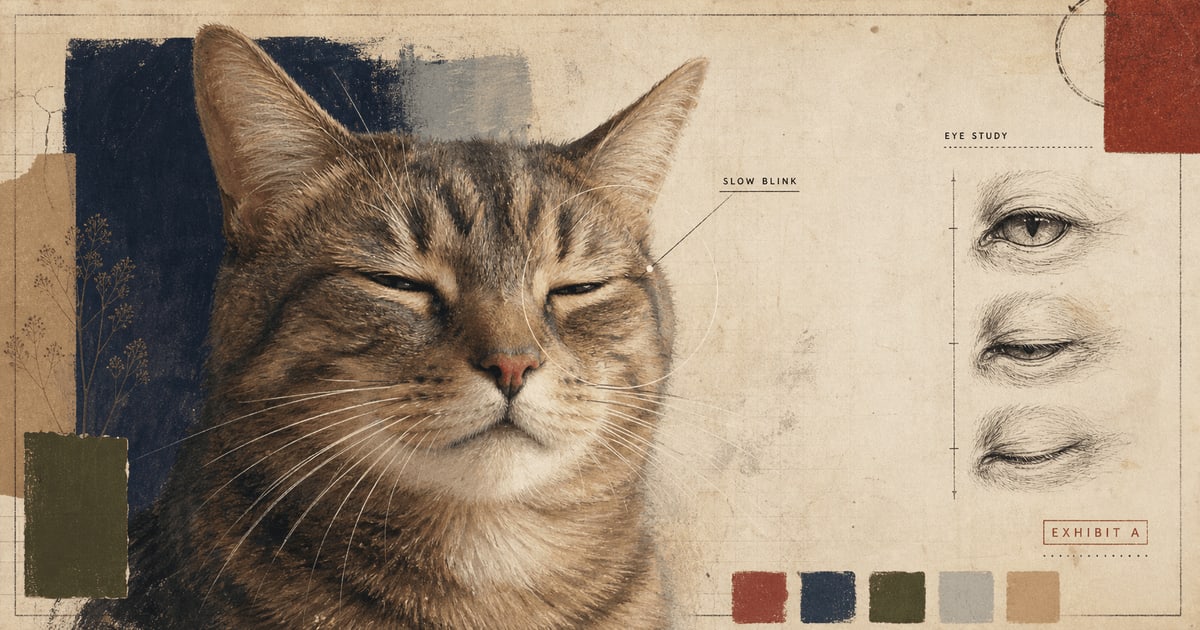
This is the context you need to understand what is actually happening when a cat narrows their eyes at you and closes them slowly.
They are putting the weapon down.
A slow blink is a cat choosing not to stare. It is the deliberate softening of a signal that normally means tension and challenge. That it registers to humans as an expression of affection is partly correct and partly a translation artifact. The gesture is closer to “I am comfortable enough in your presence to lower my threat-signaling capacity” than to any human equivalent. But in the context of a species that uses hard eye contact as a confrontation tool, choosing not to do that in your direction is, in its own way, a declaration.
What the Research Actually Measured
In 2020, a team of researchers at the University of Sussex published a study in Scientific Reports specifically investigating the slow blink sequence in cat-human interaction. The researchers, led by Tasmin Humphrey and Karen McComb, ran two experiments.
The first experiment had cat owners slow blink at their cats at home in a natural setting, with a control condition of no interaction. The result: cats produced significantly more eye narrowing and half-blinking after their owners slow blinked at them compared to the neutral condition. The cats were reciprocating the gesture.
The second experiment used an unfamiliar experimenter, not the cat’s owner. After the experimenter slow blinked, cats were more likely to approach them than after a neutral expression. A gesture from a stranger, one the cat had no previous association with, still produced a positive social response.
This is notable because cats are often described as indifferent to humans they do not know well. The slow blink appears to function as a kind of social recognition signal that crosses the familiarity threshold: here is a creature doing the thing that means reduced threat, and the cat responds accordingly.
That said, the Humphrey-McComb study is one experiment, not a decade of replication. Cats are individual animals and the gesture does not function as a universal translation key. A slow blink in the context of a relaxed body, neutral ears, and voluntary proximity means something different from narrowed eyes in a cat pressed into a corner. Context, as always, is doing most of the work.
Why Cats Got a Different Social Vocabulary
Dogs and cats developed their relationships with humans along very different paths, and this is reflected in how differently they communicate with us.
Dogs were domesticated from wolves beginning somewhere between fifteen thousand and forty thousand years ago, in a process that selected heavily for social cooperation, responsiveness to human cues, and behaviors that reinforced the human-dog bond. The Nagasawa 2015 paper in Science documented the oxytocin-gaze loop: when dogs and humans make eye contact, oxytocin rises in both parties simultaneously, the same bonding hormone active in mother-infant attachment. Wolves raised by humans do not produce this loop. Dogs do. Domestication appears to have literally built the neurochemistry of bonding through eye contact into the dog.
Cats were domesticated later, from a largely solitary species, and the process was less intensive. Wildcats self-selected into proximity with human settlements around ten thousand years ago, primarily because settlements attracted rodents and rodents attracted cats. The relationship was mutually convenient rather than deliberately engineered. Cats were not selected for the same degree of social coordination with humans that dogs were. They did not develop the same range of face-directed communicative behaviors, the mobile eyebrows, the gaze-seeking, the following of human pointing gestures, that dogs produce.
What cats did develop is a capacity for individual social bonds within a species framework that is not designed for them. The slow blink, the proximity-seeking, the head-bumping, the kneading, the sleeping on warm humans: all of these are behaviors that cats do with specific individuals they have chosen, not as a species-wide default. That selectivity is why it feels significant when a cat offers you the slow blink. It is not a thing they do with everyone.
Lauren R. Finka, a researcher at the University of Nottingham who has published extensively on cat sociality and welfare, notes in a 2022 Animals paper that cats’ social behavior is more flexible than commonly assumed, with significant individual variation shaped by early socialization, genetics, and ongoing experience. A cat that chooses to engage socially is making an active choice in a way that differs from a dog’s more generalized social orientation toward humans. The slow blink is part of that active choice.
What the Face Is Actually Doing
The mechanics of a slow blink involve the orbital area around the eye, specifically the narrowing produced by the orbicularis oculi muscle as the eyelids lower. In humans, the same muscle movement, when it appears involuntarily during a genuine smile, is called the Duchenne marker, and it is one of the signals we use to assess whether someone’s smile is authentic. Controlled lowering of the eyelids tends to register as relaxation across species because it removes the wide-open, hard-focus quality of a threat or alarm expression.
A cat in full alertness has wide eyes with fully exposed irises and pupils adjusted to current light conditions. A cat in a slow blink has reduced that exposure, softened the orbital area, and produced an expression that reads, even across species lines, as settled rather than tense.
The face as a whole participates. A cat whose eyes are half-closed but whose ears are flat and whiskers are pulled back is not in the same state as a cat whose eyes are soft and whose ears are neutral and forward. The blink is one element in a composite expression. Reading it accurately requires reading all of it, not just the eyelid position in isolation.
Why It Changes a Portrait
Cat portraits are unusually dependent on the eye expression because cats do not give artists the quantity of readable information that dogs do.
A dog at rest still provides significant compositional material: the open mouth, the relaxed tongue, the lifted eyebrows, the ear position that shifts with mood, the overall loose quality of a dog who has decided the room is safe. A resting cat compresses all of that into a few square centimeters of face. The difference between a portrait that feels alive and one that feels flat can be half a millimeter of eyelid.
This is not an exaggeration. A cat photographed with fully open eyes looks different from the same cat photographed with eyes at about 70% open. One looks alert, possibly watchful, possibly startled depending on the ear and whisker position. The other looks calm, present, and settled. An artist working from the two reference photos will produce two genuinely different emotional registers in the final portrait, even if every other element is identical.
A slow-blink expression, properly photographed, can capture the way a cat looks when they have decided the household is theirs and everything in it is adequately managed. That is a specific quality, and it is often where the actual personality of a domestic cat lives. The hunting alert, the wide-eyed startle, the hard-focus stare at something in the wall: those are real expressions, but they are not typically the expression that makes a person say “that is exactly them.”
The slow blink is.
How to Photograph It Without Ruining It
The fastest way to lose a cat slow blink is to pursue it.
Cats produce the gesture in conditions of genuine comfort, not in response to a human appearing with a phone and increasing the social pressure of the room. The approach that works is the same approach that works for most cat photography: remove urgency from the situation entirely.
Sit low. Preferably on the floor. Use natural light from a window, not flash, not overhead fluorescent. Keep the phone still. Let the cat settle and decide to stay rather than manufacturing their stillness.
If you want to try initiating: soften your own eyes first. Look near the cat rather than directly through them. Slowly lower and raise your eyelids once. Wait without leaning toward them. If the cat narrows their eyes in return, the phone is already in position. Take a short burst.
If the cat gets up and walks to the other room, you have confirmed you are dealing with a cat.
For portrait purposes, send the expressive slow-blink photo alongside a clearer backup photograph. The expressive photo tells the artist the emotional register. The clear photo tells them the eye color, the fur pattern, the exact proportions of the face. Both are useful, and an artist can work from the combination better than from one photograph that tries to be both things at once.
A short note in the order form helps: “Her eyes were always half-closed when she was relaxed” or “He had a slow-blink resting face, not alert or wide-eyed.” That single sentence tells the artist what emotional default to carry through the whole portrait.
Digital portraits start at $24.99, with proofs in 2 to 3 business days and unlimited revisions. Start here.
Sources
- Tasmin Humphrey et al., “The role of cat eye narrowing movements in cat-human communication”, Scientific Reports, 2020.
- Lauren R. Finka, “Conspecific and Human Sociality in the Domestic Cat”, Animals, 2022.
- Miho Nagasawa et al., “Oxytocin-gaze positive feedback between humans and dogs”, Science, 2015.
- Ádám Miklósi et al., “A Simple Reason for a Big Difference: Wolves Do Not Look Back at Humans, but Dogs Do”, Current Biology, 2003.
- Sarah L. H. Ellis et al., “The AAFP and ISFM Feline Environmental Needs Guidelines”, Journal of Feline Medicine and Surgery, 2013.
Welcome perk
Free expedited delivery on your first portrait
Get your digital proof in 1-2 business days instead of 2-3, free on your first portrait. Normally a $10 upgrade.
No spam. Just the perk and the occasional new style or guide.
Check your inbox for your code.