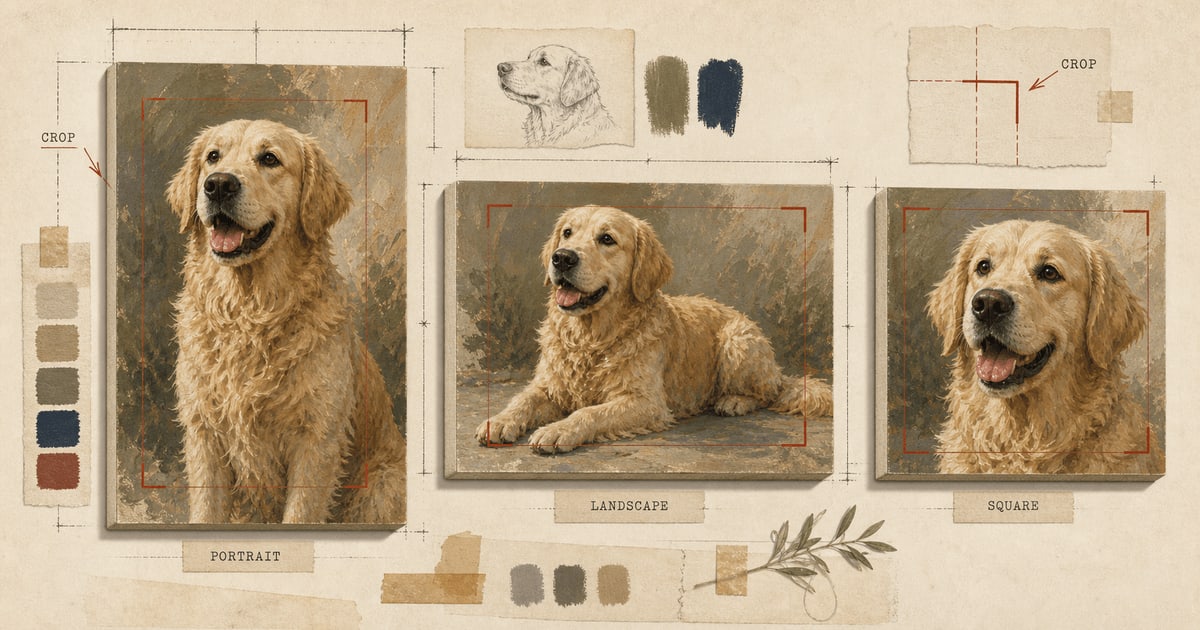
Orientation is the decision people put off because it feels like a detail. It is not a detail. The shape of the canvas changes which poses work, which rooms the painting fits, and which version of the pet ends up dominant. Most regret with finished pet portraits is composition regret, and most composition regret traces back to the orientation choice.
The plain answer: pick the orientation that matches the pet’s pose first, the wall second. Square forgives the most. Vertical is for tall, standing, or upright subjects. Horizontal is for lying-down poses, multi-pet groups, action, or compositions where the environment around the pet is doing real work.
What each orientation does
A pet portrait orientation is doing two things at once. It is framing the subject (cropping in or out around the body) and it is setting the visual rhythm of the wall it hangs on. Both matter, and they often pull in different directions.
Square
Square is the most forgiving shape. It centers the subject without forcing the eye toward an edge. It works for tight bust shots (head and chest), for compact poses (a curled cat, a corgi loaf), and for the cleanest gallery-wall compositions when you are pairing multiple portraits.
The classical reason square works is balance. Without a dominant axis, the eye settles. This is the same reason record covers, vinyl sleeves, and Instagram for years used square as the default. The shape does not steer attention to a side.
Pet on Canvas offers an 8x8 square as one of the small sizes. It is a popular choice for desk-shelf placements and for sets of two or three displayed together.
Vertical (portrait)
Vertical orientation suits subjects that are taller than they are wide. The obvious cases:
- A standing dog photographed from straight on
- A sit-up pose (dog or cat sitting upright)
- A standing cat (rare but striking)
- A bust shot where the chest and head together are taller than wide
Vertical also suits single-subject portraits in classical-style compositions, where the format echoes traditional human portraiture (which has been mostly vertical since the Renaissance for the same reason: human faces and torsos are taller than wide).
For room placement, vertical orientations fit narrow walls (between two doorways, in a hallway, between two windows) and add visual height to rooms with low ceilings.
Horizontal (landscape)
Horizontal orientation does the work for several specific cases:
- A pet lying down (most cats in repose, dogs sleeping, dogs in down-stay)
- Two or more pets together (any grouping wider than tall)
- Action poses (running, jumping, a dog mid-fetch where the body extends horizontally)
- Compositions where the setting matters (the dog on the bed, the cat in the window, the pet against a recognizable landscape)
The classical compositional principle here is the eye’s tendency to scan horizontally. A horizontal painting reads more like a scene. A vertical painting reads more like a presentation. These are different feelings.
Above a fireplace, above a sofa, above a credenza: these are almost always horizontal wall slots. A vertical portrait above a horizontal sofa often reads as undersized for the wall.
How to match orientation to pose
The most efficient way to think about this: look at the reference photo and notice the rectangle the pet’s body fits inside.
- Pet’s body fits a square (curled cat, head-and-shoulders shot): square
- Pet’s body fits a tall rectangle (standing dog, sit-up, head-to-mid-chest portrait): vertical
- Pet’s body fits a wide rectangle (lying-down, multiple pets, action): horizontal
If the pose’s natural rectangle does not match your wall’s natural rectangle, the conflict has to be resolved somehow. Usually the better resolution is to either (a) pick a different reference photo with a pose that fits the wall, or (b) accept that the painting will have generous background space on one or two sides.
For background space, more is usually better than less. A pet portrait with breathing room around the subject reads as more considered than a portrait cropped tight to the body. The Pet on Canvas background guide covers this in more depth.
How to match orientation to the wall
Once you know the pose’s preferred orientation, look at where the portrait will hang.
Above a fireplace mantel: almost always horizontal. The mantel is a horizontal line. A vertical portrait sitting on it tends to feel like a tombstone. A horizontal portrait roughly two-thirds the width of the mantel sits well.
Above a sofa or bed: usually horizontal, for the same reason. The furniture is horizontal. Match it.
On a narrow wall (hallway, between doors, between windows): vertical or square. Horizontal will look squeezed.
On a gallery wall (multiple pieces): any orientation, chosen to balance the other pieces. Sets of three are often two squares plus one larger horizontal or vertical, or three squares of varying sizes.
On a shelf or mantel (leaning, not hanging): square or modestly horizontal. Tall vertical pieces tend to tip forward.
Desk or side table: small square (8x8) or small vertical (11x14 portrait). Anything larger crowds the surface.
Pet on Canvas sizes and their natural orientations
The current size list:
- 8x8 square: small accent size, works as a single piece or in pairs. Suits compact poses.
- 11x14: classic small/medium portrait. Available as vertical (most common) or horizontal. Vertical for sit-up or head-and-chest shots, horizontal for lying-down or multi-pet.
- 16x20: the most common “main wall” size. Vertical or horizontal. Choose based on pose and wall as above.
- 30x40: large statement piece. Vertical or horizontal. Best for one main wall in a room rather than a side wall, because of the visual weight.
For sizing relative to wall, the rough guideline most interior designers use is that a piece should take up about two-thirds of the available wall width (for a single piece above furniture) or two-thirds of the furniture’s width when the furniture is what anchors the wall.
When you genuinely cannot decide
Two real heuristics:
The “first 30 seconds” heuristic: pick the orientation that lets the viewer find the pet’s face within the first 30 seconds of looking at the painting. If the orientation forces the eye to work for it, change orientations.
The “wall test” heuristic: print the reference photo at the rough orientation and size you are considering, tape it to the wall, and live with it for two days. Most orientation regret happens because the decision was made without ever seeing the rough shape in the actual room.
For new commissions, you can always ask us to mock the composition both ways before committing. The pricing page lists what is included, and the order process allows for an orientation discussion before painting starts.
The bottom line
Square forgives. Vertical presents. Horizontal scenes. Pick what suits the pose, check it against the wall, mock it up if you are uncertain, then commit. Most finished portraits land well when the orientation was the considered choice rather than the default one.
The pet will look like the pet either way. The orientation decides how comfortably the pet sits inside the frame and on the wall.
Welcome perk
Free expedited delivery on your first portrait
Get your digital proof in 1-2 business days instead of 2-3, free on your first portrait. Normally a $10 upgrade.
No spam. Just the perk and the occasional new style or guide.
Check your inbox for your code.