
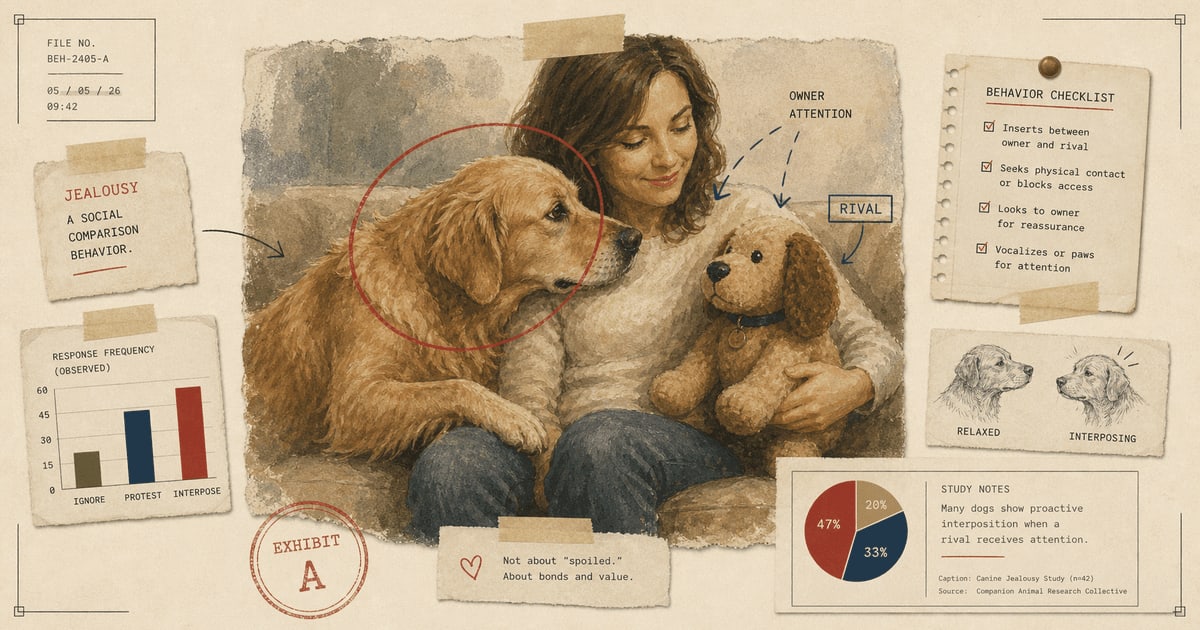
Eighty-six percent of the dogs in Christine Harris’s 2014 study tried to sniff the stuffed toy dog’s rear end.
The stuffed dog was a fake. It was a prop, equipped with a mechanism that made it bark and wag its tail. The real dogs in the study knew, or should have known, that it was not a dog. They had presumably encountered toy dogs before without incident. And yet, when their owners sat on the floor and lavished affectionate attention on this object, something switched in a majority of them. They pushed in. They got between the owner and the fake dog. Several snapped at it. And then, apparently reconsidering, they applied the standard canine verification protocol.
The study was the first experimental test of jealous behavior in dogs. It was published in PLOS ONE in 2014 and attracted immediate popular attention, because the headline wrote itself: dogs get jealous. The actual findings were more complicated, as actual findings generally are.
What the Study Did
Harris and Prouvost, both psychologists at UC San Diego, adapted a paradigm originally designed to test jealousy in human infants. The infant jealousy test works by having a parent interact with a lifelike doll while ignoring the baby, then observing whether the baby shows jealousy-like behaviors.
Infants do. They reach toward the parent. They fuss. They try to interrupt the interaction.
The researchers adapted this for dogs. Thirty-six dogs participated. Each owner was instructed to interact affectionately with three different objects while ignoring their dog: a stuffed dog that barked and wagged its tail, a Halloween jack-o’-lantern bucket (a non-social object of roughly similar size), and a book (a completely inert object that the owner pretended to read aloud).
The dogs showed significantly more jealousy-like behaviors during the stuffed dog condition than the other two. They were more likely to touch or push the owner, get physically between the owner and the object, and snap at the object. The jack-o’-lantern and the book produced noticeably less of this.
Two raters coded the videos without knowing what condition was being tested, which is an important methodological detail: it reduces the risk that the people doing the scoring were unconsciously finding what they expected to find.
The 86 percent tail, about the rear-end sniffing, is the detail that makes the study feel real. It suggests that the dogs, despite apparent certainty about what they were doing behaviorally, still ran the standard canine social verification check. The body pushed in on instinct. The nose double-checked afterward. This is not irrational. It is just very, very dog.
What “Jealousy” Actually Means Here
Harris’s interpretation was careful about this: she was not claiming dogs experience jealousy the way a person might experience it. Human jealousy is cognitively layered. It involves memory, social comparison, anticipation of future events, language-structured rumination about what the rival is doing and why, and occasionally a deeply inadvisable series of late-night text messages.
Dogs lack most of that architecture, as far as anyone can determine.
What Harris argued instead is that there may be a more primitive form of jealousy, one that does not require complex self-awareness or social cognition, but simply responds to the presence of a rival for a valued social resource. She pointed to similar findings in human infants, who show jealousy-like responses before they have the cognitive development that would be required for the full human experience of the emotion.
The idea is that jealousy, in its functional core, is a mechanism for protecting social bonds from interference. Animals that live in social groups, depend on certain relationships for survival, and are vulnerable to being displaced by rivals have a functional incentive to respond to threats to those relationships. Whether the animal experiences this as “jealousy” in any phenomenological sense is a different question, and one that nobody can currently answer.
Harris used the term “proto-jealousy” for this functional version: a response that looks like jealousy, produces jealousy-like behaviors, and serves jealousy-like purposes, without the requirement that it be accompanied by jealousy-like subjective experience.
The distinction is philosophically real and practically somewhat difficult to care about. The behavior is happening either way.
The Debates
The study attracted a fair amount of critical attention from researchers, on several grounds.
One concern was that dogs might have been responding to the novelty or social ambiguity of the stuffed dog, rather than to jealousy per se. A barking, tail-wagging object that smells like synthetic fiber and not like dog is a strange thing. The dogs’ attention to it might reflect confusion or investigative interest rather than rivalry.
A 2018 study by Prato-Previde and colleagues in PLOS ONE tested this more carefully, using a more realistic-looking robotic dog as the rival object and measuring a wider range of behaviors. Their findings were more mixed. Dogs did respond to the owner-rival interaction, but the specific pattern was harder to attribute cleanly to jealousy. Individual temperament, prior learning history, and the details of the dog-owner relationship all produced substantial variation.
This is not unusual in animal behavior research. Studies with live animals interacting in social contexts tend to produce messy data, because animals are messy, and social contexts are messier. The more careful interpretation after both studies is probably: dogs can show jealousy-like behavior in situations involving competition for owner attention, but the phenomenon is not uniform across dogs, not limited to a single clean mechanism, and not fully explained by any single study.
This is less satisfying than “dogs get jealous: confirmed.” It is more accurate.
Why Social Animals Respond This Way
The functional argument for jealousy as an evolved response is fairly straightforward.
Dogs are highly social animals descended from wolves, who live in groups with differentiated relationships and resource-sharing arrangements. In that context, an individual who pays no attention when a valued social bond is threatened by a rival would be at a disadvantage. The ability to notice the threat and do something about it, in the bluntest possible sense, would be selected for.
Research on chimpanzees documents jealous behavior in a range of social contexts. Titi monkeys, a species that forms strong pair bonds, become agitated when their mate interacts with a stranger and will sometimes physically position themselves between their mate and the intruder. Human infant jealousy appears before the cognitive apparatus for “sophisticated” jealousy is present, suggesting the functional mechanism develops early and the cognitive overlay develops later.
In this framing, jealousy is not uniquely human and not uniquely dependent on language or self-concept. It is a mechanism for monitoring and protecting social relationships that evolved in multiple lineages independently, because social relationships are valuable and losing them to rivals is costly.
Dogs may have retained, and may have elaborated through domestication, a version of this mechanism oriented toward their primary social relationships with humans. The 10,000 to 40,000 years of co-evolution between dogs and humans involves a great deal of selection for social responsiveness to human behavior. Dogs that were more attuned to human attention, more responsive to the quality and direction of human social engagement, presumably fared better in human social groups than dogs that were not.
A dog that notices when the human’s attention goes elsewhere, and does something about it, may be exactly the kind of dog that domestication produced.
What This Looks Like in Practice
The behaviors Harris and her colleagues coded are recognizable to most dog owners: pushing in, getting between, touching or nudging.
Some of these behaviors look cute in small doses and become problems in larger ones. A dog who puts their head on your knee when you pet another dog is one thing. A dog who snaps at other dogs who approach you, or who guards you from other household pets, or who cannot relax when guests are present and receiving your attention, is dealing with the same underlying response at a different intensity.
The behavior is worth managing rather than just tolerating or finding endearing, primarily because it can escalate. Dogs who successfully interrupt interactions (by pushing in, getting between, making enough fuss that the owner redirects) learn that the behavior works. It brought the owner’s attention back. It disrupted the rival interaction. The reinforcement is clear and immediate, even if the owner’s intention was to stop the behavior by pushing the dog away, speaking to them, or laughing at the timing.
Pushing a dog away is still physical contact and attention. Laughing is social engagement. From the dog’s perspective, the interruption may have produced exactly the outcome it was aiming for.
A more effective approach is to teach a specific alternate behavior for the situation: a mat station, a sit-stay, a hand touch. Reward heavily when the other dog or person receives attention while your dog holds the alternate behavior. Keep the sessions short enough that your dog can succeed. The goal is to make the rival-attention situation predictable and manageable rather than a trigger for escalating bids.
This does not eliminate the underlying response. It gives the dog something to do with it that is more compatible with the household functioning as a household.
The Attachment It Reflects
Whatever the mechanism, the jealousy-like response in dogs points at something real: a strong investment in the relationship with their human.
A dog who does not notice when your attention goes elsewhere, who shows no differential response to rival-attention situations, who is equally engaged regardless of what the social dynamics in the room are doing, is a dog with a different relationship to social bonds than the dog in Harris’s study. That is not better or worse. But it is different.
The dog who pushes in, who needs to be nearest, who notices where your attention is and responds to its redirection: that dog has a specific quality of social attachment. It can create management challenges. It is also, in its own way, a form of devotion, expressed with all the subtlety a dog can muster, which is approximately zero.
A portrait of a dog like that benefits from the same recognition. The leaning-in posture, the watching eyes, the proximity to a human hand, the orientation toward the person rather than away: these are visual expressions of the same social attention that makes the jealousy-like behavior happen. They are not separate qualities. They are the same quality, appearing in different contexts.
If your dog is the kind of dog who keeps track of where you are, consider sending a reference photo that reflects that. Not jealousy itself, but attentiveness. The face turned toward the person. The body leaned in. The alert quality that comes from a dog who considers your location relevant information.
That is the portrait.
Sources
- Christine R. Harris and Caroline Prouvost, “Jealousy in Dogs”, PLOS ONE, 2014.
- Prato-Previde et al., “Pet dogs’ behavior when the owner and an unfamiliar person attend to a faux rival”, PLOS ONE, 2018.
- UC San Diego, “Dog Jealousy: Study Suggests Primordial Origins for the ‘Green-Eyed Monster’”, 2014.
- PMC/NIH, “Jealousy in Dogs” (full text)
- PMC, “Jealous Behavior in Chimpanzees Elicited by Social Intruders” (comparative primate context)
- Live Science, “Do Animals Get Jealous?” (broader evolutionary context)
Welcome perk
Free expedited delivery on your first portrait
Get your digital proof in 1-2 business days instead of 2-3, free on your first portrait. Normally a $10 upgrade.
No spam. Just the perk and the occasional new style or guide.
Check your inbox for your code.