The chemical compound responsible for the smell of popcorn is called 2-acetyl-1-pyrroline. It forms when heat drives a reaction between sugars and amino acids in corn kernels. It is also present in jasmine rice, fresh bread, and, with some regularity, your dog’s feet.
That is not a metaphor. It is the same molecule. The same nose receptors that signal “movie theater” are being triggered by the microbiome living between your dog’s toes. Snack companies should feel something about this, though what exactly is unclear.
The phenomenon is called “Frito feet” or “corn chip paws” in the veterinary internet, which has a fondness for cheerful branding. The underlying biology is more interesting than the nickname suggests.
The Specific Bacteria
Two genera get most of the credit: Pseudomonas and Proteus.
Pseudomonas bacteria are gram-negative rods found widely in soil, water, and on healthy skin surfaces. They are metabolically versatile, which is a polite way of saying they will eat almost anything organic and produce volatile byproducts while doing it. Pseudomonas aeruginosa, the most common species in this family, is well-known in clinical microbiology for producing 2-aminoacetophenone, a compound that smells sweet and grape-like. But other Pseudomonas species, operating in the warmer, moister conditions of a dog’s paw, produce compounds that shift toward the corn-chip register.
Proteus bacteria, including Proteus mirabilis, are also gram-negative and commonly found in soil and on skin. They metabolize amino acids and produce volatile nitrogen compounds in the process. Proteus mirabilis has a distinctive smell of its own, and microbiologists who work with it learn to recognize it quickly, which is one of the minor inconveniences of that career.
Neither of these bacteria is doing something wrong. They are resident flora, part of the normal skin microbiome of a healthy dog. They eat, they metabolize, they produce volatile organic compounds as byproducts, and those compounds waft upward to human noses, which are, without exception, located above the dog’s feet.
Why Paws Specifically
The question is not why dogs have bacteria on their skin. Every animal does. The question is why the paws produce a stronger smell than, say, the dog’s back or ears.
The answer is structural. Dog paw pads contain eccrine sweat glands, the same type of sweat gland that produces moisture in human hands and feet. Most of a dog’s skin is covered in apocrine glands, which produce a different kind of secretion used for scent communication, but the pads are a genuine sweat surface. They produce moisture continuously.
That moisture, combined with the warmth generated by proximity to the circulatory system and the dark, enclosed spaces between toes, creates conditions that allow bacteria to thrive at higher concentrations than on dry exposed skin. The toes also trap environmental material: soil particles, organic debris, whatever the dog walked through in the last few hours. All of it becomes substrate.
It is, in other words, a small and well-functioning fermentation environment, operated involuntarily, at the bottom of the dog.
Yeast, particularly Malassezia pachydermatis, often adds its own contribution. Malassezia is the same genus responsible for dandruff in humans (a different species, Malassezia globosa, in that case). It is a normal resident of dog skin and tends to concentrate in warm, lipid-rich environments. Its metabolic output adds a yeasty note to the overall profile. The result is not one compound but a mixture, which is why dogs vary in how strongly they smell and in the precise quality of the odor.
Is It a Health Problem
For most dogs: no.
A mild, consistent corn-chip smell from clean paws is normal. The bacteria and yeast responsible are resident flora operating within normal parameters. The smell is stronger after walks, in warm weather, after rain, or when the dog has been lying down and trapping moisture against the feet. None of that is pathological.
The situations that warrant a veterinarian are different in quality, not just intensity. Watch for the smell changing to something sharp, sour, or distinctly unpleasant in a new way. Watch for redness between the toes, swelling, discharge, cracks in the pads, or a dog who cannot leave their own paws alone. Those signs can indicate yeast overgrowth (often related to allergies), bacterial infection, foreign body, contact dermatitis, or other paw problems that are genuinely treatable.
The key word is “change.” A dog who has always had mild corn-chip feet and is otherwise comfortable is a dog with corn-chip feet. A dog whose paws recently became smellier, or whose feet also look or feel different, is a dog worth checking.
A blog post cannot examine paws. A veterinarian can.
The Broader Point About Skin Microbiomes
The corn-chip smell is a small window into something larger: the skin microbiome of a healthy dog is a community, not a contamination.
Research on the human skin microbiome has expanded significantly since the early 2000s, driven largely by advances in metagenomic sequencing. The dog skin microbiome has received less systematic attention, but what exists suggests it is similarly complex: dominated by Proteobacteria, Firmicutes, and Actinobacteria, varying by body region, breed, coat type, and age. The paw microbiome appears distinct from the dorsal skin microbiome, likely because of the different substrate conditions.
This is a living ecosystem shaped by the dog’s genetics, diet, environment, and immune function. Mild smells are generally evidence of a functioning system. Strong or suddenly changed smells are often the first signal that something in the system has shifted. Dogs cannot explain symptoms. Their bodies communicate in other ways.
Corn chips happen to be one of them.
The Paws as a Portrait Subject
Pet portrait photography gravitates toward the face, for obvious reasons. Eyes carry likeness. Expression carries personality. The face is where most people look first, in a photo and in a dog.
But paws have their own story.
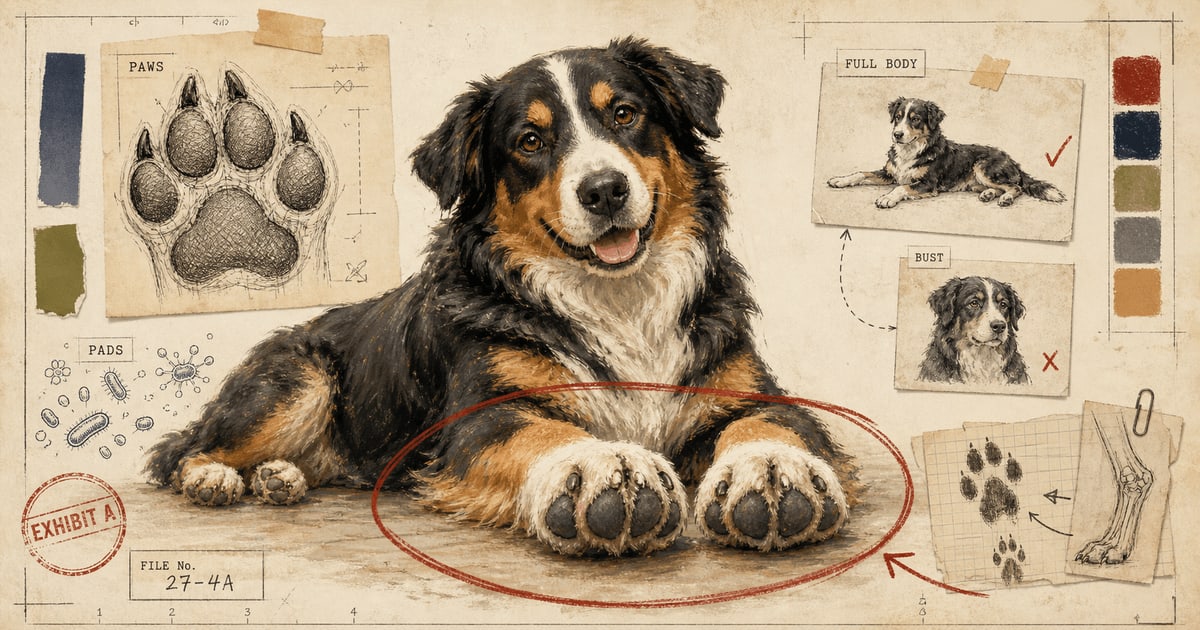
Puppies have paws absurdly oversized for their bodies, hinting at what is coming. Senior dogs develop thick, worn pads that are a record of terrain and years. Certain breeds have distinctive feet: the Newfoundland’s webbed toes, the Greyhound’s narrow elegant feet built for stride efficiency, the German Shepherd’s compact arched paws. Individual dogs carry their own signatures: the white sock on the left front leg, the single dark toe, the front paw that turns out slightly when sitting, the full-body sploot that puts all four feet at improbable angles.
If a full-body portrait captures posture and markings and scale, it also captures feet. For dogs whose paws are part of what makes them specific, that matters.
If the paws matter to you, send reference that shows them clearly: one full-body photo from the side or front, one close-up in natural light, one shot showing the dog’s natural resting position. Let the artist see what the camera sees, including the part that occasionally smells like a gas station snack.
The corn-chip aroma is not required for the portrait. The paws themselves sometimes are.
Sources
- Bekoff, Marc. “Social communication in canids: evidence for the evolution of a stereotyped mammalian display.” Science, 1977. (background on canid sensory biology)
- A-Z Animals, “The Curious Reason Binturongs Smell Like Popcorn” (2-acetyl-1-pyrroline production by bacteria on skin)
- ScienceDirect, “2-Acetyl-1-Pyrroline” (chemistry of the compound)
- Microbe Online, “Microbes with Good and Bad Smell” (Pseudomonas and Proteus odor profiles)
- American Kennel Club, “Why Do My Dog’s Feet Smell Like Fritos?” (veterinary context)
- Eastside Veterinary Associates, “Frito Feet: Why Do My Pet’s Paws Smell Like Corn Chips?” (clinical context)
- BetterPet, “Why does my dog smell like Fritos?” (bacteria identification)
Welcome perk
Free expedited delivery on your first portrait
Get your digital proof in 1-2 business days instead of 2-3, free on your first portrait. Normally a $10 upgrade.
No spam. Just the perk and the occasional new style or guide.
Check your inbox for your code.