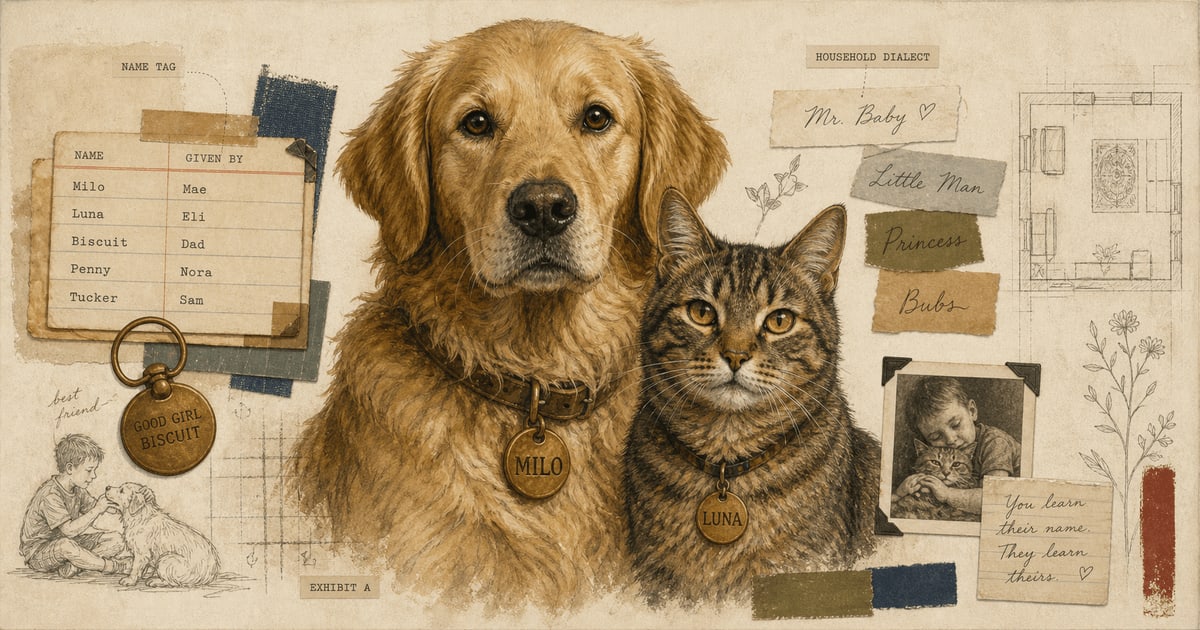
The most popular pet name in the United States has been, for several consecutive years, either Charlie, Bella, or Max. These are also common human names. A cat named Bella is statistically more popular than a cat named Mittens or Whiskers, which were supposed to be the cat names. Somewhere along the way, the joke names became the serious ones and the serious ones became what you call your calico.
This is not a coincidence and it is not shallow. The trend toward human names for animals runs on the same engine that drives most of the ways people relate to companion animals: a deep, largely automatic tendency to perceive minds in things that behave as though they have one. You do not name a dishwasher Kevin. You name a dog Kevin because the dog looks at you in a way that Kevin would look at you.
The research on this is substantial. The mechanism is well-understood. The behavioral consequences are real.
Anthropomorphism is a feature, not a bug
In a 2007 paper in Science, Nicholas Epley and colleagues proposed a framework for understanding anthropomorphism: the tendency to attribute human mental states, emotions, and intentions to nonhuman agents. They argued that anthropomorphism is not a cognitive error to be corrected but a natural output of the human social-cognition system. We are equipped with neural machinery for understanding other minds. That machinery runs on any sufficiently mind-like input. Dogs, cats, and other companion animals produce enough mind-like output (gaze, response to voice, apparent emotional states, apparent intentions) to trigger it reliably.
The paper’s title was “Seeing Life in the Lifeless: Toward a Unified Theory of Anthropomorphism,” and one of its key claims is that the more socially isolated or in need of social connection a person is, the more readily they anthropomorphize. The mechanism is not delusion. It is the social system doing what it was built to do.
Companion animals benefit from this substantially. They get named, given pronouns, assigned personalities, spoken to, and incorporated into family narratives in ways that carry real consequences for their welfare. An animal with a name and a personality gets better care than an animal without one. The anthropomorphism is partly pragmatic.
A later review by Adam Waytz, John Cacioppo, and Nicholas Epley in Perspectives on Psychological Science in 2010 further developed this framework, identifying three core factors that reliably trigger anthropomorphism: unpredictability of behavior (which makes you feel the need to infer intentions), chronic loneliness or social need, and low “agent knowledge,” meaning you know less about how the thing actually works mechanically. Dogs and cats check all three boxes. They are behaviorally unpredictable enough to warrant prediction, they provide social connection that triggers the relevant neural systems, and most people have no mechanistic model of dog psychology whatsoever.
What the name actually does
A name does several things at once.
The most fundamental is what linguists call addressability. You cannot speak to something without a name. You can produce sounds near it, but you cannot hail it, scold it by name, praise it by name, or call it across a room in a way that distinguishes it from any other animal in earshot. The name makes the animal addressable inside human social interaction.
James Serpell, in his 2003 paper “Anthropomorphism and Anthropomorphic Selection” published in Society & Animals, examined how naming practices both reflect and reinforce the human-animal bond. One of his central observations is that naming an animal separates it categorically from food animals, from livestock, from vermin. Naming is a social act that confers something like personhood on the named entity, at least within the household’s social logic. A cow named something is substantially harder to slaughter than a cow designated by a tag number. A chicken given a name by a child is, practically speaking, no longer food.
For companion animals, the name operates in the same direction but with different consequences. The cat is not being spared slaughter. The cat is being folded into the family’s social narrative. “Margaret knocked it over” is a different sentence than “the cat knocked it over.” The first sentence has a suspect with a character. The family now has a story. The second sentence has a minor inconvenient fact.
Human names specifically
The move toward human-sounding names for pets is measurable and culturally specific. A study of naming conventions in Taiwan, published in Names in 2017, found that Mandarin-dominant households did not show the same preference for human-sounding names in the dominant language. The pattern is not universal: it reflects the particular intensity of companion-animal personhood in contemporary Anglo-American household culture.
What human names do, more specifically, is pull the animal into the existing category of person without the speaker having to make an argument for it. A dog named Theodore occupies the same grammatical and social slot as a family member named Theodore. Both get referred to with personal pronouns. Both get mentioned by name in stories. Both get a stocking, probably.
There is also a tonal dimension that is easy to miss. Human pet names carry class and era signals in the same way human names do. A dog named Winston carries different connotations than a dog named Diesel. A cat named Priscilla is doing something different in the household vocabulary than a cat named Gremlin. People choose names that communicate something about how they see the animal, what role they want the animal to occupy, sometimes what they think is funny.
The name is a position paper.
Nicknames as domestic record
The official name is almost always the beginning of the naming process, not the end.
Every sufficiently loved pet develops a secondary vocabulary. A dog named Oliver becomes Ollie, then Ollie Wollie, then The Colonel, then just “you, stop.” A cat named Penelope becomes Penny, then Penny-Lou, then The Auditor, because she sits on the counter and watches you make dinner with an expression of professional skepticism.
Linguists have described this kind of nicknaming as affectionate language play: repetition, rhyme, distortion, reference to observed personality, and inside jokes accumulating into a private household dialect. The nicknaming is not random. It preserves exactly what the family noticed about the animal. The dog that sighs becomes Grandma. The cat that appears from nowhere becomes The Ghost. The small anxious terrier becomes Senator.
These names are jokes, but they are also field notes. They record how the animal lived in the house, what it did that was memorable, what the family found funny or frustrating or endearing. After the animal dies, the nicknames are often what people miss most particularly, because the official name is on the vet records and the memorial post, but the nicknames live only in the household. They are the ones that disappear.
The portrait implication
When clients write a commission brief, we read it the same way a novelist reads a character note. The official name tells us one thing. The nicknames tell us the real thing. “Her name was Rosie but we called her The Ambassador” is a portrait instruction: this dog had a certain gravity, a formal quality, a bearing. “His name was Theodore but honestly he was more of a Gerald” is a different instruction: the formal name was aspirational; the reality was something scruffier and more honest.
If you are commissioning a portrait and writing a brief, include the full naming history if there is one. You do not need to explain every inside joke. But the nickname that captures what the animal was actually like in the household is usually more useful to the artist than the official call name. It tells us the tone of the painting: regal, funny, tender, chaotic, elegiac.
If the portrait is a gift, the naming question matters for a different reason. The recipient probably thinks of the animal under a specific name, which may not be the name they registered at the vet. A portrait whose emotional register is calibrated to “Bub” rather than “Buddy” lands differently. A painting of “The Cheese Minister” is funnier and more accurate than a painting of “Theodore.” The small language is the language of the relationship. It is the part worth preserving.
Humans name pets like people because pets occupy the part of life where names do real work. The name calls someone into the room. It keeps them in the room after they are gone. That is not sentimentality. That is what names are for.
Sources
- Epley, Nicholas, Adam Waytz, and John T. Cacioppo. “On Seeing Human: A Three-Factor Theory of Anthropomorphism.” Psychological Review, vol. 114, no. 4, 2007, pp. 864-886.
- Waytz, Adam, John Cacioppo, and Nicholas Epley. “Who Sees Human? The Stability and Importance of Individual Differences in Anthropomorphism.” Perspectives on Psychological Science, vol. 5, no. 3, 2010, pp. 219-232.
- Serpell, James A. “Anthropomorphism and Anthropomorphic Selection: Beyond the ‘Cute Response’.” Society & Animals, vol. 11, no. 1, 2003, pp. 83-100.
- Hsiao-Hung Chen. “Pet-Naming Practices in Taiwan.” Names, vol. 65, no. 3, 2017.
- Power, Emma R. “Furry Families: Making a Human-Dog Family Through Home.” Social & Cultural Geography, vol. 9, no. 5, 2008, pp. 535-555.
Welcome perk
Free expedited delivery on your first portrait
Get your digital proof in 1-2 business days instead of 2-3, free on your first portrait. Normally a $10 upgrade.
No spam. Just the perk and the occasional new style or guide.
Check your inbox for your code.