
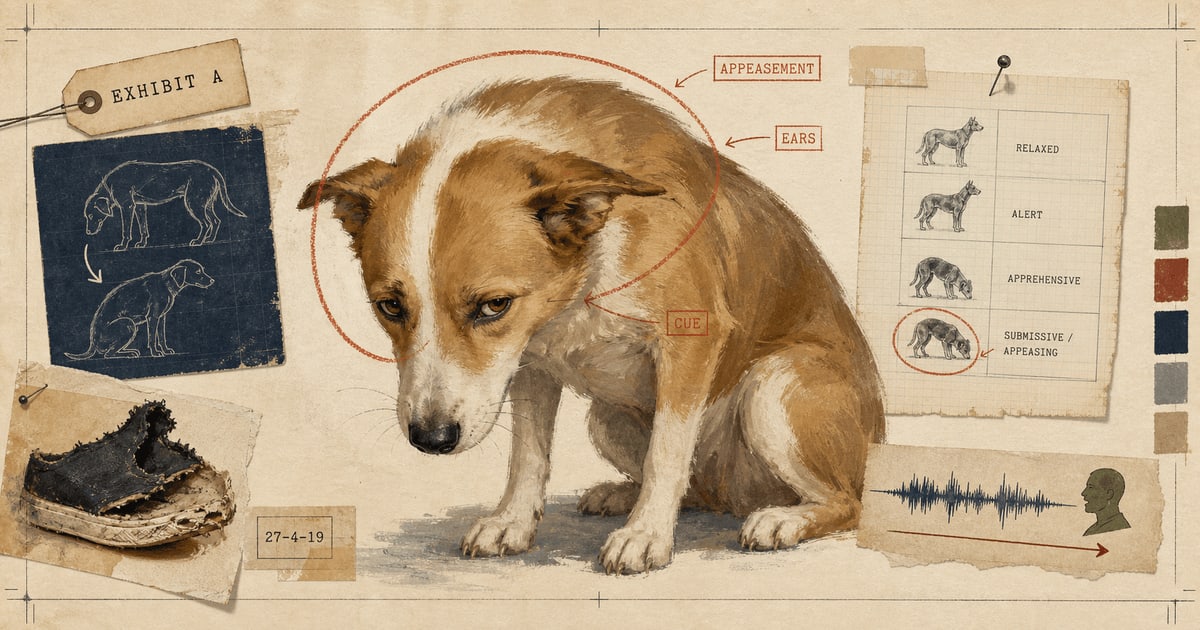
In 2009, a cognitive scientist at Barnard College set up an experiment designed to be simple and slightly ruthless. She told dogs not to eat a treat, left the room, and then lied to their owners.
Some owners were told their dog had eaten the treat. Others were told the dog had behaved. In both cases, the owners were sometimes told the truth and sometimes told the opposite. Then the researchers watched what happened when the owners came back in and either scolded or greeted their dog normally.
Alexandra Horowitz’s results were clean enough to be embarrassing. Dogs did not show more “guilty look” behaviors when they had actually eaten the treat. They showed more of those behaviors when they were scolded. The most dramatic guilty-looking displays appeared in dogs who had not eaten the treat at all but were scolded anyway. One group was innocent, berated, and looking more guilty than the actual offenders.
The guilty face followed the human reaction. Not the crime.
This study, published in Behavioural Processes, has been replicated and extended in multiple directions since. In 2015, Ljerka Ostojic and Nicola Clayton at the University of Cambridge added another variable: they also manipulated whether the evidence of the misdeed (the food item) was visible when the owner returned. Did dogs show more guilty behavior when the proof was sitting right there on the floor? No. The “guilty look” remained driven by the owner’s emotional response, not by whether the dog had done anything or whether the evidence was visible. The face is social weather-reading, not a conscience display.
So: you walk in, see the shredded shoe, change your posture and voice, and the dog responds to those changes. You interpret the response as guilt. Horowitz’s data says you are writing the closing argument, not receiving a confession.
What Is Actually Happening
Appeasement behavior is one of the older concepts in ethology, and the signals involved are not subtle. A dog offering appeasement is usually doing several things at once: making themselves physically smaller, softening their gaze or looking away, tucking the tail, pinning the ears back, moving slowly, sometimes licking their lips or yawning. The combined message is closer to “please reduce the pressure in this room” than to anything resembling moral reflection.
This matters because appeasement is not deception. The dog is not running a con. They are responding to real cues in the environment: your posture, your voice, the stiffness in how you are standing, the way the room changed when you noticed the kitchen situation. Dogs are acutely good at reading this. In most domesticated dogs, that skill has been refined over thousands of years of living inside human social structures where reading the human correctly meant the difference between a warm spot and a cold night.
When a dog triggers on your tone of voice and your rigid shoulders, that is cognition working correctly. The confusion comes from the human side. We see a collection of signals that look enough like human shame-body-language that our social brain pattern-matches it as guilt and fills in the rest of the story.
The dog is not troubled by wrongdoing. The dog is troubled by you.
“But My Dog Knows”
This is the most common objection, and it deserves a serious answer rather than dismissal.
Many owners report that their dog looks guilty specifically when there has actually been a misdeed, even before the owner has seen or reacted to anything. This experience feels definitive. If the dog only looks guilty when they actually did it, that is causation, not coincidence.
A few things are probably happening here.
First, dogs are excellent at reading environmental cues that the owner may not consciously register: the smell of the chewed object, small sounds, a different arrangement of items in the room. The dog may be picking up that something is off before the owner notices, and preemptively offering appeasement because the pattern has taught them that this kind of room atmosphere leads to scolding.
Second, confirmation bias is powerful. Owners notice the guilty face on the days there is a misdeed and file it as confirmation. On the days the dog does a worried-greeting for no identifiable reason, it gets chalked up to something else.
Third, Horowitz herself has been careful to say that her 2009 study cannot rule out the possibility that dogs have some form of guilt-adjacent state under certain conditions. What it shows is that the familiar guilty face is not reliable evidence of that state. The face is not a truth-teller. It tells you what the dog thinks is about to happen socially, not what the dog knows about their own behavior.
The distinction between “knows they did something wrong” and “has learned that this environmental context leads to bad outcomes” is philosophically real even when it is practically hard to test.
The Deeper Issue: We Want Them to Understand
There is a reason this belief persists despite the evidence. It is not stupidity. It is attachment.
We want our dogs to understand us. We want them to operate inside our moral world. The guilty face feels like shared moral language: the dog did wrong, the dog knows it, the dog is sorry, therefore the dog participates in the same ethical vocabulary we do. That feels like closeness.
The actual situation is, in a way, more interesting. The dog has learned to read you with enough precision that they can pre-empt your emotional state based on subtle environmental signals before you have said a word. That is not moral understanding. It is something closer to a continuous, lifelong study of you as a person. The dog is a better reader of your moods, your micro-expressions, your slight postural changes than almost any human you know. That is its own kind of intimacy.
It just is not the one you were narrating.
Why This Changes What You Should Do
The practical consequence of the Horowitz finding is that scolding your dog after-the-fact is doing almost nothing useful.
If you find the destruction an hour after it happened, your dog’s guilty face is a response to your current behavior, not a signal that they know why you are upset. Punishing at that point does not teach the dog not to destroy things. It teaches the dog that when you come home with certain energy, something uncomfortable is about to happen. Over time, that can make dogs anxious around homecoming in general, which is the opposite of what anyone wants.
Horowitz, who has written extensively about dog cognition in both scientific papers and popular books, has consistently made this point: the guilty look is not an acknowledgment of wrongdoing. It is a social response to a cue. Responding to it as though it were a confession misses the actual behavior entirely and usually trains the wrong thing.
The intervention that works is management before the fact: removing access to whatever is getting destroyed, providing appropriate outlets for the behavior, and addressing the underlying cause, which is almost always boredom, anxiety, teething, or insufficient exercise.
That is less satisfying than the courtroom version, but considerably more effective.
Why Guilty Photos Make Weak Portrait References
This is a different matter, but it connects to the same underlying point: the guilty face is a temporary stress state, and a portrait is not supposed to be a snapshot of your dog managing an emotionally charged situation.
When a dog is in appeasement mode, everything about their physical presentation has shifted away from baseline. The ears are pinned where they are not naturally. The eyes are squinted or averted. The head is lower than it usually sits. The body is compressed. These are not the proportions or expressions of the dog you actually live with. They are the proportions of a dog trying to manage a tense room.
An artist working from a guilty-look reference photo can technically produce an accurate painting of the photo. That is not the same as an accurate portrait of the dog. Likeness lives in the expressions the dog wears when nobody is turning a chewed slipper into an investigation.
Better reference photos have relaxed eyes, a natural head position, ears held the way your dog normally holds them, and good light on both sides of the face. The goal is not perfect alertness or manufactured cheerfulness. The goal is baseline: the dog as they are when nothing is on trial.
If your current photo selection includes a lot of stress-face candidates, wait for a quiet moment. Natural light, dog at floor level, no looming angles, no recent kitchen incident. Take the photo when your dog looks like they are simply existing in the world. That face is more informative for an artist and more truthful as a record of the animal you know.
The guilty face is a moment. It is not the dog.
Sources
- Alexandra Horowitz, “Disambiguating the ‘guilty look’: Salient prompts to a familiar dog behaviour”, Behavioural Processes, 2009.
- Ljerka Ostojic, Mladenka Tkalcic, and Nicola S. Clayton, “Are owners’ reports of their dogs’ ‘guilty look’ influenced by the dogs’ action and evidence of the misdeed?”, Behavioural Processes, 2015.
- Alexandra Horowitz, Inside of a Dog: What Dogs See, Smell, and Know, Scribner, 2009.
- Scientific American, “Don’t Be Fooled When a Dog Looks Guilty”
Welcome perk
Free expedited delivery on your first portrait
Get your digital proof in 1-2 business days instead of 2-3, free on your first portrait. Normally a $10 upgrade.
No spam. Just the perk and the occasional new style or guide.
Check your inbox for your code.