
In 2004, a Science paper reported a discovery from Cyprus: a grave containing a human skeleton and, placed deliberately nearby, the skeleton of a small wildcat. The burial dated to roughly 9,500 years ago. The cat had been killed around the time of interment, placed with evident intention. Neither agriculture nor formal cat domestication had yet arrived in Cyprus. Someone had carried a live wildcat across open water to get it there, since cats are not native to the island and could not have swum.
Nobody thought to bring livestock to Cyprus by accident.
So the question is not just when cats became useful to humans. It is why, before cats were fully domesticated, before Egyptian temples gave them bronze faces, before the internet gave them kingdoms, someone decided a wildcat was worth carrying on a boat and burying beside the dead.
That question does not have a clean answer. It has the kind of messy, interesting answer that requires grain storage, religious meaning, and tens of thousands of years of mutual tolerance between two very different kinds of apex predator.
It Began With Rodents, Not Affection
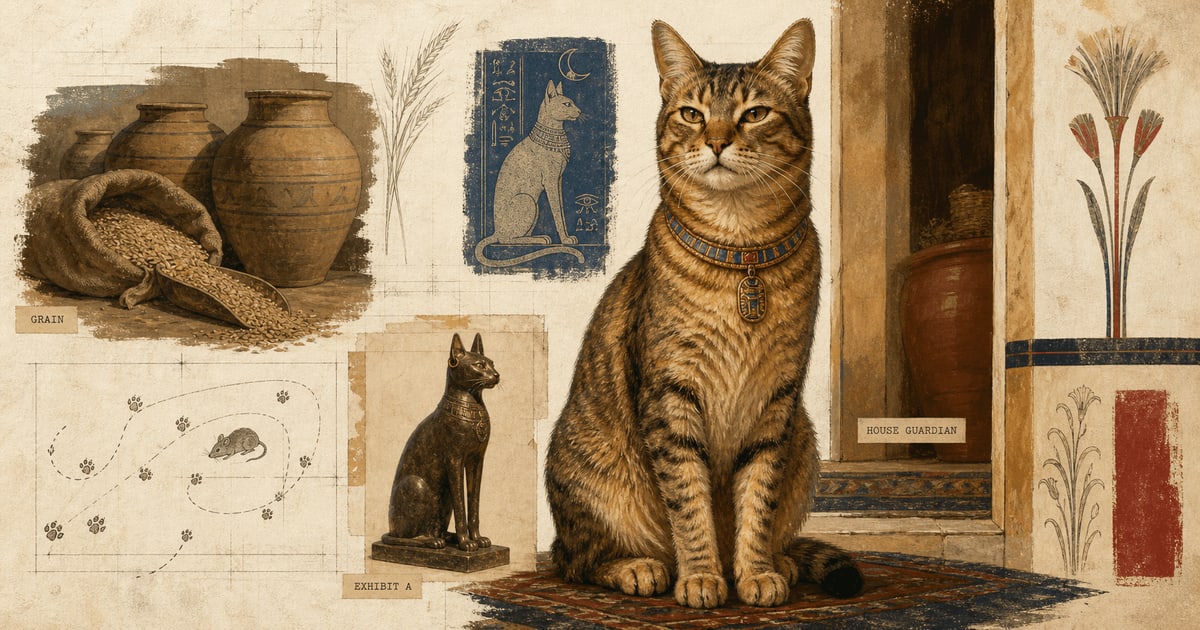
The accepted mechanism for cat domestication is commensal, which is the ecologist’s word for a relationship where one organism benefits by hanging around another without being invited. Cats got closer to people because human settlements were extraordinarily attractive to rodents, and rodents were the original target.
Genetic and archaeological work has mapped the broad outline. A 2017 ancient DNA study in Nature Ecology and Evolution by Claudio Ottoni and colleagues traced two main waves of domestic cat dispersal: one from the Near East beginning around 10,000 years ago as farming spread, and a second from Egypt beginning around 3,000 years ago. The Near Eastern wave appears linked to early agricultural settlements in the Fertile Crescent. Store grain, attract mice. Attract mice, attract wildcats. Wildcats that tolerated the crowd of humans stayed long enough to eventually pass that tolerance to their offspring.
It was not love. It was probably not even mutual awareness for a long time. It was ecology working on two species that happened to have adjacent interests.
A 2014 PNAS study by Yaowu Hu and colleagues at an archaeological site in Quanhucun, China, found direct isotopic evidence of the dynamic. The cats at that site were eating the rodents that were eating the stored grain. The rodents had been eating millet. The cats were downstream of the whole arrangement, getting fat on a food chain that humans had inadvertently constructed. There is something almost philosophical about that: humans built civilization partly around surplus food, surplus food created rodent problems, and the solution to the rodent problem walked in on four paws without being asked and has been telling people what to do with the furniture ever since.
What Egypt Actually Added
Egypt did not invent human attachment to cats. The Cyprus burial happened roughly seven thousand years before Egyptian cat veneration reached its peak. What Egypt added was scale, formalization, and cultural visibility that spread far beyond the Nile.
Cats were associated in Egyptian religious thought with Bastet, a goddess of home, protection, fertility, and music. The association was not metaphorical decoration. Cats actively protected granaries and households from snakes, mice, and rats, which in a society where stored grain was the difference between surviving the year and not, made them genuinely important. The Gayer-Anderson Cat in the British Museum, a bronze figure from around 600 BCE with gold earrings and a scarab amulet at the throat, shows what happens when a useful animal gets 3,000 years of symbolic investment. It does not look like a pest manager. It looks like something that would accept tribute.
Herodotus reported that Egyptians in mourning for a dead household cat shaved their eyebrows. Whether or not this happened in every household is a historical debate for another post, but the archaeological record supports extraordinary reverence: cat cemeteries at Bubastis containing hundreds of thousands of mummified cats, penalties recorded for killing a cat, and enough cat imagery across tomb art, jewelry, and household objects to suggest that the cat had become something genuinely different from other working animals.
The cat had become a household spirit. Present, protective, autonomous, and not entirely reducible to the job it was doing.
That quality stuck.
What “Semi-Domesticated” Actually Means
Compared with dogs, pigs, cattle, or horses, the domestic cat is a minimally domesticated animal. The Montague et al. 2014 genomic study in PNAS found that domestic cats show selection signals in genes related to memory, fear conditioning, and reward, but are still remarkably similar, genetically and behaviorally, to their wildcat ancestors. They are not far removed from Felis silvestris lybica, the Near Eastern wildcat from which all domestic cats descend. Morphologically, they are almost identical.
Dogs were fundamentally reshaped by domestication. Cats were lightly edited.
This is not a failure of the domestication project. It is the project. Cats were useful precisely because they retained their predatory competence. A cat that had been selected for compliance and herding ability would have been a terrible mouser. The job required the animal to remain, in most of the ways that mattered, a small wild predator that happened to live in your house.
The result is an animal that carries two reputations simultaneously: domestic companion and something slightly other. Cats knead and purr and sleep in sunbeams, and they also stare at walls, bring home half-alive gifts, and exit rooms with the energy of someone who has just received information you are not cleared to know. The domestic and the feral coexist in the same animal on the same afternoon.
This is why cats have attracted so much symbolic weight throughout history. They are the one common household animal that never quite resolved the tension between belonging and not belonging. Dogs resolved it completely toward belonging. Livestock resolved it toward utility. The cat kept one paw on each side of the line.
The Household Spirit as Cultural Constant
After Egypt, cats moved through the ancient Mediterranean world slowly and then quickly. The 2017 Ottoni study documented their spread through trade routes, on ships as rat-catchers, through the Roman world and into northern Europe. Medieval Europe complicated the picture with persecution, particularly the association of cats with witchcraft, which reflects less about cats than about what humans do with autonomous, nocturnal, independent-seeming animals when those traits become culturally threatening instead of useful. The cat did not change. The cultural pressure on its symbolic meaning changed.
By the time European cats recovered their standing, they had been household presences for so long that their ambiguity had calcified into something like mystique. The Japanese maneki-neko, the beckoning cat figure that represents good fortune, draws on the same tradition: the cat as guardian, as luck, as something watching over the threshold. You find guardian cat figures in historical contexts as different as ancient Egypt, medieval Japan, and the windowsills of modern apartment buildings where a tabby has stationed itself like a small, furry building superintendent.
The cultural persistence is not accidental. It reflects something about the actual animal. Cats do patrol. They do appear in doorways. They do sit in windows watching the street with an attention that reads, however erroneously, as watchfulness with purpose. They move silently. They find the warm places in a room and occupy them like they own the survey rights.
What This Means for a Portrait
A cat portrait should resist over-domesticating the subject. Soft, warm, and affectionate is often true, but it is not the whole animal. The best cat portraits hold the tension.
The reference photos that tend to produce the most interesting results are the ones that catch this ambiguity: a cat in a window with the street or garden visible behind it; a cat in an upright seated posture that reads as watchful; a cat resting in a familiar room but looking at something outside the frame; a cat in warm, indirect light with direct eye contact. These are not just aesthetic choices. They show how the cat occupied the household. The watchfulness. The presence that felt like something more than furniture.
A custom portrait made from that kind of reference can carry the quality that made the animal feel like a household spirit in the first place. Not a decoration. Not a symbol. The actual cat: warm, strange, useful, and very certain about its position in the room.
They were useful before they were adored. Then they were adored anyway. The cat has accepted this development without appearing particularly surprised.
Sources
- Jean-Denis Vigne et al., “Early taming of the cat in Cyprus”, Science, 2004. DOI: 10.1126/science.1102598
- Yaowu Hu et al., “Earliest evidence for commensal processes of cat domestication”, PNAS, 2014. DOI: 10.1073/pnas.1311439110
- Claudio Ottoni et al., “The palaeogenetics of cat dispersal in the ancient world”, Nature Ecology & Evolution, 2017. DOI: 10.1038/s41559-017-0139
- Michael J. Montague et al., “Comparative analysis of the domestic cat genome reveals genetic signatures underlying feline biology and domestication”, PNAS, 2014. DOI: 10.1073/pnas.1410083111
- British Museum, “The Gayer-Anderson cat”
Welcome perk
Free expedited delivery on your first portrait
Get your digital proof in 1-2 business days instead of 2-3, free on your first portrait. Normally a $10 upgrade.
No spam. Just the perk and the occasional new style or guide.
Check your inbox for your code.