The history of multi-animal portrait painting is largely a history of artists quietly solving problems that their patrons did not know they were creating.
In the 17th century, Dutch hunting scenes routinely required painters to depict several dogs in a single composition, animals who never sat still for a portrait and who certainly never agreed to be arranged in an aesthetically convenient grouping. The painters worked from sketches, from memory, from separate studies of each animal, assembled into a coherent scene through the same compositional logic they would use for any group of figures: hierarchy, eye line, spatial relationship, balance between active and passive shapes.
George Stubbs, the 18th-century English animal painter who remains the technical standard for equine and canine portraiture, regularly painted groups of animals belonging to aristocratic estates. His multi-animal compositions work because he understood that each animal in a group needs a visual role, not equal prominence, not equal space, but a role that makes their presence feel intentional. One animal is the focal point. Others support, frame, or balance. The eye knows where to look and knows how to read the relationships.
This is still the problem. The animals are different. The photos are separate. Someone needs to assemble them into a portrait that feels like a coherent scene rather than a police lineup.
Start With the Relationship, Not the Pose
Before you think about size, angle, or composition, think about how these animals related to each other.
Were they bonded? Tolerant? Did one run the household while the other provided floor coverage and ambient warmth? Did the cat have established territorial rights over the couch that the dog was required to respect? Did they sleep touching each other or sleep in different rooms and happen to share ownership?
This information shapes everything a portrait can do. Two bonded animals can be placed with their heads close together and a shared visual rhythm. Animals with a more careful relationship can have a little space between them in the composition. The portrait does not have to document the exact dynamics of the household (the cat’s ongoing grievance about the food bowl situation does not need to be rendered in oil), but it should not contradict how they actually existed together.
A note to the artist about the relationship is more useful than a specific instruction about pose. “They were inseparable” tells the artist something. “Please put their heads close together” tells the artist the same thing with less flexibility. Give the artist the information and let the composition decisions follow from it.
The Reference Photo Problem
Multi-pet portraits are built from separate reference photos more often than from a single shot of the animals together, because a single photo of two animals where both look good, both are at eye level, both have readable expressions, and the lighting matches is rarer than the existence of unicorns would suggest.
Separate reference photos are fine. The challenge is making them compatible enough for the artist to work from.
The best case is two photos with similar angles, similar light quality, and faces turned in directions that make sense in the same frame. Two photos taken from above in different lighting conditions create twice the work for the artist and increase the chance that the animals will look like they were inserted into each other’s space rather than actually sharing it.
Aim for:
- Both pets photographed at approximately eye level
- Similar lighting (ideally both in natural daylight near a window)
- Faces turned in compatible directions, one slightly inward is ideal
- Clear eyes in both
- Head and chest crop, consistent between the two photos
If you have a single photo of them together, send it even if it is imperfect. A blurry photo of the two animals actually occupying the same space tells the artist something about their real relationship and how they moved around each other. That spatial information can be worth more than technical quality.
The Scale Question Nobody Warns You About
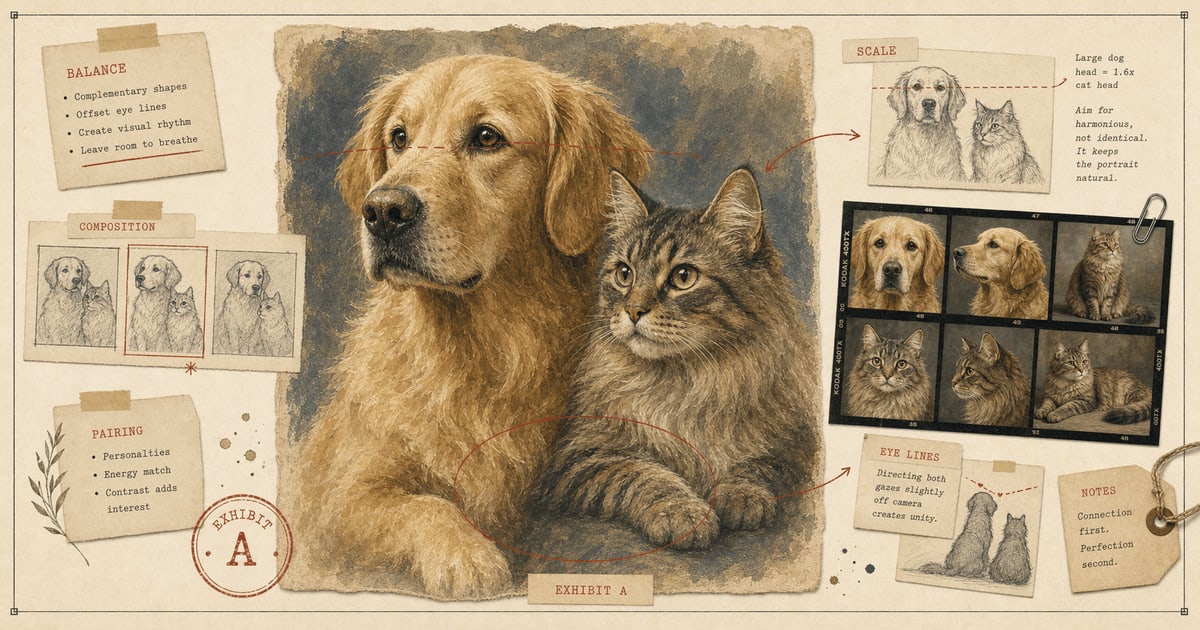
Most multi-pet portrait complications come down to scale, and specifically to the temptation to make both animals the same size because it feels fair.
It is not fair. It is distortion. A Great Dane and a Chihuahua are not the same size. Painting them with equally sized heads produces a portrait that looks wrong in a way that is hard to name but impossible to ignore. It is the visual equivalent of a sentence with a grammatical error: technically intelligible but persistently uncomfortable.
Real-world scale is also not always the answer. If the dog weighs ninety pounds and the cat weighs nine pounds, painting them at exact proportional scale produces a portrait where the cat is a decorative footnote in the corner of a dog portrait. Nobody wanted that.
The practical middle ground: respect the size difference while adjusting the scale enough that each animal has sufficient presence in the composition. The larger animal does not need to shrink dramatically. The smaller animal may need to be positioned or scaled slightly so that they register as equally present. This is what portrait painters have always done with group subjects of different sizes. A child standing next to an adult in a family portrait is not painted at exact proportional scale if exact proportional scale would make the child invisible. The painting finds the version of the scene that lets both subjects be read.
Tell the artist what you want. “Make them about the same apparent size even though the dog is much bigger” is a legitimate instruction. “Keep their real size difference because it was part of their dynamic” is also a legitimate instruction. Either can work. Having no instruction means the artist makes a judgment call that may or may not match your expectation.
Give Each Animal a Role
Stubbs understood this, and it remains true: a group portrait needs a visual hierarchy. That is not a statement about which animal was more loved. It is a compositional fact about how humans read images.
When two subjects share equal prominence, equal size, equal placement, equal expression, the eye does not know where to start. It bounces. The portrait feels inert. When one subject is slightly more prominent (closer, brighter, more forward in the composition) and the other supports or frames them, the portrait has a reading order, and the viewer can inhabit it.
In most multi-pet portraits, the relationship between the animals provides the natural hierarchy. The dominant animal, the older one, the one who was in the household first, the one who sets the emotional tone of the pair often reads as the primary subject. The other animal becomes the companion, which is not a lesser role. Every portrait of a main subject and a companion works because the companion provides context and relationship that the main subject alone cannot provide.
This is also where personality helps the artist. “The cat was the dignified one and the dog was a clown” gives the artist permission to render them with different energies. “They were both elderly and calm” tells the artist something about the register the whole portrait should have. The artist is not making these things up from reference photos. They need the context.
When the Background Needs to Step Back
Two or three animals in a single portrait already create significant visual activity: different fur textures, different sizes and shapes, different markings, different expressions. A detailed background adds more activity to a composition that is already occupied.
Simple backgrounds serve multi-pet portraits better than complex ones. Soft washes, warm neutrals, muted color fields. If a specific location matters, a window, a couch, a favorite blanket, it can be implied rather than reproduced, present as color and light rather than as a fully described scene.
The short version: the more animals, the quieter the background needs to be. This is not a rule that requires justification. It is just how visual attention works.
When Separate Portraits Are the Better Answer
Sometimes the right answer is two portraits rather than one.
If the pets had very different personalities that cannot be resolved into a single mood, if the reference photos are incompatible, or if one animal is being memorialized while the other is still living and the distinction matters to how the family wants to remember them separately, two portraits on the same wall can feel more complete than one portrait that tries to contain both.
Two matching portraits make a strong wall installation. They can share a style, a color palette, a background tone without being a single composition, and they let each animal be the primary subject of their own piece. Gallery walls are built on this logic. It is not a consolation prize. For some households and some relationships, it is the right answer.
What to Send the Artist
For any multi-pet portrait:
- One clear photo of each pet (at eye level, natural light, face readable)
- Any photo of them together, even imperfect
- A note about their relationship (bonded, tolerant, one in charge, both elderly)
- A note about relative scale preference (same apparent size, realistic difference, or somewhere between)
- The mood you want (playful, calm, formal, memorial, funny)
If you have a photo where one pet looks perfect and another where the coat color reads better, say that. The artist can take the expression from the first and the color accuracy from the second.
Digital portraits start at $24.99, with proofs in 2 to 3 business days and unlimited revisions. Start your order here.
When you place the order, the notes box is where the real portrait gets made. The artist can handle the balance, the spacing, and the small diplomatic challenge of making a cat and a dog look like they agreed to share the same frame. They have done it before. They just need to know who these particular animals were to each other.
Sources
- Judy Egerton, George Stubbs, Painter, Yale University Press, 2007.
- Svetlana Alpers, The Art of Describing: Dutch Art in the Seventeenth Century, University of Chicago Press, 1983.
Welcome perk
Free expedited delivery on your first portrait
Get your digital proof in 1-2 business days instead of 2-3, free on your first portrait. Normally a $10 upgrade.
No spam. Just the perk and the occasional new style or guide.
Check your inbox for your code.