
Archaeologists have found bronze collars from ancient Rome inscribed with the owner’s name and address, essentially the first ID tag, so that if the dog got loose, whoever found it knew where to return it. One collar from the 2nd century reads, in Latin: “Hold me so I do not run away, and return me to my master.” A dog wearing that was identified, claimed, and attached to a specific household by a small piece of metal. The collar was not decoration. It was evidence of belonging.
Dog and cat collars have worked this way throughout recorded history. Medieval hunting dogs wore elaborately tooled leather collars, sometimes with metal spikes to protect against wolves, sometimes embossed with the name of the estate they served. 17th-century aristocratic families had their dogs’ collars painted into portraits alongside the animals, because the collar communicated status and ownership in a way that was understood by everyone who would see the work. Portraits of hunting dogs hung in manor houses with the collars clearly visible, because the collar said: this animal is ours, it is known, it belongs here.
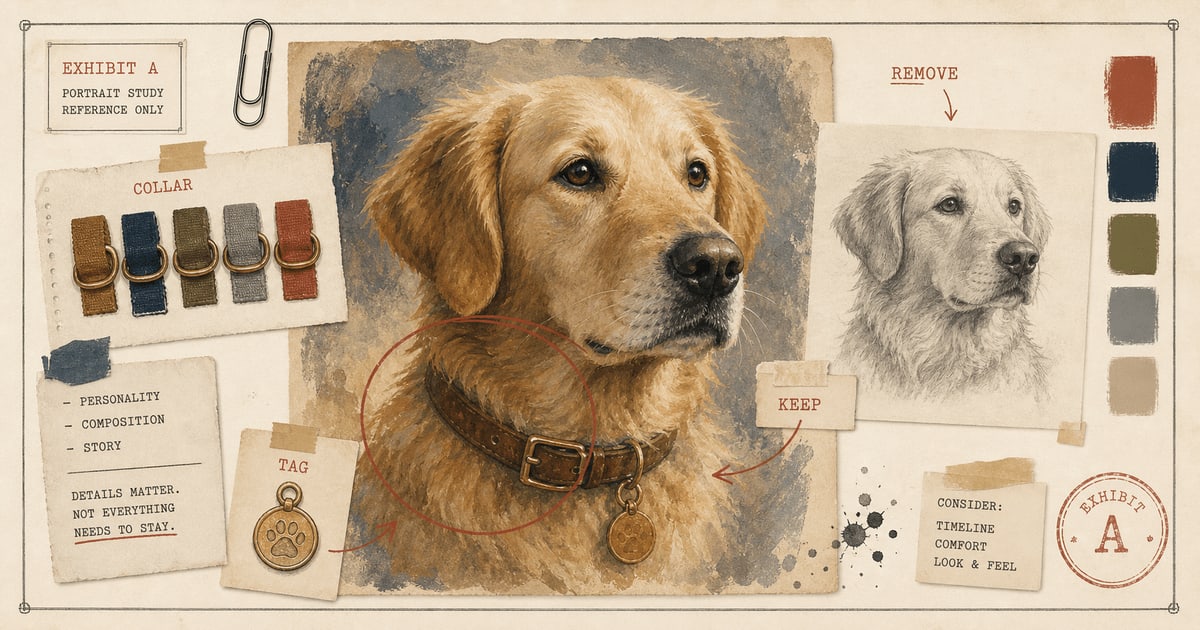
The question of whether to include a collar in a modern pet portrait is, at its core, the same question those 17th-century painters were answering. What does the collar communicate, and does that communication strengthen or complicate what you want the portrait to do?
The Collar as Identity
Some pets are almost never seen without their collar. It becomes part of their silhouette. The red collar on a black lab. The worn leather collar on an old golden retriever. The little bell on a cat that everyone hears ten seconds before they see.
If the collar is part of how the family sees the animal, removing it from the portrait can make the portrait feel slightly wrong. Not wrong in an obvious way. Wrong in the way that a photo of someone you know is slightly wrong when they are wearing a shirt you have never seen them in. The shape is right but something is missing.
This is especially true for memorial portraits. When someone is gone, the details of their daily life become important in ways that would have seemed disproportionate before the loss. The tag with the name on it. The specific color of the collar. The small bow or bandana they wore every day. These are not decorative elements. They are how the animal existed in the world, and a portrait that includes them is a portrait that is actually paying attention to that particular animal rather than a generic version of the breed.
Keeping the collar makes sense when:
- It is the first thing you picture when you picture the pet
- The color works with the coat and does not compete with the face
- The tag has emotional significance (and especially for memorial portraits, the name tag often does)
- The collar is worn and particular, meaning it has clearly been this animal’s collar rather than a fresh generic one
- The portrait is a memorial piece and the collar is tied to memory
When the Collar Works Against the Portrait
The face should win. Every compositional decision in a portrait is subordinate to the face, because the face is where the animal lives: the eyes, the expression, the markings, the particular quality of personality that makes this cat different from other cats and this dog different from other dogs.
If the collar competes with the face, it needs to go or be simplified.
The common offenders: bright neon harnesses that are louder than anything else in the reference photo. Wide, patterned collars that cut across the chest and interrupt the fur. Reflective clip hardware that catches light and drags the eye down and away from the expression. Collars that are twisted or bunched in the photo. Harnesses with extensive hardware that make the dog look like they are wearing equipment rather than having their portrait painted.
A portrait is not a documentation of everything the animal owned. The harness may be practical and present in daily life without being part of what the portrait is trying to capture. There is no rule that says everything in the reference photo has to make it into the final work.
Remove or simplify the collar when:
- It pulls the eye away from the face
- It clashes with the palette or the style
- It covers important markings that identify the animal
- It is clearly gear rather than identity
- The portrait is meant to feel timeless and the collar would date it in a way you do not want
This comes up specifically with harnesses. Harnesses are functional objects and many dogs wear them on every walk. They are also often visually busy in ways that collars are not. A simple collar hugs the neck and stays relatively contained. A harness distributes across the chest and shoulders. Painted at full detail, it can become the loudest element in the portrait. For most family portraits, that is not the goal.
Tags Are Their Own Question
A collar can be simplified or removed while its tag stays. The name tag in particular carries emotional weight that the collar hardware does not. Small, specific, often engraved with just a name and a phone number, the tag was the piece of the collar that most directly identified the animal as a specific individual belonging to a specific family.
For memorial portraits, a name tag is a quiet anchor. It does not dominate the composition. It does not demand attention. But it is there, and people who loved the animal will notice it.
Be realistic about scale. If the tag is small in the reference photo, the artist may not be able to reproduce the engraved text clearly. That is physics, not lack of devotion. If you want the name legible, say so in the order notes, and the artist can make a judgment about whether it works at the portrait’s scale. Some portrait dimensions accommodate this. Some do not.
How Each Style Handles Collar Detail
Watercolor portraits work best when collar detail is softened. The medium’s strength is luminous washes and soft edges, and a high-contrast collar with hard edges can feel like it belongs in a different painting. An artist can keep the color and general shape of the collar while removing the visual sharpness that makes it compete.
Oil painting portraits can carry richer collar detail. The medium handles dark leather, metal hardware, and textural contrast well. If the collar is part of the portrait’s story, oil is the format where it can hold its own without disrupting the composition.
Pencil sketch portraits benefit from collar simplicity. The strength of pencil work is line and tone, and a complex harness with multiple straps introduces competing lines that dilute the drawing’s focus. A simple collar rendered in a few clean lines can work. Extensive hardware usually does not.
Pop art portraits can embrace a bold collar as part of the graphic statement. If the animal has a bright collar and the palette is working with strong color contrasts, the collar can contribute rather than distract. This is the one style where a neon harness might belong.
Surrealist portraits can go either direction. A collar grounds the animal in the domestic world and can function as a visual anchor that makes the rest of the portrait’s departures feel intentional rather than disorienting. Removing it pushes the portrait further into the timeless and the strange. Both choices are defensible depending on what the portrait is trying to do.
For Memorial Portraits
The collar question is more charged when the pet is gone.
Some people want the collar in the portrait because removing it would feel like removing a piece of who the animal was. Others want it removed because the portrait is meant to feel soft and eternal rather than tied to the daily equipment of a life that has ended. Both instincts are legitimate.
If you are ordering a memorial portrait as a gift and you are uncertain, keep the portrait simple. A softened collar or small tag usually works. A complex harness that was purely functional rarely needs to be preserved in oil paint unless it was somehow part of the animal’s personality, which harnesses rarely are.
The honest answer to the collar question, for memorial portraits and for portraits generally, is this: include what belongs to the animal, not what was attached to them. If the collar was part of who they were in your memory, it belongs. If it was just something they wore because of local leash laws, the portrait does not owe it anything.
What to Put in the Order Notes
You do not need to resolve the entire art direction before placing the order. A single sentence in the notes is enough. The artist can work from there.
Useful note formats:
- “Please keep the red collar, it was his.”
- “Remove the harness, keep the collar.”
- “Include the name tag if it fits naturally, skip the rest of the hardware.”
- “Memorial portrait, please keep her tag. The collar itself can be softened.”
- “Completely remove the collar, I want it clean and timeless.”
If you genuinely do not know what you want, say that. “Not sure about the collar, please use your judgment based on the composition.” The artist will make a decision, and if the proof is not quite right, unlimited revisions are included.
Welcome perk
Free expedited delivery on your first portrait
Get your digital proof in 1-2 business days instead of 2-3, free on your first portrait. Normally a $10 upgrade.
No spam. Just the perk and the occasional new style or guide.
Check your inbox for your code.