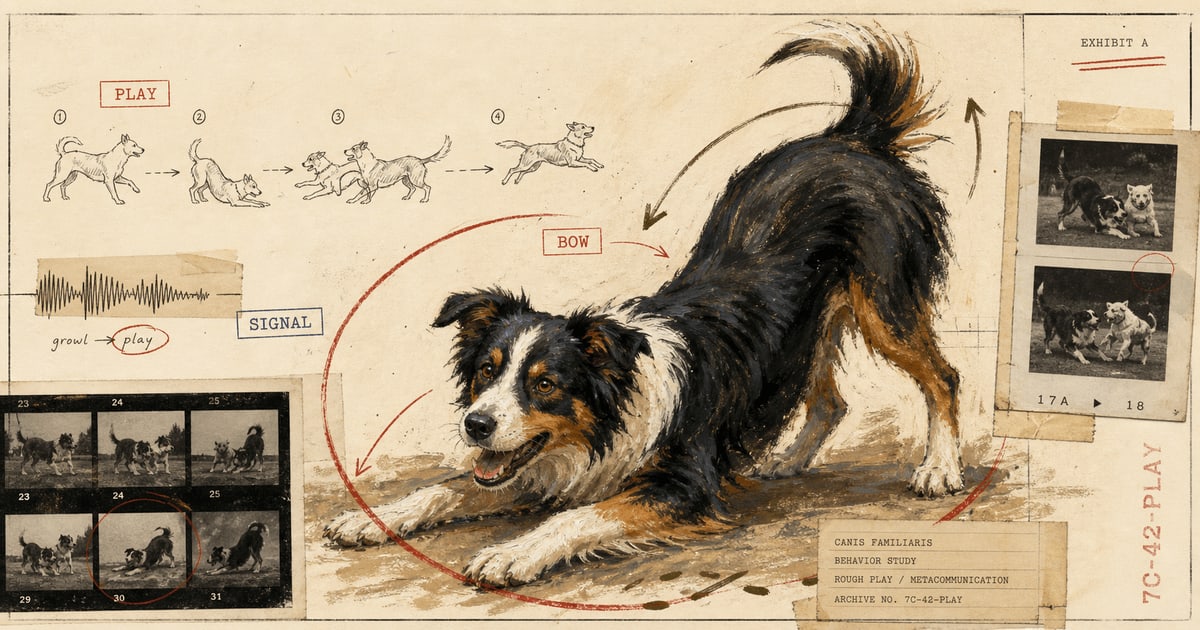
In 1977, ethologist Marc Bekoff published a paper in Science describing what he called a stereotyped mammalian display in canids. He had been watching dogs, wolves, and coyotes at play, filming and analyzing the sequences, and what he noticed was that a particular posture appeared at specific moments in the interaction: front legs extended, chest near the ground, hindquarters elevated, tail active.
The posture was consistent. It appeared not randomly but at predictable junctures. It preceded certain actions and followed others. And it seemed to function as something like communication, not between the dog and a human observer, but between the dogs themselves.
He called it the play bow.
If you have a dog, you already know the posture. What you may not have considered is why it works.
The Problem with Playing at Biting
Dogs at play do genuinely alarming things.
They bite. They shake each other by the scruff. They chase, tackle, pin, and roll. They growl. They snap. They grab legs and necks and ears. Any of these behaviors, in a different context, would be conflict. In play, they are the game. The challenge for the dog is that its play partner needs to know the difference, in real time, with no time to think about it.
This is the core problem that the play bow solves.
Bekoff’s 1995 study in the journal Behaviour, titled “Play Signals as Punctuation,” looked specifically at the temporal placement of play bows relative to the riskiest action in the play repertoire: the bite-shake. The bite-shake involves biting and then rapidly shaking the head side to side while maintaining the bite. In predatory and agonistic contexts, it is serious. In play, it is common and apparently fine with everyone involved.
Bekoff found that play bows appeared nonrandomly in relation to bite-shakes. They clustered before and after this particular action. The bow was functioning as a frame, signaling that what was coming, or what had just happened, was inside the play context and not a statement about intent to do harm.
He examined this across three species: domestic dogs, infant wolves, and infant coyotes. The pattern held for all three, with some species-specific variation. Coyotes, whose “standing-over” behavior is a genuine dominance assertion in their species (unlike in beagles or wolves of similar age), showed significantly more bowing after that action, as if the coyote were doing extra clarification work. The posture is apparently context-sensitive across species: the more ambiguous the preceding action, the more often the bow appears.
This is what Bekoff meant by punctuation. The bow does not just mean “I want to play.” It means “what I am doing, or what I just did, belongs to play, not to the other thing.”
Self-Handicapping and Why It Matters
There is a second thing the bow does, which Bekoff and others have observed and which more recent researchers have examined in adult pet dogs.
When a dog bows, its head goes below the level of the other dog’s head. This puts the bower in a physically vulnerable position. A dog at full height, attacking downward, has a significant mechanical advantage. A dog with its chest near the ground and its head low does not.
This is deliberate. Or at least: it appears to function as a deliberate signal.
Researchers call this self-handicapping. In play behavior research, self-handicapping refers to an animal placing itself at a disadvantage in order to maintain play, typically to signal that it is not a threat. Larger or stronger dogs handicap themselves in play with smaller or weaker ones. They roll over. They bite more gently than they could. They slow their chase speed. The point is not charity but communication: “I am capable of hurting you and I am choosing not to.”
The play bow does this structurally. The posture itself is the handicap. The bower is not just saying “play,” it is demonstrating non-threat through physical vulnerability. The combination of those two signals, the declared intent and the demonstrated non-threat, makes the play bow unusually readable.
That readability is why it works across species.
Dogs Use It With Humans
Dogs bow at humans.
They also bow at other species: cats, in some documented cases, and humans reliably. This is worth pausing on. The play bow evolved in a canid social context. It is shaped by canid body language, canid visual perception, and canid social structure. It should, by rights, be primarily legible to other canids.
And yet dogs use it with humans without modification.
There are a few explanations for this. One is that dogs have been co-evolving with humans for somewhere between 15,000 and 40,000 years, depending on the study, and have undergone significant selection for social communicability with humans in that time. Dogs are unusually attentive to human gaze, human pointing, and human emotional displays. The play bow directed at a human may be an extension of that general social attentiveness: use the signal that works, regardless of who the recipient is.
Another explanation is simpler: it works. Dogs who bow at humans get play. Natural selection does not require understanding. It requires outcomes.
More recent research on adult pet dogs by Bradshaw, Pullen, and Rooney (2015) found that adult dogs use play bows primarily to reinitiate play after a pause, rather than exclusively as a pre-action clarifier. Their data suggested the punctuation function is especially pronounced in puppies and young dogs, while adult dogs may use bowing more broadly, including as an invitation to restart after a break. This is consistent with what most dog owners observe: the bow after a pause, the sudden drop into position after both dogs have been sniffing around separately, the invitation broadcast to whatever is nearby.
Patricia McConnell, the applied animal behaviorist, has written about a variation she calls the “prey bow,” in which the posture looks similar but is oriented toward a small animal or object being stalked. The front-down position facilitates the visual tracking involved in predatory approach. This is a different functional context using the same general body configuration. Dogs apparently have no difficulty keeping them straight; humans sometimes do.
What Makes a Good Play Partner
The play bow is a signal, not a guarantee.
Good play requires partners who are matched enough in play style that the interaction stays reciprocal. One dog bowing repeatedly while the other stands stiff and avoids eye contact is not the beginning of a game. Mutual bowing, loose body movement, role switching (the chaser becomes the chased), and brief pauses followed by re-engagement are all signs of genuine play.
The bow gets the sequence started. Everything else has to hold it together.
There is something genuinely sophisticated in this, even if “sophisticated” feels like the wrong word for animals who will also eat random things off the sidewalk. The ability to maintain a shared understanding of context, to signal play intent, to read that signal in another animal, to self-handicap voluntarily in order to keep the game going: this is a small set of social cognitive operations. It does not require language. It does not require theory of mind in any strong philosophical sense. But it requires something.
Research in comparative cognition has spent considerable effort trying to characterize what dogs understand about play versus conflict, versus simply responding to context. The honest answer is that this remains genuinely open. What is clear is that the signals work, the sequence is structured, and dogs have been maintaining these play games with each other, and with humans, long enough that neither side seems confused about what it means.
Why the Bow Makes Good Art
A dog in a play bow has something that a seated dog does not: visible intention.
The pose is a statement. The body is mid-communication. Front legs extended on the floor, rear elevated, tail active, eyes up. The whole animal is organized around a message, and the message is legible even to people who have never thought about ethology or play signals.
For a portrait, that means personality is built into the geometry. You do not need to explain the dog. The bow explains itself.
It is also one of the rare action poses where the face stays accessible. In a running photo, the face is often turned away or blurred. In a leap, the body dominates. But in a bow, the head is forward and usually visible from the front or three-quarter angle. You get body shape, ear position, eye expression, and energy at the same time.
If your dog has a distinct play style, a particular enthusiasm for certain games, or an exuberant personality that seated photos do not quite capture, the bow is worth trying. Use a toy, a familiar voice, or whatever reliably sends your dog into play mode. Shoot at dog level. Use burst mode. Expect to take a great many photos before getting one that shows the face clearly while the body is still in the bow position, because dogs do not pause for composition.
The bow lasts about one second, if you are lucky. Work with it.
A portrait made from a play bow reference tends to have something that polished posed portraits sometimes lack: the sense that the dog is actually present in it, doing the thing they do, communicating directly.
That is what Bekoff was noticing in 1977. The bow is not incidental. It is the dog saying something.
Sources
- Marc Bekoff, “Social communication in canids: Evidence for the evolution of a stereotyped mammalian display”, Science, 1977.
- Marc Bekoff, “Play Signals as Punctuation: The Structure of Social Play in Canids”, Behaviour, 1995.
- John W. S. Bradshaw, Anne J. Pullen, and Nicola J. Rooney, “Why do adult dogs ‘play’?”, Behavioural Processes, 2015.
- Horowitz, A. and Bekoff, M. “Investigating the function of play bows in adult pet dogs (Canis lupus familiaris)”, Behavioural Processes, 2016.
- Patricia McConnell, “A New Look at Play Bows”, The Other End of the Leash, 2016.
Welcome perk
Free expedited delivery on your first portrait
Get your digital proof in 1-2 business days instead of 2-3, free on your first portrait. Normally a $10 upgrade.
No spam. Just the perk and the occasional new style or guide.
Check your inbox for your code.