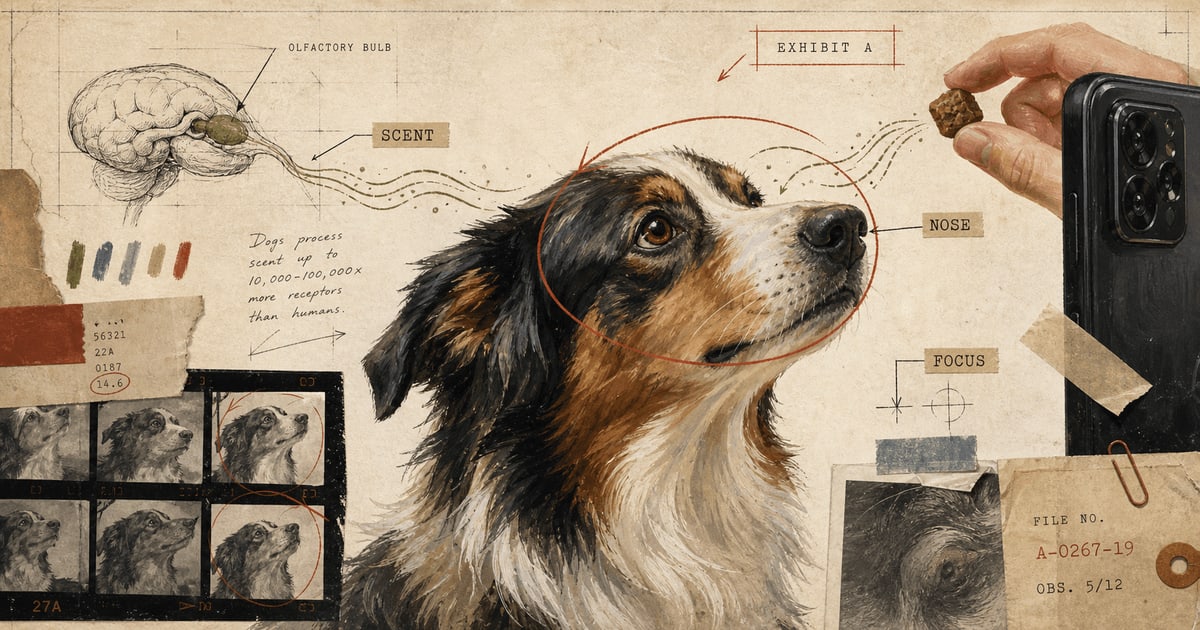
A dog’s nose contains approximately 300 million olfactory receptors. A human nose contains about 6 million. The part of the dog’s brain devoted to analyzing smell is, proportionally, 40 times larger than the equivalent region in the human brain. Researchers at the University of Florida have estimated that dogs can detect odors at concentrations somewhere between 10,000 and 100,000 times lower than a human can. Alexandra Horowitz, the cognitive scientist who runs the Dog Cognition Lab at Barnard, has written that if you could smell what a dog smells walking into a kitchen, it would be something like the difference between noticing a painting on a wall and reading every brushstroke, color origin, and canvas texture simultaneously.
None of this is abstract when you are trying to get one clean photo and you have said the dog’s name seventeen times in ninety seconds.
The name is not working because it is not the sharpest tool in the box. It is not even in the top five. You have a 300-million-receptor instrument at the end of that dog’s face, and your media strategy is repeating a sound they hear sixty times a day.
“Bailey. Bailey. Bailey. Over here. Bailey. No. Bailey.”
By repetition twelve, the dog has not gone deaf. They have simply reclassified the sound. It started as a signal. It is now weather. Background noise. A thing that happens when the human gets strange around the small rectangle.
The Habituation Problem
The technical name for what happens to an overused cue is habituation. A stimulus presented repeatedly without consequence gradually loses its power to produce a response. This is one of the most basic and well-documented phenomena in animal learning, and it happens to dog names constantly, in households everywhere, because the name gets used for everything: breakfast, walks, correction, praise, strangers saying hello, owners narrating their own lives at the dog.
Alexandra Horowitz notes in Inside of a Dog that the name only retains its force when it predicts something useful. Say it before a meal, before a walk, before a game, and the dog listens with anticipation. Say it before nothing in particular, forty times a day, and it becomes ambient sound. A verbal screensaver.
The photo session makes this worse. The human is stressed. The phone is out. The dog can read human stress with accuracy that would unnerve most therapists, and it shifts their behavior accordingly. The whole gestalt says: something uncomfortable is happening involving the rectangle. The name, in this context, is one more data point in the category of “situation is weird, I should investigate the perimeter.”
You need something that cuts through.
For most dogs, that means scent.
Why Scent Works Differently
A 2021 paper in Scientific Reports by Juliane Brauer and Damian Blasi looked at dogs’ olfactory expectations of their owners. The study found that dogs form specific olfactory representations of the people they know and rely heavily on scent when recognizing individuals and orienting to their environment. A dog recognizes you by smell before they recognize you by sight or sound. The nose is the primary channel.
This does not mean verbal cues are useless. A 2016 paper in Science by Attila Andics and colleagues showed that dogs process words and the intonation of words in different brain hemispheres, suggesting a meaningful degree of lexical understanding. The word “well done” activates a different neural response than a neutral word, and the combination of a praise word and a praising tone activates the brain’s reward center. Dogs can understand words. They just hear them differently than we imagine, and they hear them through a lot of competing signal.
Scent is harder to habituate to. A high-value smell arrives new every time. The nose goes up. The eyes follow. The expression opens. You have about two seconds.
That is the window.
How to Use It Without Creating a Scene
The mistake is waving the treat. A treat waved near a dog’s nose at close range produces jumping, spinning, forward motion, and the specific facial expression of a dog who has just realized there is a deal available. That is not a portrait face. That is negotiation face.
The technique is quieter:
Hold the phone at the dog’s eye level. Hold a small piece of high-value food (freeze-dried liver, chicken, cheese, whatever this particular dog considers worth interrupting their schedule for) just above or just beside the camera lens. Not in front of the lens. Not waving. Stationary, about two inches from the glass.
Let the dog smell it. Pull it back to the lens position. The eyes will track upward toward the camera. That is the moment. Take the photo, then reward immediately.
One repetition yields one to three shots. After that, take a break. The loop of smell, look, reward can repeat, but spacing it gives the nose time to reset and keeps the dog from learning to expect the pattern and get ahead of it.
For dogs who lunge, use two people. One operates the camera. The other stands beside the camera holding the treat at eye level. The dog orients toward the treat and the lens simultaneously. The cameraperson takes the photo while the dog holds that look.
What the Expression Looks Like
A treat held at eye level near a camera tends to produce an alert expression: ears forward, eyes bright, head lifted, mouth closed or softly open. This is often an accurate expression for the dog. Many dogs live in a state of interested attention, and the treat just makes that state visible.
For some dogs, food produces too much intensity. The eyes get hard. The face loses softness. There is drool. The portrait reference starts to look like a hostage situation over cheddar.
If that happens, use a lower-value scent or a familiar toy instead of food. The goal is not maximum excitement. The goal is soft, present attention. A toy that the dog likes but is not frantic about can produce that better than an extremely desirable treat for a dog with a food obsession.
You can also take the photo slightly after the reward rather than right at the moment of anticipation. Wait until the dog is relaxed and mildly interested rather than vibrating with expectation. The residual alert expression, with the anticipatory tension removed, often reads better in a portrait.
When Sound Is Better Than Scent
A single novel sound can work when food creates too much energy.
The key word is novel. A whistle the dog has heard a thousand times is the same problem as the name: it becomes part of the auditory wallpaper. An unusual sound, used once, can produce a sharp head tilt, perked ears, and a direct look. A soft kiss noise. A new squeaker. A word in a foreign language. Anything the dog has no training history around.
Use it once. Take the photo. Stop. If you use it twice in a row, the habituation process begins again in miniature. The dog’s brain categorizes it as “that sound that follows the rectangle” and preprograms itself to care slightly less next time.
Some dogs are noise-sensitive. A loud or sudden sound in a photo session will produce the wrong kind of alert face: tight eyes, lowered ears, tension across the jaw. Know your dog. If they are sensitive to sound, stay with scent. If scent creates chaos, try sound at lower volume from a distance.
The method is not the point. The expression is the point. Use whatever produces the face that belongs to that specific dog.
What the Artist Needs From This
A portrait reference photo is doing one job: giving the artist the structure and expression they need to paint your pet accurately. Eyes visible, face clear, markings readable, expression real. The backstory of how you obtained it is not part of the file.
The Andics brain-scan research is interesting precisely because it shows that dogs hear words in a sophisticated way, yet still struggle to perform the one-second sustained look that a camera requires. That is not an intelligence failure. It is a mismatch between what the camera needs (stillness, duration, eye contact) and what a dog naturally does in response to being looked at (reciprocate the gaze for a moment, then investigate the hands, the floor, the interesting sound from outside).
You are not trying to override the dog. You are trying to briefly align your needs with their existing behavior. The nose comes up toward food. The eyes follow the nose. The camera is already there. The reward arrives. The dog logs it as: small rectangle, usually boring, sometimes associated with excellent chicken.
The name will still be useful for everything else.
For the portrait session, put the liver near the lens and let the nose do the recruiting.
Sources
- Juliane Brauer and Damian Blasi, “Dogs display owner-specific expectations based on olfaction”, Scientific Reports, 2021.
- Attila Andics et al., “Neural mechanisms for lexical processing in dogs”, Science, 2016.
- Alexandra Horowitz, Inside of a Dog: What Dogs See, Smell, and Know, Scribner, 2009.
- Nicky Shaw et al., “Domestic dogs respond correctly to verbal cues issued by an artificial agent”, Applied Animal Behaviour Science, 2020.
- E. F. Hiby, N. J. Rooney, and J. W. S. Bradshaw, “Dog training methods: their use, effectiveness and interaction with behaviour and welfare”, Animal Welfare, 2004.
Welcome perk
Free expedited delivery on your first portrait
Get your digital proof in 1-2 business days instead of 2-3, free on your first portrait. Normally a $10 upgrade.
No spam. Just the perk and the occasional new style or guide.
Check your inbox for your code.