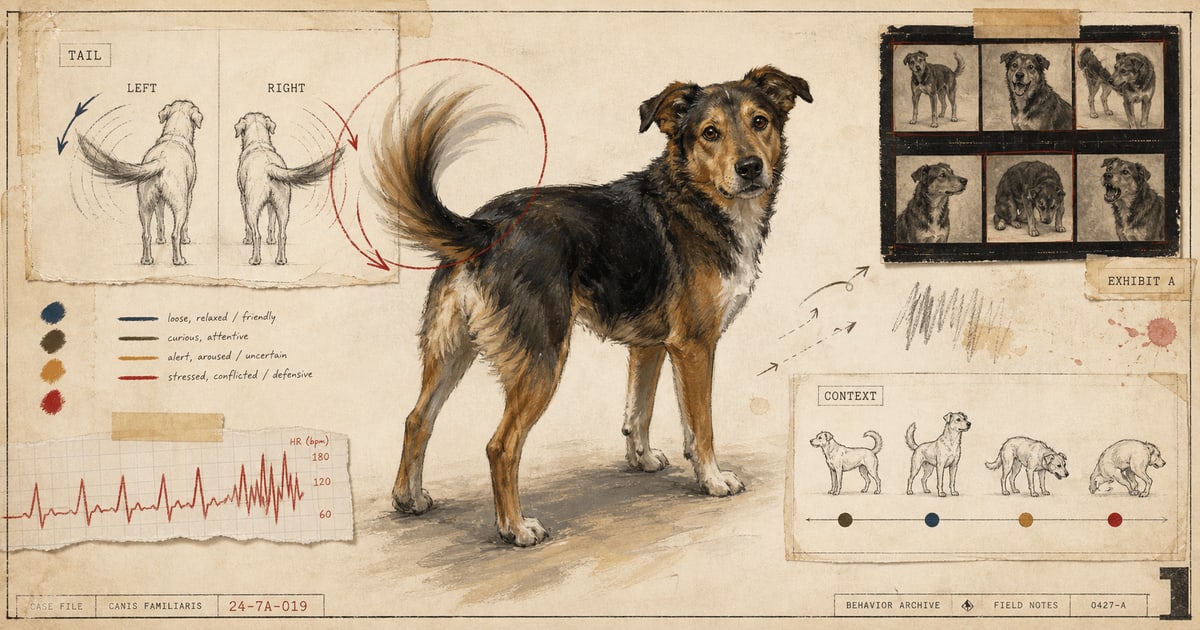
In 2007, researchers at the University of Bari in Italy strapped motion-capture equipment to dogs and filmed them reacting to four different stimuli: their owner, an unfamiliar human, a cat, and an unfamiliar dominant dog. What they found was not that dogs wag more for some things than others, though that was also true. What they found was that the tail moved in a different direction depending on what the dog was looking at.
When dogs saw their owner, the wag skewed to the right, toward the dog’s right side. When they saw the unfamiliar dominant dog, the wag skewed to the left.
The researchers, Angelo Quaranta, Marcello Siniscalchi, and Giorgio Vallortigara, published this in Current Biology in 2007. They followed up in 2013 with a second study that was, if anything, stranger: they showed those asymmetric wags back to dogs. Dogs watching another dog wag to the left became anxious. Heart rate elevated. Stress behaviors increased. Dogs watching a right-biased wag stayed calm.
The tail wag contains lateralized emotional information. Other dogs can read it. They probably always could. Humans have been missing it.
Why Left and Right Are Not the Same
The left-right asymmetry of the tail wag is not random. It reflects a property of vertebrate nervous systems that has been documented across many species: the two hemispheres of the brain tend to specialize for different emotional valences.
In the rough general version: the left hemisphere, which controls the right side of the body, is associated with approach motivation and positive affect. The right hemisphere, which controls the left side of the body, is associated with withdrawal motivation and negative affect. This is not a perfect binary, and it has exceptions, and neuroscientists spend a great deal of time complicating it, as is their function. But the general pattern holds broadly enough that researchers use it as a framework.
In dogs, when the left hemisphere is more active (positive, approach state), the tail tends to swing more to the dog’s right. When the right hemisphere is more active (negative, withdrawal state), the tail tends to swing more to the dog’s left. The tail is, in this sense, a readout of relative hemispheric activation, produced by the muscles that control it, which are innervated asymmetrically.
The 2013 study by Siniscalchi, Vallortigara, and colleagues used dog-shaped silhouettes with a motorized tail set to wag either left-biased or right-biased, at the same speed and amplitude, so the only variable was direction. The dogs watching left-biased wags showed significantly higher heart rates and significantly more anxious behavior than those watching right-biased wags. The dogs were, in other words, reading information from the direction of the wag that they then used to regulate their own physiological state.
This is not a small finding. It means the tail is a more sophisticated communicative instrument than “happy” or “not happy.” It carries emotional valence information encoded in laterality, readable by conspecifics, probably invisible to most human observers looking at a wag.
The Other Variables: Height, Speed, and Stiffness
The left-right asymmetry is only one dimension. The tail’s height, speed, and stiffness each carry additional information.
Height is probably the most practically legible variable, at least to human observers. A tail carried high, particularly above the line of the back, is associated with arousal and confidence. A tail carried low or tucked is associated with fear, submission, or appeasement. The breed’s natural tail carriage matters here: a Basenji’s tail curls over the back as its neutral position, which is different from a Labrador’s natural carry. You need a baseline for a specific dog before tail height tells you much.
Speed indexes arousal generally. Fast wags indicate high arousal. Slow wags indicate lower arousal, often uncertainty or caution. But arousal is not the same as positive emotional state. A dog can be highly aroused in a stressful or aggressive situation. A fast wag attached to a stiff body, hard eyes, and a closed, tight mouth is not the same as a fast wag attached to a loose, wiggly body and open relaxed mouth. Speed gives you intensity; the rest of the body gives you valence.
Stiffness is its own signal. A tail moving in small, tight, rapid arcs at high elevation, with the rest of the body rigid, is a warning configuration regardless of direction or speed. The whole dog is braced. The tail is a flag, not a greeting. This is the configuration people misread most often, because “tail wagging” gets processed as a category that means one thing, and the body’s other signals do not override the category label quickly enough.
The Full-Body Problem
The reason people misread tail wags is that they evaluate the tail as a stand-alone signal rather than as one variable in a system.
Dogs communicate with their entire body simultaneously. Ears, eyes, mouth, body tension, weight distribution, tail height, tail motion, hackle position: all of these are active at once, and they are partially redundant (several signals often point in the same direction) and partially independent (some signals can contradict others in ways that indicate ambivalent or mixed emotional states).
A dog approaching with a loose, wiggly body, soft eyes, an open mouth, and ears relaxed or slightly back, with a tail sweeping in large arcs, is communicating something different than a dog approaching with stiff body, hard eyes, closed mouth, and a tail held high moving in tight fast arcs. Both dogs have wagging tails. Only one of them is the dog you want to reach down and pet without thinking about it first.
The error humans make is applying a simple rule (tail up equals happy, tail down equals sad, tail wagging equals friendly) to a system that has no simple rules. The dog does not have one channel of communication. It has several operating in parallel, and reading them together is the actual skill.
This same principle applies to photos. A still image captures all the signals simultaneously, which means a photo of a dog with a wagging tail may contain a great deal of other information that tells a more complicated story than the wagging implies.
Reading a Photo for a Portrait
If you are selecting a reference photo for a pet portrait, look at the dog’s whole body, not just whether the tail is up.
A few things to check. Are the eyes soft, with relaxed muscles around the socket, or are they hard, with tension above and around them? Is the mouth open and loose, or closed and tight? Are the ears in the dog’s natural relaxed position, or are they pinned flat or pulled sharply forward? Is the body weight distributed evenly, or is the dog bracing, shifting back, or leaning forward with tension?
These details survive in a portrait. An artist painting from a reference photo does not automatically correct tension that is present in the image. If the dog in the photo is stressed, uncertain, or in a high-arousal state that reads as alertness rather than ease, some of that will likely show in the finished piece.
The goal, for most people commissioning a portrait, is a dog who looks like themselves: their specific dog in a state that captures who they are at their best or most characteristic. For most dogs, that is not the anxious-wag, it is the easy full-body wag with the soft face and the whole rear end involved.
Some dogs, of course, are perpetually high-arousal, or are best captured mid-alert, or have a quality of intensity that is exactly their character. In those cases, send that photo. The portrait should reflect the dog.
But it is worth asking, before you choose, whether the tail in the photo is telling the story you want.
When the Tail Is the Story
For certain dogs, the tail is an essential part of the likeness.
The plume tail of a Samoyed or a Chow, raised and carried like a statement. The question-mark curl of a Shiba Inu. The ridiculous helicopter rotation some dogs achieve when extremely happy, in which the tail appears to be piloting the dog rather than attached to it. The tiny stub wag of a docked breed, where the whole rear end compensates for the reduced tail mass. The full-body wag in which the spine participates entirely and the dog essentially wags themselves from the shoulder blades back.
If the tail is part of the dog’s signature, consider a pose and framing that includes it. A bust portrait stops at the shoulders. A three-quarter or full-body portrait gives the tail room. For a dog where the tail is always in motion or has a distinctive shape or carriage, that inclusion matters.
Video is genuinely useful here. A short clip of your dog at rest, playing, or greeting you gives the artist reference for the tail’s natural position, motion, and shape that a still photo often cannot provide. A still photo captures one instant of a motion. The artist benefits from knowing what the tail looks like across several instants.
The Siniscalchi and Vallortigara work, taken together, suggests that what dogs are doing with their tails is more legible than it looks, at least to other dogs. The left-right asymmetry, the height, the speed, the stiffness: these are not decorations. They are information that other dogs process and respond to physiologically.
That is a tail worth understanding, and, for the right portrait, worth including.
Sources
- Marcello Siniscalchi et al., “Seeing Left- or Right-Asymmetric Tail Wagging Produces Different Emotional Responses in Dogs”, Current Biology, 2013.
- Angelo Quaranta, Marcello Siniscalchi, and Giorgio Vallortigara, “Asymmetric tail-wagging responses by dogs to different emotive stimuli”, Current Biology, 2007.
- VCA Hospitals, “What Your Dog’s Tail Is Saying” (overview of tail height, speed, and context)
- Humane Society of Missouri, “Interpreting Tail Wags in Dogs” (behavioral context)
- ScienceDaily, “Dogs know a left-sided wag from a right” (summary of 2013 research)
Welcome perk
Free expedited delivery on your first portrait
Get your digital proof in 1-2 business days instead of 2-3, free on your first portrait. Normally a $10 upgrade.
No spam. Just the perk and the occasional new style or guide.
Check your inbox for your code.