Here is what a standard pet photo session looks like from the outside: one human crouching on the floor, phone extended, saying the dog’s name with progressively more theatrical inflection. “Biscuit. Biscuit. Over here. Good boy. Wait. Biscuit. HERE. No, up here. BISCUIT.”
Here is what it looks like from the dog’s perspective: someone is acting strange near the rectangle again. The name, which they have heard approximately eight hundred times this week, is happening more than usual. The human looks tense. There is no clear job available. The perimeter seems fine. Maybe investigate the corner.
The problem is not the dog’s attention span. The problem is that being called by name in a vague situation, with no specific task attached, is a low-information cue. Dogs learn through consequences. A behavior that produces a reliable, good consequence gets stronger. A sound that produces nothing in particular gets quieter in the brain’s hierarchy, which is exactly what happens to a name used constantly for everything from breakfast to “stop eating that.”
There is a cleaner method. It takes about fifteen minutes to teach and produces good portrait reference photos indefinitely.
What Nose Targeting Is and Why It Works
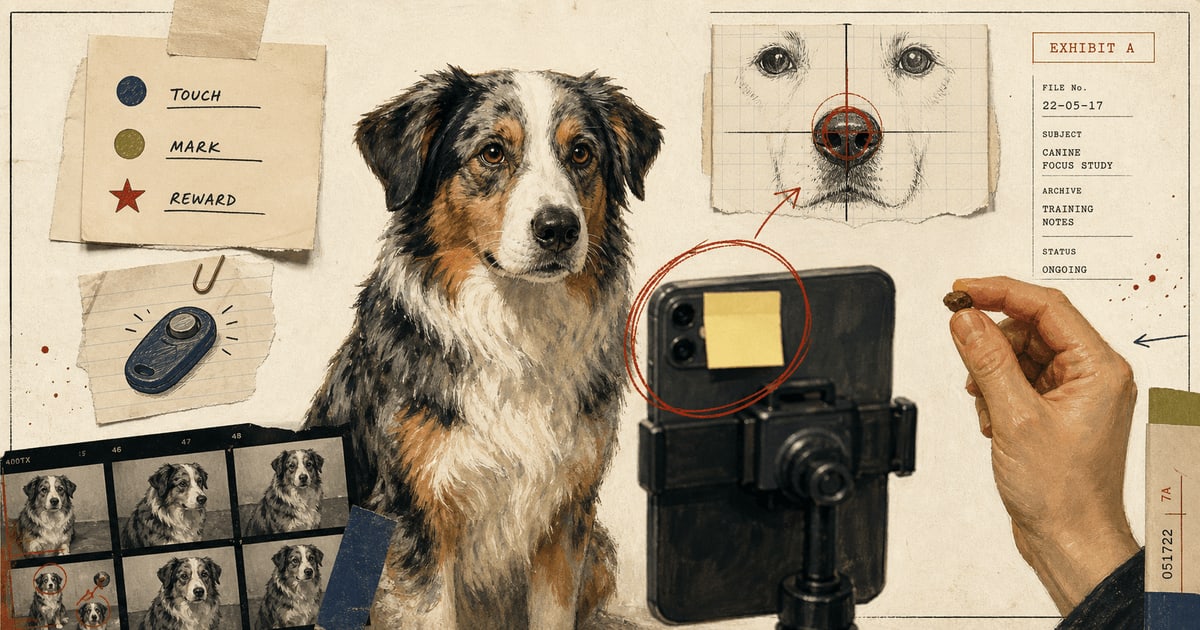
A nose target is a trained behavior: the dog touches a specific object with the tip of their nose, a hand, a lid, a sticky note, in exchange for a reward. Once taught, it can be cued reliably and applied to specific locations in the environment.
The learning mechanism here is operant conditioning, specifically positive reinforcement. The dog offers a behavior, a marker (a word like “yes,” or a clicker) fires the instant the behavior occurs, and a reward follows. The marker is important because it tells the dog precisely which moment earned the reward. Without a marker, the dog has to infer which of the forty things they did in the last five seconds was the one you wanted. With a marker, the link is specific and the learning is fast.
Research on reward-based dog training consistently shows that it is both more effective and better for the dog’s welfare than aversive methods. A 2004 paper by Hiby, Rooney, and Bradshaw in Animal Welfare found that dogs trained with reward-based methods scored better on obedience tasks and showed fewer problem behaviors than those trained with punishment. The American Veterinary Society of Animal Behavior’s position statement on humane training explicitly recommends reward-based approaches, noting that aversive methods are not necessary for teaching any behavior and carry welfare costs that reward-based training does not.
For portrait photography specifically, the welfare dimension is practical rather than merely ethical. A dog that is uncomfortable during the photo session will show it. Hard eye contact, ears pinned back, mouth tight, body angled away: these are not portrait expressions. They are stress expressions, and no amount of cropping resolves them. A dog given a small, clear job it already knows how to do approaches the camera session in a fundamentally different state.
Building the Behavior in Three Steps
Step 1: Teach the hand target.
Start away from the camera and away from any particular goal. Hold your flat palm a few inches from your dog’s nose. The dog will almost certainly investigate it, because dogs investigate the world with their nose and have never agreed to maintain personal space around human hands.
The instant the nose touches the hand, mark it (“yes”) and give a treat. Repeat until the dog is enthusiastically and reliably bumping your palm. This usually takes five to ten minutes spread across a couple of short sessions. Keep each session under five minutes. Stop while the dog is still enjoying it, not after their interest has clearly flagged.
Once the nose touch is reliable, add a verbal cue: “touch.” Say the word just before offering the hand. After a few repetitions, the word alone will tell the dog what you want.
Step 2: Move the target to an object.
A sticky note works well: visible, cheap, flat, and easy to position near a phone. Hold it over your palm and ask for “touch.” Mark and reward when the dog touches the note. After several repetitions, remove your palm and hold the note by itself. Then place it on a wall, a chair, or a cabinet at the dog’s head height.
Move the distance gradually. The goal is not to create an elaborate distance behavior. It is to transfer the value from your hand to the target object, so the dog understands that the small square means the same thing the hand did: touch it, get paid.
Step 3: Place the target near the lens.
Now bring in the phone. Attach the sticky note just above or beside the camera lens (not over it). Ask for “touch.” The dog should look toward and move toward the note. Mark when their eyes orient to it. Reward.
At first, practice this as a separate behavior without worrying about taking a photo. Splitting the training from the photography means you are not asking the dog to learn and be photographed simultaneously, which is two different demands. Once the behavior is solid, hold the phone in portrait position, note near the lens, and take the photo as the dog’s eyes come up toward the target.
That is the shot: eyes at lens height, head up, attentive expression, dog who knows what they are doing.
What to Do About Dogs Who Rush Forward
Some dogs will try to physically touch the note by walking into the camera, which is correct behavior but unhelpful photography. If this is happening, shift the cue from “touch” to a look cue.
Hold the target near the lens, but instead of rewarding contact, reward the moment the dog orients their gaze toward it from a slight distance. Take the photo during that gaze, then reward. You are reinforcing attention rather than physical touch. The dog gets the concept quickly, because they already understand that the target is the important thing in the scene.
A sit-stay before the cue also helps, especially for dogs who are enthusiastic movers. Ask for the sit, let them settle, cue the look, shoot, reward. The sit gives the dog a structure to occupy before the photo. Without a job to do, the energy has to go somewhere, which is usually forward.
Why Portrait Reference Photos Reward This Investment
An artist working from a portrait reference photograph needs specific things: clear eyes, visible markings, face in focus, natural expression. A photo taken from above the dog’s head creates distortion that makes the head appear larger and the body smaller. A photo taken with the dog looking at something off to the side gives the artist good information about the ear and profile but less information about the eye and face symmetry. A straight-on, eye-level photo where the dog is relaxed and looking near the lens gives the artist almost everything.
This is exactly what the nose target produces. Not a dog staring with wide, tense eyes at a stranger holding a device. A dog doing a known, rewarded task, looking at a familiar location with a familiar expression, collected and at ease.
The 2016 Andics et al. paper in Science showed that dogs process both words and the intonation of words in distinct brain hemispheres, suggesting a meaningful degree of lexical understanding. A dog that knows “touch” as a trained cue is using that kind of processing: the word means something, the task is clear, the reward is predictable. That state of known-task engagement is visible in the body and the face. It reads very differently from the state of vague, escalating pressure that the standard photo session produces.
Teach the target once. Refresh it occasionally with a few practice reps before a photo session. The sticky note costs a cent. The photos are good for years.
Sources
- E. F. Hiby, N. J. Rooney, and J. W. S. Bradshaw, “Dog training methods: their use, effectiveness and interaction with behaviour and welfare”, Animal Welfare, 2004.
- American Veterinary Society of Animal Behavior, “Humane Dog Training Position Statement”, 2021.
- Attila Andics et al., “Neural mechanisms for lexical processing in dogs”, Science, 2016.
- American Kennel Club, “How to Teach Your Dog to Nose Target or ‘Touch’”.
Welcome perk
Free expedited delivery on your first portrait
Get your digital proof in 1-2 business days instead of 2-3, free on your first portrait. Normally a $10 upgrade.
No spam. Just the perk and the occasional new style or guide.
Check your inbox for your code.