
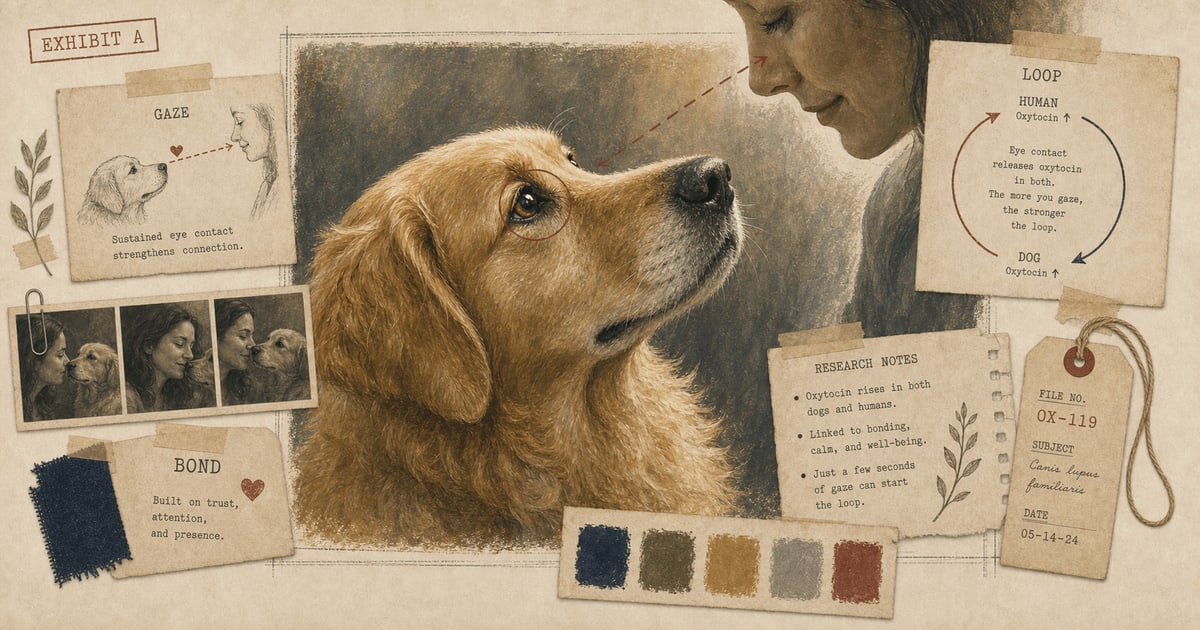
Miho Nagasawa’s 2015 paper in Science begins with what sounds like a hypothesis only a sentimentalist would bother testing: that the reason dogs look at you the way they do has a measurable physiological correlate, and that you produce it right back. She was right. And the finding is both more solid and more limited than the version that circulates at dinner parties.
The study, “Oxytocin-gaze positive loop and the coevolution of human-dog bonds,” remains one of the more carefully designed pieces of comparative animal cognition research in the last decade. It also happens to confirm something that every person who has ever owned a dog already believed. Science is occasionally useful that way.
What Nagasawa actually measured
The setup was simple in principle and painstaking in practice. Thirty owner-dog pairs were brought into a room for a 30-minute interaction. Urine samples were collected before and after. Researchers coded video recordings frame by frame, measuring how many seconds of mutual gaze occurred, how often the owner touched the dog, and how often the owner spoke to the dog. Then they compared the oxytocin levels in both species before and after.
The result: pairs that engaged in more mutual gaze showed the largest oxytocin increases in both the dog and the owner. Long-gaze dyads saw roughly a 130 percent increase in dog urinary oxytocin and roughly a 300 percent increase in owner urinary oxytocin. Short-gaze pairs showed no significant change. Touch and vocalization correlated less strongly with the oxytocin response than gaze did.
The second experiment was more mechanically elegant. Nagasawa’s team intranasally administered either oxytocin or saline placebo to female dogs, then put them in a room with the owner and an unfamiliar person. Female dogs given oxytocin spent significantly more time gazing at their owners, and those owners subsequently showed elevated oxytocin compared to the placebo condition. The loop ran in both directions: gaze triggered oxytocin, and oxytocin promoted more gaze.
The wolf comparison is the methodologically important piece. Eleven hand-raised wolves, socialized to humans from puppyhood, were tested in the same room setup with their human handlers. They did not engage in mutual gaze with the handlers, and they did not show the oxytocin response. These were not feral animals. They had grown up around people. The behavior was not present anyway, which strongly implies it was not learned but selected.
What the paper claims and what it does not
Oxytocin is often described, in popular writing, as “the love hormone.” This description is technically defensible in the narrowest possible interpretation and misleading in every practical sense.
Oxytocin in humans is involved in childbirth, lactation, social affiliation, trust, and pair bonding. It is also involved in in-group favoritism and out-group aggression. It rises during orgasm and during hugging and during generalized anxiety in some contexts. Calling it the love hormone is like calling cortisol the coffee hormone. It’s touching something real while flattening the complexity into nothing.
What the Nagasawa paper actually shows is that a specific behavioral gesture between dogs and humans, mutual sustained eye contact, produces a measurable rise in a specific neuropeptide in both species, and that this is true of dogs but not wolves. It does not show that dogs experience love in any way that would survive philosophical scrutiny. It does not prove conscious emotional states. It provides a physiological correlate of a behavior that we interpret as connection, which is not the same thing, but is also not nothing.
The sample size caveat is real. Thirty pairs is small. Urinary oxytocin is a noisier measure than blood plasma, and the relationship between peripheral oxytocin and central oxytocin, meaning the oxytocin acting on the brain, is still debated in the literature. The 2019 and 2020 replication literature produced mixed results on effect magnitude, though the directional finding, that dogs engage in mutual gaze and wolves do not, is robustly supported by other work.
The domestication argument
The more interesting claim in the paper is the evolutionary one. Nagasawa and her co-authors argue that dogs co-opted the mammalian parent-infant oxytocin loop, the same neurochemical feedback that promotes bonding between human mothers and their newborns, and repurposed it for dog-human bonding. The gaze behavior was selectively advantageous: dogs that looked at humans in a way that humans read as affectionate got more food, more shelter, and more reproductive success. Over tens of thousands of years, this produced a species that is, physiologically and behaviorally, unusually well adapted for the specific task of being a pet.
This interpretation is consistent with earlier work by Brian Hare and colleagues, particularly the 2002 Science paper showing that domestic dogs outperform both chimpanzees and wolves in reading human social cues, including gaze, pointing, and nodding. Hare’s finding was that dogs are better at this than any other animal tested, including animals with much larger brains, and that this ability appears to be a product of domestication rather than individual socialization. Wolves raised with humans do not develop it. Dogs raised in kennel conditions with minimal human contact still retain a version of it.
Put together, the picture is of a species that, over somewhere between 15,000 and 40,000 years of contact with humans, developed a specific behavioral toolkit for triggering human bonding responses. The dog is not pretending to love you. But the dog is also a highly refined machine for producing the neurochemical experience of being loved, which is possibly the more interesting finding.
Why inter-species eye contact is unusual
In most mammals, sustained direct eye contact between adults is either a threat or a prelude to one. Two unfamiliar dogs staring at each other is not a bonding moment. Two cats holding a gaze are usually about four seconds from a territorial dispute. The social mammal default is that direct eye contact signals dominance challenge, and the appropriate response is to look away.
Domestic dogs are an outlier. They have, through selection pressure, developed the ability to offer sustained soft eye contact to humans and to read human eye contact as something other than threat. The softness matters. A dog with hard, unblinking eyes locked on a stranger is alarming. The eye contact that Nagasawa measured is the relaxed, slightly droopy-eyed contact that a dog offers a person it trusts, and it is recognizably different in both the dog’s posture and the human’s interpretation.
This is not something a dog can be trained into from a blank starting point. Some dogs engage in it freely; others almost never do. Individual variation exists, but the capacity is species-level. The same is not true of cats, most of whom engage in a different affiliative visual gesture: the slow blink, a half-closing of the eyes that appears to function as an appeasement or greeting signal, and which humans can reciprocate. Alexandra Horowitz, in Inside of a Dog (2009), notes that cats and dogs have developed different solutions to the problem of communicating non-threat to a different species, which is itself evidence of how much both species have adapted to human social cues.
What this means when you look at your dog
The honest position is that the Nagasawa study gives you one small, real piece of evidence for something you probably already knew. When you look at your dog and the dog holds your gaze, something is being exchanged that has physiological effects on both of you. What those effects mean subjectively for the dog, whether there is any felt experience behind the oxytocin rise, is a question that no urinary hormone study can answer. The hard problem of consciousness does not yield to clever biochemistry.
But the finding does push back against the view that pet attachment is entirely projection, entirely a human narrative overlaid on a creature that is, underneath it all, just running behavioral subroutines. The dog is doing something specific when it looks at you. The response it triggers is specific. The fact that wolves do not do this, even after years of human socialization, suggests the behavior was selected for. Something was being selected toward a relationship, not just toward proximity.
There is also the question of what you are doing when you look back. The owner oxytocin increase in the long-gaze dyads was proportionally larger than the dog’s. Whatever the loop is, humans are not passive recipients. You are responding to the dog at a level below conscious choice, which is a stranger and more interesting fact than the simple “dogs love you” version allows for.
When you commission a custom pet portrait, one of the design questions that comes up is whether the painted animal should be looking directly at the viewer. It is not always the right choice. A three-quarter gaze, a dog mid-action, a cat looking away, can all make strong portraits. But if you want the animal looking back at you, you are asking for something specific: the depiction of the moment the science says is closest to the actual bond.
Sources
- Nagasawa, M., et al. “Oxytocin-gaze positive loop and the coevolution of human-dog bonds.” Science, Vol. 348, Issue 6232, 2015. DOI: 10.1126/science.1261022.
- Hare, B., Brown, M., Williamson, C., Tomasello, M. “The domestication of social cognition in dogs.” Science, Vol. 298, Issue 5598, 2002. DOI: 10.1126/science.1072702.
- Horowitz, Alexandra. Inside of a Dog: What Dogs See, Smell, and Know. Scribner, 2009.
- Kis, A., et al. “The interplay of oxytocin and social information in dogs’ gaze toward humans.” PLOS ONE, 2017. DOI: 10.1371/journal.pone.0173796.
- MacDonald, Kathleen. “The peptide that binds: a systematic review of oxytocin and its prosocial effects in humans.” Harvard Review of Psychiatry, 2012. DOI: 10.3109/10673229.2012.656348.
Welcome perk
Free expedited delivery on your first portrait
Get your digital proof in 1-2 business days instead of 2-3, free on your first portrait. Normally a $10 upgrade.
No spam. Just the perk and the occasional new style or guide.
Check your inbox for your code.