
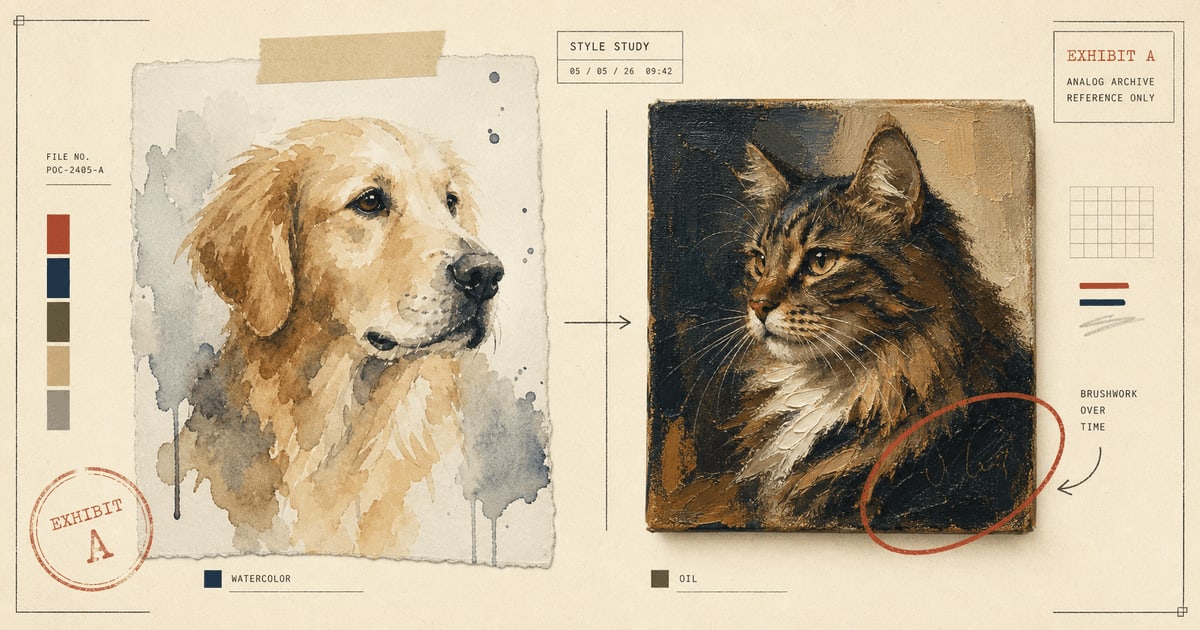
The question of watercolor versus oil is not primarily a question of taste. It is a question of physics.
Watercolor works because the paper does half the work. Pigment is suspended in water with a small amount of gum arabic binder; as the water evaporates, what remains on the paper’s surface is a transparent layer of color. The white of the paper shows through. That is not a limitation. That is the mechanism. Watercolor’s luminosity, its airiness, the way it seems to glow from within, comes entirely from light passing through pigment, bouncing off white paper, and returning to the eye. The paint does not generate light. It allows it.
Oil is the opposite system. Pigment is suspended in linseed oil, which dries slowly by oxidation rather than evaporation. The dried film of oil remains in the paint layer, giving it a kind of physical substance that watercolor never has. More importantly, the Flemish painters who refined this technique in the fifteenth century discovered that you could build oil paint in transparent layers, called glazes, over an opaque underpainting. Light enters the topmost glaze, passes through it, bounces off the underpainting, and returns through the glaze again. The result is color that seems to exist inside the surface rather than on it: depth, not just hue. Jan van Eyck’s surfaces look like they have an interior. The technique is still used today.
Why does this matter for a portrait of your dog? Because these two physical mechanisms produce genuinely different pictures. Not aesthetically different, though that is true too. Structurally different, at the level of what information the painting can contain.
What Each Medium Handles Well
Watercolor is good at edges that dissolve. An artist painting a golden retriever in watercolor can let the outer fur feather into the background by controlling water content and timing, creating what painters call a “lost edge.” The fur does not end. It disperses. That is technically accurate and also beautiful, and you cannot do it in oil without a great deal of manipulation.
Watercolor is also good at the kind of light that comes from within a pale or moderate coat. Cream, gold, pale gray, warm brown: all of these colors, in watercolor, carry a luminosity that reads as life. The paper’s white contributes to every color, however subtly, and the result is that even dark passages feel lit.
Where watercolor runs into trouble: black coats, very dark coats, and any subject where shadow is the primary source of drama. Watercolor builds from light to dark, and the darkest values you can achieve are limited by pigment density. A black Labrador in watercolor, handled carelessly, becomes a silhouette. Handled skillfully, it can still be done, but it requires a very different approach than the same dog in oil. The artist is working against the medium’s grain.
Oil is good at shadow. The Flemish glazing technique exists specifically to build rich, luminous darkness, the kind of shadow that has color inside it. Rembrandt’s brown shadows are not brown because he mixed a brown pigment. They are brown because he layered warm amber glazes over cool gray underpaintings, creating an optical mixture that the eye resolves as a living, breathing dark. You can do something analogous with a black Labrador. The coat is not black; it has blue-black in the highlights, dark brown in the midtones, near-black in the shadows. Oil’s layering system can distinguish between those values in a way that watercolor cannot.
Oil also handles the eyes. The eye of an animal is, technically, a transparent sphere with an opaque iris, a pupil, and a curved reflective surface. Painting it convincingly requires layering: opaque midtones, transparent dark glazes, opaque highlights, sometimes transparent color washes to indicate reflected sky or foliage. Oil paint’s willingness to be both opaque and transparent, sometimes within the same square centimeter, makes this possible. This is why oil portraits often seem to be looking back at you in a way that watercolor portraits sometimes do not. The eye is a more technically complex object than any other part of the painting.
The Coat Question
The single most useful variable for choosing between these two media is your pet’s coat, specifically its value range: how far apart are the lightest and darkest areas?
High-contrast, dark-dominant coats tend toward oil. Tuxedo cats, Dobermans, Rottweilers, black and white border collies, black Labradors, black German shepherds: these animals are compositionally structured around deep shadow and sharp contrast. Oil’s capacity for rich dark values and controlled highlights is better suited to this.
Pale, soft-value, or high-luminosity coats tend toward watercolor. Golden retrievers, Samoyeds, cream Persians, buff-colored cocker spaniels, pale tabby cats, white dogs of any breed: these animals’ primary visual quality is light, warmth, and surface texture. Watercolor can render this more naturally than oil, without fighting the medium.
Animals with medium-value, modulated coats, the interesting midtones of a husky, the brindle of a boxer, the warm grey of a Weimaraner, can go either way. Here the choice comes down to the other variables.
The Room Question
Watercolor and oil have different visual weights, and this matters if you are deciding where to hang the portrait.
Watercolor is physically lighter in presence. It tends toward warmth and intimacy. It fits well in spaces with natural light, pale walls, warm wood tones, linen textiles, and an overall feeling of ease. Bedrooms, living rooms with soft furnishings, nurseries, home offices with warm décor: watercolor integrates in these spaces without asserting itself aggressively.
Oil asserts itself. This is a feature, not a problem, when the space is designed to hold it. Deep-toned walls, traditional furniture, strong ambient light, formal rooms: oil paintings do not disappear into these spaces. They hold them. A well-painted oil portrait on a navy wall in a dining room is a different object, functionally and aesthetically, than the same subject in watercolor on a light living room wall. Both are good. They are doing different things.
The practical implication: if you are not sure where the portrait will hang, or if the space is light, minimal, and modern, watercolor is the lower-risk choice. It is harder to misplace.
The Memorial Portrait Question
For memorial portraits, the honest answer is that the style question is secondary to the image quality question. The portrait will carry emotional weight regardless of medium. But if you are making the choice and need a tiebreaker: watercolor’s softness tends toward comfort. The gentle edges, the warm luminosity, the way the animal seems to inhabit the painting rather than be pinned to it. These qualities make watercolor a common and understandable choice for portraits of animals that are gone.
Oil works for memorials too, especially for animals with a strong, solid, occupying presence. The kind of dog who filled a room. The cat who had been in the house so long they had become architecturally necessary. Oil can render that weight. The portrait has heft. Sometimes that is exactly what you want.
J.M.W. Turner, who spent a career pushing watercolor into territory most painters thought required oil, once described watercolor as a medium that “breathes.” The word is not as vague as it sounds. Watercolor paintings do seem to move slightly, to have air in them, in a way that oil paintings, for all their richness, do not. Whether you want that quality or the solid presence of oil depends entirely on what you are trying to hold.
The Short Version
Choose watercolor if the coat is pale or golden, the space is warm and informal, the portrait is a gift without a known destination, or you want something that feels personal and gentle.
Choose oil painting if the coat is dark or high-contrast, the space is formal or dramatic, the pet had a physical presence that the portrait should hold, or you want something that will anchor a wall rather than float on it.
If you cannot decide, there is a simple test. Find the best photo of your pet and look at it for thirty seconds. If your first instinct is that the animal looks warm, soft, and close, watercolor is probably right. If your first instinct is that the animal looks solid, serious, or compositionally strong, consider oil. The photo usually knows.
Both styles at Pet on Canvas are custom made from your photo, proofed within 2 to 3 business days, and include unlimited revisions before final approval. Start your portrait here or browse completed examples to see the difference on actual animals.
Sources
- Mandar Marathe, “Comparing oil colors to watercolors”: https://mandar-marathe.medium.com/comparing-oil-colors-to-watercolors-b8db49c955b7
- The Wallace Collection, “Turner’s Watercolour Materials and Techniques”: https://www.wallacecollection.org/explore/explore-in-depth/turner/turners-watercolors/turners-watercolour-materials-and-techniques/
- Old Masters Academy, “How to Paint Using the Flemish Method”: https://oldmasters.academy/old-masters-academy-art-lessons/how-to-paint-using-the-flemish-method-glazing-skin-tones-over-dead-layer
- Artsology, “Main Differences Between Watercolor and Oil Painting”: https://artsology.com/blog/2024/07/main-differences-between-watercolor-and-oil-painting/
Welcome perk
Free expedited delivery on your first portrait
Get your digital proof in 1-2 business days instead of 2-3, free on your first portrait. Normally a $10 upgrade.
No spam. Just the perk and the occasional new style or guide.
Check your inbox for your code.