
In 1808, Lord Byron’s dog Boatswain died of rabies at Newstead Abbey in Nottinghamshire. Byron nursed the dog through the illness himself, wiping foam from his mouth without caring that the disease was fatal and transmissible, because Boatswain was Boatswain and the risk was apparently beside the point.
Byron built him a marble tomb in the garden. On it he had inscribed a poem that opens with a list of the dog’s qualities: beauty without vanity, strength without insolence, courage without ferocity, and all the virtues of man without his vices.
That last line is not a tribute to a dog. It is a verdict on a species, delivered through a eulogy for a Newfoundland. Byron gave Boatswain more funeral architecture than he himself ever received. When Byron died in 1824, the famous wish in his will, that he be buried beside Boatswain, was refused by the Abbey. The man lies elsewhere. The dog is still in the garden.
Dog quotes have been carrying this kind of weight for a long time.
The Problem with Most Dog Quotes
Most dog quotes on calendars and coffee mugs are not attached to anything. They float free of any particular dog, any particular loss, any moment where a human looked at a specific animal and wrote something down.
They are generalizations: dogs are loyal, dogs are good, dogs do not judge, dogs fill the silence. Some of these are true. Most of them are true in the way that most generalizations are true, which is to say roughly, approximately, when the specific facts cooperate.
What keeps the best dog quotes alive for centuries is not that they captured some universal truth about dogs in general. It is that they were attached to the grief or admiration someone felt about one specific dog. Boatswain was not a symbol. He was a Newfoundland who ate things he was not supposed to eat and knocked guests into the furniture and eventually died of a disease that his owner refused to step away from. The poem survives because it came from that, not from a general position about the species.
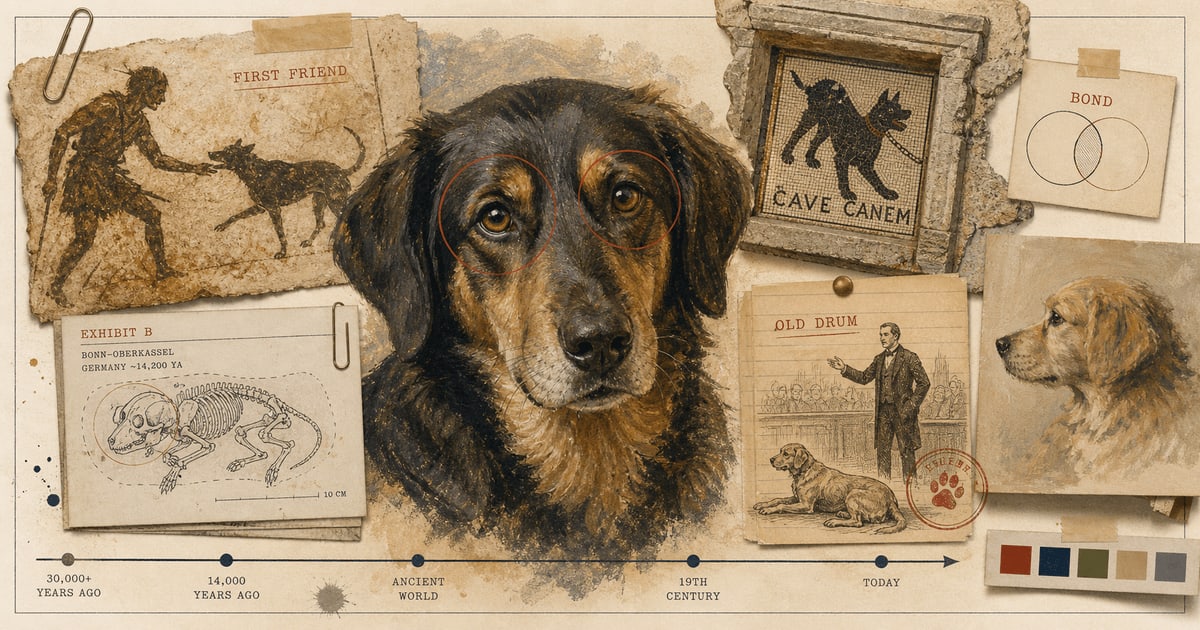
The archaeology supports this. We do not have quotes from anonymous Paleolithic humans about dogs in general. We have a burial at Bonn-Oberkassel, Germany, approximately 14,223 years old, in which one severely ill puppy was placed with two adult humans. The puppy had survived at least six weeks of canine distemper, a disease that causes neurological collapse and incontinence, and could only have done so with intensive human care. There is no quote attached to this. There is just the act, preserved in limestone, of people who had no antibiotics and no material benefit keeping a sick animal alive and then burying it with their dead. The quote that belongs to this burial is unwritten. But it is the oldest version of every dog quote we have.
Cave Canem Is Not a Sweet Sentiment
The famous Roman mosaic at Pompeii reads Cave Canem: beware of the dog. The image beneath it shows a dog straining at a leash, eyes forward, clearly committed to the premise.
This is not a tribute. It is a utility statement. It says the household has a dog, the dog takes its work seriously, and you should not test that.
What it tells us about dog history is something the sentimental quotes obscure: dogs were valued long before they were purely companion animals. The Roman household dog was infrastructure. It guarded the entrance, monitored the property, and responded to strangers with enough commitment that the household bothered to warn visitors. The dog was loved, but it was loved partly because it mattered. It did things. It held a post.
Modern dog quotes often skip this history and go directly to the emotional register, loyalty, unconditional love, the dog as a salve for human problems. That is not wrong. But it edits out most of the reason the emotional register developed. Dogs earned their place in human households through centuries of functional partnership, and the sentiment accumulated around a relationship that was already load-bearing before it became primarily affectionate. The dogs we have now sleep on couches and wear sweaters, but they are descended from the dog in the Cave Canem mosaic, still turning toward the entrance when someone knocks.
What “Man’s Best Friend” Actually Cost
The phrase that most people associate with dogs as companions is not from a poem or a novel. It is from a closing argument in a civil lawsuit.
In 1870, in Warrensburg, Missouri, a farmer named Leonidas Hornsby shot a neighbor’s hunting dog named Old Drum. The neighbor, Charles Burden, sued. The case attracted enough attention that Senator George Graham Vest agreed to argue Burden’s side.
Vest’s closing argument, delivered without notes to a courtroom that reportedly had people standing in the windows to hear it, made the case that a dog’s value could not be measured in the economic terms the law usually required. It argued that a dog was something else: the one creature who loved a man without reservation, who stood by him in prosperity and poverty, who slept on cold ground rather than abandon him. The argument concluded with a statement that the only absolutely unselfish friend a man could have in this selfish world was a dog.
The jury awarded Burden $50.
The phrase, abbreviated and polished over the subsequent century, became man’s best friend, which is now so familiar that it has lost almost all of its specific meaning. But the original speech was making a legal argument about value: that a dog could occupy a place in a person’s life that money could not describe, even while a specific dollar amount was being argued over in a specific courtroom. It was a contradiction, and Vest made it work.
The phrase survives because the contradiction is still real. Courts still struggle with how to value animals in wrongful death cases. Pet owners still feel the gap between what the law says an animal is worth and what the animal was actually worth to them. Old Drum died 155 years ago, and the argument Vest made has not been resolved. Every “man’s best friend” bumper sticker is an unresolved legal brief.
Why Named Dogs Last and General Sentiment Does Not
Argos, the dog in Homer’s Odyssey, waits twenty years for Odysseus to return. He recognizes his master on sight, wags his tail once, and dies. He is described as having been a great hunting dog in his youth, now lying neglected on a dung heap outside the palace. Homer gives him one scene, and it is enough to make him the most famous literary dog in Western literature.
Argos has lasted three thousand years not because he represents dogs in general but because he is specific: his age, his condition, his decline from capable working dog to neglected old animal, his single moment of recognition before he dies. The specificity is what makes the scene do what it does. Replace Argos with “a loyal dog” and the scene becomes an illustration. With Argos, it is something else.
Boatswain in his marble tomb. Old Drum in a Missouri courtroom. Argos on a dung heap outside Ithaca. The common thread is not loyalty as an abstract quality. It is that someone recorded a specific dog’s story with enough detail that the animal survived the writing.
What the History Means for Portraits
This is why a portrait that tries to capture a general quality (the loyal dog, the loving companion) does less work than one that tries to capture a specific one.
“She had a face that looked offended if you were ten minutes late with dinner” is not a general statement about dogs. It is a fact about one specific animal that will never need further explanation to anyone who knew her. The portrait that comes from that specific information does not need to announce its theme. The theme arrives with the likeness.
The dog quotes that have lasted are the ones with specific animals behind them. The portraits that work are the ones made from specific reference and specific observation. Byron did not write about a generalized noble dog. He wrote about the dog that sat at his feet while he worked and died in his arms and whose tomb he designed to outlast his own. That is the approach that survives.
Sources
- Lord Byron, “Epitaph to a Dog”, 1808, via Wikisource.
- Luc Janssens et al., “A new look at an old dog: Bonn-Oberkassel reconsidered”, Journal of Archaeological Science, 2018.
- World History Encyclopedia, “Cave Canem, Dog Mosaic”.
- Missouri Encyclopedia, “George Graham Vest”.
- Homer, The Odyssey, Book 17 (Argos), trans. Emily Wilson, W. W. Norton, 2017.
Welcome perk
Free expedited delivery on your first portrait
Get your digital proof in 1-2 business days instead of 2-3, free on your first portrait. Normally a $10 upgrade.
No spam. Just the perk and the occasional new style or guide.
Check your inbox for your code.