
In 1647, the Dutch painter Jan de Bray was commissioned to paint a portrait of a boy named Johannes. Johannes had died some time before the commission was placed. De Bray had no subject to observe. He had a grieving family, some accounts of what the child looked like, and probably a small sketch or two made before the death. He painted the portrait anyway. It is in the Frans Hals Museum in Haarlem. It looks like a specific child, not a generic one.
Portrait painters worked from inadequate information for centuries before photography solved the technical problem of capturing a likeness. They painted from memory, from description, from the accounts of people who had known the subject and were trying to explain what made them unmistakably themselves. The portrait was not a copy of a photograph. It was a reconstruction, an act of attention applied to whatever evidence remained.
This matters because most people who apologize for their single blurry pet photo are comparing themselves to a standard that did not exist for most of human history. The bar you are worried about not clearing is a modern invention. Artists have worked with worse.
What the Photo Actually Needs to Contain
The useful question is not whether the photo is perfect. It is what information the photo contains.
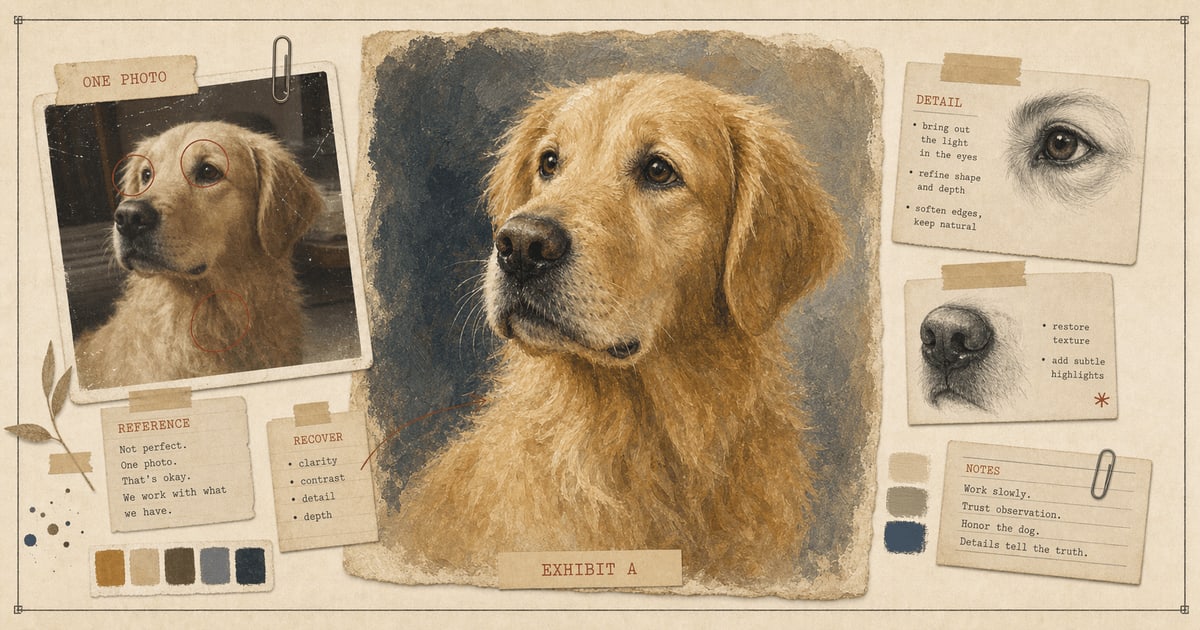
An artist working on a pet portrait needs to understand the structure of the face: the placement and shape of the eyes, the proportions of the muzzle, the ear set, the particular combination of features that makes this animal recognizable rather than generic. They need to know the coat color and pattern with enough accuracy to represent it faithfully. And they need something about the expression, some quality of the face that tells them what the animal was like.
A photo can be dim, cropped oddly, slightly blurry, or taken from a non-ideal angle and still contain this information. A photo of a dog in the backseat of a car, caught mid-yawn in warm afternoon light, with some of the body out of frame, can give an artist everything they need to paint that specific dog if the face reads clearly. The background is not the point. The nose of an otherwise excellent photo cut off by poor framing is inconvenient but rarely fatal if the eyes and face are present. Color inaccuracies can be corrected in the notes.
What actually limits an artist is when the important structural information is missing or unreadable: eyes in complete shadow, face blurred beyond any discernible feature, the animal’s head turned so far from the camera that the face provides no useful angle. These are genuine constraints, not because artists cannot invent, but because invention in a memorial portrait is not what you want. You want accuracy. Accuracy requires evidence.
The Eyes Are the Priority
If you only have one photo and are trying to decide whether it is usable, look at the eyes first.
The eyes in a portrait carry more of the likeness than any other single element. An artist can suggest a coat’s texture and warmth from incomplete color information. They can infer the general body shape from the small portion visible in the frame. What they cannot reconstruct is the specific quality of an individual animal’s gaze from a photo that shows only shadow where the eyes should be.
This is not mysticism. It is the same principle that makes the catchlight, that small bright point of reflected light in the eye, so critical in portrait painting that artists have added it deliberately for centuries. Rembrandt’s portraits use it. Singer Sargent’s do. Every portrait painter who has thought seriously about what makes a face look alive has discovered the same thing: remove the light from the eye and the subject loses their presence. With it, they look back at you.
For a memorial portrait, this is often the central question. Not: do I have a beautiful photo? But: do I have a photo where I can see their eyes? If yes, the artist has what they need for the part of the portrait that will do the most work.
Color Lies More Than You Think
One photo can misrepresent color significantly, and this is worth knowing because it means you have more ability to correct the portrait than the photo alone would suggest.
Indoor lighting shifts warm tones toward orange or yellow. Flash photography bleaches color and produces unnatural contrasts. Old photographs fade in ways that mute the vibrancy of what the original coat actually looked like. Digital compression can shift subtle tones in ways that are invisible at thumbnail size and obvious when the photo is examined closely. Dark-coated animals are especially susceptible: what the camera renders as a flat, undifferentiated black was, in the room, a richly textured dark coat with variation the camera could not capture.
The correction is simple: tell the artist what the photo gets wrong. Her coat was warmer than this photo shows. His eyes were amber, not the dark brown the indoor light made them look. The white was cleaner and brighter than the aged photo suggests. These notes cost you five seconds and can change the portrait significantly. An artist working without them has to make guesses. An artist working with them makes informed decisions.
Memory as a Second Reference
Memory is unreliable in certain ways and reliable in others. It is notoriously bad at capturing the precise details of appearance, the exact shade of a color, the specific dimensions of a feature. But it is often good at holding the quality of presence: what was characteristic, what the animal looked like doing the thing they always did, what you would recognize instantly if you saw it again.
These qualities translate into portrait notes. “She always looked slightly skeptical” is information. “He had one ear that flopped differently from the other” is information. “Her face got very soft when she was relaxed, not the alert look in this photo” is information. This kind of description tells the artist which emotional register to work in, which direction to push the expression, where to soften and where to strengthen.
The note does not replace the photo. But it fills in around it, providing the contextual knowledge that the single reference image cannot carry alone.
When One Photo Is Not Enough
There are situations where a single photo cannot support a detailed portrait, and it is worth being honest about this rather than discovering it after the order is placed.
If the face is tiny in the frame, blurry, and turned away, with no clearly readable features, the artist is working from inference rather than observation. The resulting portrait may capture the species and the general type but not the specific individual. This is a real limitation, not a failure of effort.
If you are uncertain whether your photo will work, say so when you order. A good artist or studio will look at the reference honestly and tell you what is possible. Some photos that look too limited turn out to contain more useful information than expected. Some that look adequate reveal problems at closer inspection. Better to have that conversation early.
What is not useful is rejecting the photo yourself before getting that second opinion. People frequently assume a reference is unusable when it still has enough structure for a strong portrait. The standard you are holding the photo to may be stricter than the one the artist needs.
The Practical Steps
Send the highest-quality version of the file you have. Not a screenshot of a screenshot. Not an image exported from social media at reduced resolution. The original phone photo or scan, if you can find it, contains more information than compressed derivatives.
If the only version is a screenshot or a low-resolution copy, send it anyway and note that limitation. Less is not nothing.
Gather any other photos you have, even ones that do not show the face clearly. A photo that captures the coat color in good light, even from the wrong angle, supplements a primary reference that shows the face but misrepresents the color.
Then write the notes. Personality in three words. Color corrections. Features the photo hides. What you want the portrait to feel like. These are the second reference, the one that fills in what the camera could not get.
Digital portraits start at $24.99, with proofs in 2 to 3 business days and unlimited revisions. Start your order here. Upload the best version of what you have and tell us what the photo does not show. We work with the information available, and we tell you honestly when the photo creates real constraints before we start.
Jan de Bray painted Johannes from memory and description in 1647, and you can look that child in the eyes at the Frans Hals Museum today. The photo being imperfect is not the last word on the portrait.
Sources
- Jan de Bray, Portrait of a Boy (Johannes?), c. 1647, Frans Hals Museum, Haarlem.
- Richard Brilliant, Portraiture, Harvard University Press, 1991.
- Daniel Schacter, The Seven Sins of Memory, Houghton Mifflin, 2001.
Welcome perk
Free expedited delivery on your first portrait
Get your digital proof in 1-2 business days instead of 2-3, free on your first portrait. Normally a $10 upgrade.
No spam. Just the perk and the occasional new style or guide.
Check your inbox for your code.