
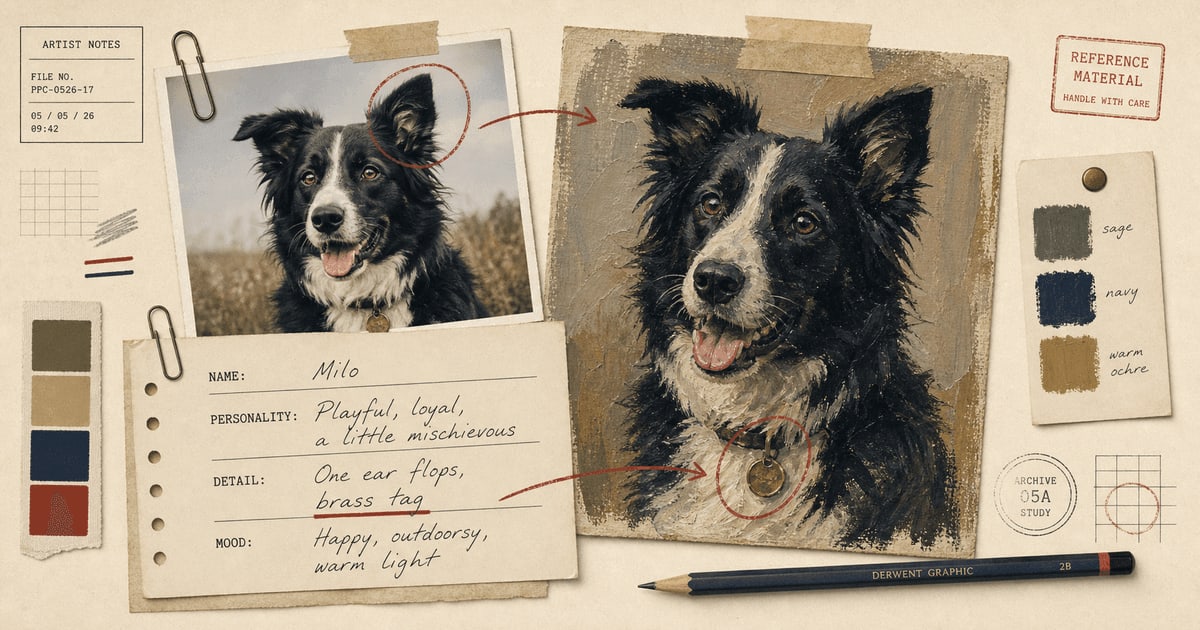
Portrait painting from a photograph is an act of interpretation. The artist does not see your pet. They see a flat image, a fixed moment, a specific quality of light, and whatever relationship to the subject the camera happened to catch. Everything else, the personality, the gait, the particular way your dog looks at you when you say the word “outside,” is invisible to them unless you say something.
This sounds obvious. In practice, most people filling out the notes field of a portrait order either write almost nothing or write far too much of the wrong things. “Make her look pretty” is too vague. A 400-word essay about your cat’s childhood trauma is, while appreciated as literature, not especially useful for a painting. What artists actually need is something more specific and more economical than either.
Here is what determines portrait quality, what you can control, and how to communicate it.
The Photo Is Not a Formality
Before the notes, the photo. Everything else in this post is contingent on having a usable reference image, and it is worth spending a moment on what that actually means.
Portrait painters talk about reference photos constantly, and not always charitably. The professional forums are full of variations on the same complaint: the client loved the photo, the photo was taken at 11 PM with a phone, the subject is a silhouette against a lamp, and now the artist is being asked to paint a likeness from something that contains essentially no visual information.
What artists need from a reference photo: a clear, well-lit image where the eyes are sharp, the fur direction is visible, and there is enough tonal range to distinguish the darks from the lights. What they most commonly get: photos taken in low light, photos where the pet is in motion, photos taken from above (your dog looks dramatically different from above than at eye level), and photos where the flash has eliminated all shadow and flattened every plane of the face.
The single most important technical element is the eyes. Painters, regardless of style or medium, tend to start with the eyes, because when the eyes look correct, the brain accepts the rest of the portrait as plausible. If the eyes are a blur, an abstraction, or a pair of flash reflections, the portrait starts from a deficit that no amount of skill fully recovers.
Natural light from a window, diffused rather than direct, at roughly eye level, close enough that the pet fills at least a third of the frame. This is not complicated equipment. It is a different time of day than midnight and a different angle than standing over the dog.
If you have multiple photos, that is not a problem. Multiple photos are often better than one, because different images capture different things. The key is telling the artist which photo has the truest expression, which shows the coat color most accurately, and which is the primary reference. Without that hierarchy, the artist is guessing.
What to Put in the Notes
The notes field is not a biography. It is a set of instructions about priorities. The artist is making thousands of small decisions during the portrait: how to handle the ear, where to place emphasis, what expression to bring out, how much of the background to develop. The notes tell them which of those decisions matter to you and which can be made on their own judgment.
Name the pet. This is not about being sweet. It changes the framing. “I’d like a portrait of my dog” is a transaction. “This is Walter” is the beginning of a communication. It tells the artist they are painting a specific individual, not a representative specimen. Most artists paint better when they have a name.
Describe the personality in two or three plain words. Not a character study. Not a metaphor. “Sweet and anxious” is more useful than “she has known hardship but remains open to love.” Examples of notes that work: “confident and slightly imperious,” “nervous around strangers but extremely affectionate at home,” “acts like he owns the room,” “gentle, a little goofy, always curious.” These give the artist a tone. They help with expression choices.
Name the details that matter to you. Every pet has one or two things the owner cares about most that a stranger would not necessarily notice. One floppy ear. A white patch on the chest that appeared three years ago. A collar with a particular tag. An unusual eye color that gets more visible in certain light. The asymmetrical markings on a tuxedo cat’s face. If the detail is important to you and not obviously prominent in the photo, say so explicitly. The artist will not invent or omit it, but they cannot prioritize what they do not know matters.
Tell them which photo to use for expression and which for color. If you are uploading multiple photos, this is not optional. The sharpest photo and the truest photo are often different photos. “Photo 2 has the best expression but the color in Photo 1 is more accurate” is a sentence that changes the portrait. Without it, the artist may use the sharpest image as their primary reference even if it was taken in the wrong light and makes your dog look slightly jaundiced.
State the mood you want. The same animal can be painted in very different emotional registers. Warm and tender. Bold and celebratory. Formal and composed. Playful. Melancholy, if the portrait is a memorial and you want that weight. These are not the same as art styles. They are directions within a style. A watercolor portrait can be bright and energetic or quiet and retrospective. An oil portrait can feel stately or quietly funny. Stating the mood prevents the artist from guessing at something they have no way to infer from a photo.
What You Do Not Need to Say
You do not need to describe the brushwork. You do not need to specify “more contrast in the midtones” or “I prefer a warmer color temperature” unless you genuinely know what you mean and have a reason for it. The artist has a technique. They will apply it. Instructions that contradict their technique without a specific reason create more problems than they solve.
You also do not need to explain the full emotional context unless it changes the brief. “She passed away two months ago and I miss her” is a statement that might affect how an artist approaches a memorial portrait, and it is fine to include it. A twelve-paragraph account of the pet’s medical history, while understandable, does not change what goes in the painting.
The useful principle: notes should cover what the photo cannot show and what the portrait needs to prioritize. Everything else can safely be left out.
The Memorial Portrait Problem
Memorial portraits are the case where clients most reliably omit the most useful information, because they are in a state where plain description is difficult.
What is actually helpful for a memorial portrait: two or three words about how the animal carried itself, which expression feels most true, and what mood the portrait should have. That is the whole brief. “He was calm and steady. Photo 3 is the most like him. Peaceful, not sad” is a complete set of instructions for a memorial portrait.
What is not necessary: a full account of the illness, the timeline, the last day. This is not callousness. It is a recognition that none of that information changes the painting. The portrait is not a record of the death. It is a portrait of the animal. Focus on the animal.
A Practical Template
If you want to skip the thinking:
This is [name]. They are [two or three personality words]. Please make sure to capture [specific important detail]. Photo [number] has the best expression; Photo [number] shows the coat color most accurately. I want the portrait to feel [mood word].
Concrete example, the kind that actually helps:
This is Noodle. She is anxious but affectionate, and she has extremely specific energy. Please keep the white blaze on her forehead, it is uneven and that is correct. Photo 1 has the truest expression. Photo 3 shows her coat better. I want it to feel warm but not saccharine.
“Warm but not saccharine” is excellent art direction. It tells the artist something they could not know from the photos alone, it sets a boundary against an error they might otherwise not know to avoid, and it does so in about four words. That is the calibration you are going for.
The Portrait the Photo Cannot Give You
There is one more thing worth saying. The notes exist partly to supply information the photo lacks, and partly to tell the artist what to do with that information. But there is a third function that is easy to miss: the notes give the artist permission to make interpretive choices.
A portrait is not a reproduction. The artist is not a printer. They are making decisions about composition, emphasis, expression, and emotional register throughout the painting. Good notes give them the anchors for those decisions. Bad notes (or no notes) leave them guessing, which means they default to safe and generic rather than specific and true.
The portrait that feels most like your pet is the one where the artist understood what to aim for. The photo shows them the shape. The notes tell them what to do with it.
Start your order here. The notes field is short. It does not need to be long.
Sources
- SKH Portraits, “What Makes A Good Photo Reference For A Portrait Painting?”: https://skhportraits.co.uk/what-makes-a-good-photo-reference-for-a-portrait-painting/
- Artists Network, “The Importance of a Good Photo Reference”: https://www.artistsnetwork.com/art-techniques/lee-hammond-importance-good-photo-reference/
- Evolve Artist, “Why Quality Reference Photos Make Quality Paintings”: https://evolveartist.com/blog/why-quality-reference-photos-make-quality-paintings/
Welcome perk
Free expedited delivery on your first portrait
Get your digital proof in 1-2 business days instead of 2-3, free on your first portrait. Normally a $10 upgrade.
No spam. Just the perk and the occasional new style or guide.
Check your inbox for your code.