
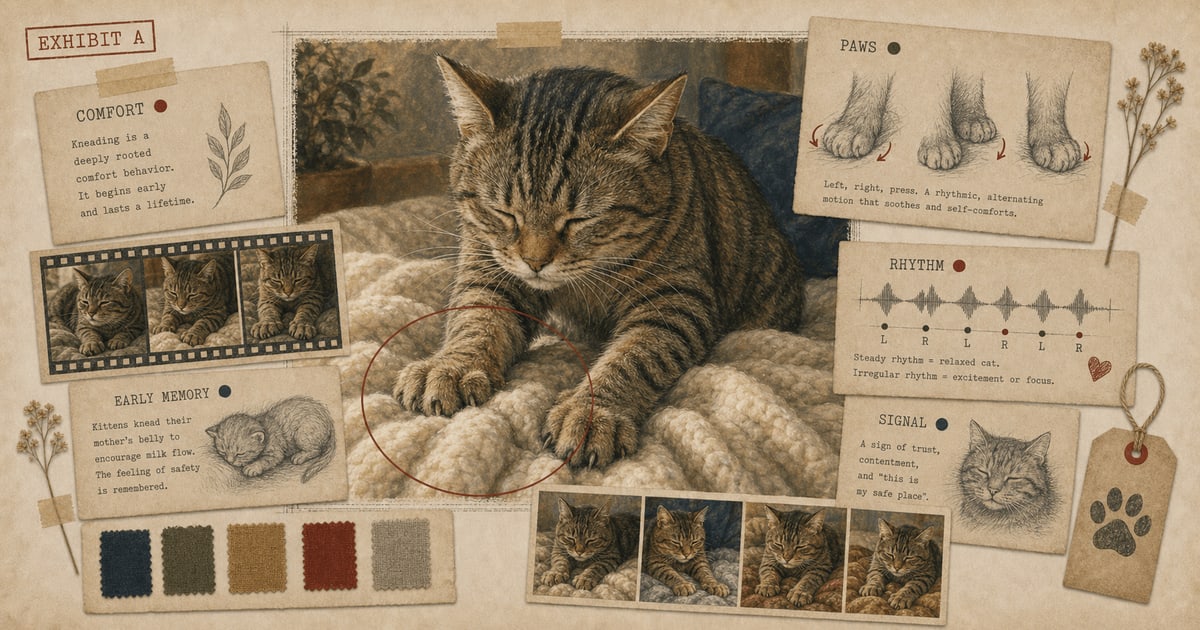
Before a kitten is old enough to see anything, before its eyes open on day ten or eleven, before it has any experience of the world beyond warmth and smell and touch, it is already kneading. The alternating push-push-push against the mother’s belly is one of the very first motor patterns a newborn cat produces, present within the first twenty-four to forty-eight hours of life. It exists to stimulate milk letdown. The kitten has no learned knowledge of how lactation works. It just pushes, and milk comes, and that is the first lesson the animal gets about the relationship between effort and reward.
What is strange, and genuinely interesting, is that this pattern never goes away.
Most infant behaviors get retired. You do not see adult cats latching onto their mothers. You do not see adult cats displaying rooting reflexes. But kneading, this very first motor act, the one wired into the animal before it can see or hear properly, persists into adulthood and fires in contexts that have nothing to do with nursing. The soft blanket. The warm lap. Your stomach at midnight when you were not expecting company.
This is the behavior people call “making biscuits,” and it deserves a better explanation than “your cat loves you,” because the actual explanation is stranger and more interesting.
The Developmental Biology of a Retained Reflex
John Bradshaw, whose Cat Sense (Basic Books, 2013) is the standard lay reference on feline behavioral science, argues that domestic cats are in some respects permanently juvenile. Domestication, he suggests, selected for extended kittenhood: the willingness to accept food from another species, playful behavior well past sexual maturity, and the retention of kitten-specific vocalizations and motor patterns into adult life.
Meowing is the most famous example of this. Adult cats almost never meow at other adult cats. It is a behavior they produce primarily for humans, apparently developed or amplified through the domestication process because it was effective at getting human attention. Kneading belongs in the same category: a kitten behavior that persisted, probably because domestic life offered no strong selection pressure against it and, in many cases, actively reinforced it.
The nursing origin explains the specific trigger conditions. The behavior fires most reliably in situations the cat associates with safety, warmth, and being close to something trusted. Soft surfaces work because they compress under the paw the way a nursing belly compresses. Warmth works because kittens nurse in warmth. A familiar human works because the category of “thing associated with security and good outcomes” now includes the person who fills the food bowl and opens the window and sits still long enough to become a viable kneading surface.
The cat is not reliving a nursing memory. It does not have the cognitive architecture for that kind of explicit recall. The motor pattern simply fires when conditions resemble the conditions under which it was first strongly reinforced: soft, warm, safe, close to something that reliably provides good things.
The Scent Signature in the Paw Pads
Kneading is not purely a motor expression of contentment. There is a second function running in parallel, and it involves the interdigital glands.
Cats have scent-producing glands distributed across the body: at the cheeks, chin, forehead, the base of the tail, and between the toes. The interdigital glands sit in the paw pads and between the digits. When a cat kneads a surface, particularly with slight claw extension, these glands can deposit chemical secretions onto the substrate. The cat is, in the language of chemical ecology, scent-marking the spot.
S. L. H. Ellis and colleagues codified this in the 2013 AAFP and ISFM Feline Environmental Needs Guidelines, published in the Journal of Feline Medicine and Surgery, which identified normal marking behaviors including paw-pad gland deposition as part of a healthy feline behavioral repertoire. The guidelines describe allowing cats to engage in these marking behaviors as one of the five pillars of an enriched feline environment, because blocking them creates stress.
This helps explain behaviors that otherwise seem irrational. A cat that kneads a freshly washed blanket longer and more intensely than usual is, in one reading, responding to the removal of its prior scent signature. The familiar smell is gone. The cat is reinstating it. The compression and the claw extension that might look like aggression or excitement are actually the tool for getting the gland secretion onto the surface.
It also explains why some cats knead the same spots in a household with a kind of ritualistic consistency. These are not random comfort moments. The cat is maintaining a chemical map of its territory, marking the places it uses and trusts, building a scent environment that reads, in cat neurology, as home.
How You Accidentally Trained This Behavior
There is a third layer on top of the reflex and the scent-marking, and it is operant conditioning. Whatever gets reinforced gets repeated. This is one of the most robust findings in behavioral science, and it applies to cats regardless of whether the cat is aware of the arrangement.
When an adult cat kneads a human and the human responds with warmth, softness, gentle petting, and absence of any correction, that response is reinforcing. The cat did something; the environment responded positively; the probability of the behavior repeating in that context increases. Over time, the schedule of kneading expression in adult cats tends to align very precisely with the human’s schedule: the time of evening you usually sit still, the chair you use most often, the specific hoodie that has become structurally compromised by repeated use as a biscuit surface.
You can test this informal hypothesis yourself. If your cat kneads at the same time of day, in the same location, triggered by the same cue (you sitting down, pulling a blanket onto your knees, opening a laptop), that regularity is learned. The biological capacity came from kittenhood. The schedule was shaped by what happened after.
Patricia Turner Morow’s work on learned behaviors in domestic cats and the review literature on feline operant conditioning both support the position that context-specific kneading in adults reflects genuine learned associations on top of the underlying reflex. The reflex provides the behavior. The history provides the schedule.
What “Making Biscuits” Looks Like in the Body
A cat in full kneading is in one of the rare states where body language is unambiguously soft. The face relaxes. The eyes go half-lidded or fully closed. The ears are forward or neutral rather than swiveled back. The whiskers rest in the forward-facing “curious-content” position rather than the flattened position of stress or fear. The body has contact with the surface on multiple points: the kneading forepaws, usually the chest, sometimes the hindquarters if the cat is sprawled rather than upright.
The paws themselves show something specific: on the downward pressure stroke, the interdigital pads spread slightly. The slight claw extension that accompanies many kneading cats is visible in the spread of the toes. The fur on the back of the front legs shifts with each alternating push. For a portrait, this is rare material. Most cat photos catch either full alertness or full sleep. A kneading cat is in between: present, engaged, and doing something specific with its paws that reads as intention without aggression.
If you have a photo of your cat mid-knead, on a blanket or a lap, with that specific half-lidded face and the paws active, it can make a more emotionally specific portrait than a clean seated pose. The moment is private. It shows the cat in its safe mode. A custom portrait from that kind of reference tends to carry warmth that posed shots can miss, because the animal’s body language is doing the work rather than the composition doing it.
When Kneading Is Worth Paying Attention To
A few practical notes for the well-informed cat household.
Extended claws during kneading hurt. The correct response is not punishment, which tends to suppress the affectionate context without removing the underlying reflex, creating a cat that has learned that kneading near you leads to correction. The correct response is a folded blanket between the paws and your skin, plus a regular claw-trimming schedule.
Not every cat kneads. Some adult cats never develop the habit. Cornell Feline Health Center notes that absence of a behavior is rarely diagnostically meaningful; the presence of a behavior tells you more than its absence. A cat that has never kneaded is not withholding something. It may have been raised in conditions where the behavior was not reinforced, or it may simply vary from the norm the way individuals in any species vary.
Sudden-onset intense kneading that is compulsive in character, paired with other changes like weight loss, restlessness, or unusual vocalization, warrants a veterinary visit. On its own, kneading is not a symptom of anything. In combination with other changes, it can be part of a pattern worth examining.
Sources
- Bradshaw, John W. S., Cat Sense: How the New Feline Science Can Make You a Better Friend to Your Pet (Basic Books, 2013).
- Brown, Sarah L. and Bradshaw, John W. S., The Behaviour of the Domestic Cat (CABI, 2nd ed., 2012).
- Ellis, S. L. H., et al., “AAFP and ISFM Feline Environmental Needs Guidelines”, Journal of Feline Medicine and Surgery, 2013. DOI: 10.1177/1098612X13477537
- Vitale Shreve, K. R. and Udell, M. A. R., “What’s inside your cat’s head? A review of cat (Felis silvestris catus) cognition research past, present and future”, Animal Cognition, 2015. DOI: 10.1007/s10071-015-0897-6
- Cornell Feline Health Center, “Feline Behavior Problems”
Welcome perk
Free expedited delivery on your first portrait
Get your digital proof in 1-2 business days instead of 2-3, free on your first portrait. Normally a $10 upgrade.
No spam. Just the perk and the occasional new style or guide.
Check your inbox for your code.