Lions loaf.
Not as internet content. Not named, not categorized, not assigned the “smug” or “emergency” or “submarine” variants. Just as ordinary feline behavior: an African lion at rest during the midday heat often sits with its front paws tucked under its chest, body compact, head upright, ears rotating. The leopard does this. The cheetah. The ocelot, the caracal, the clouded leopard, the Pallas’s cat. Every extant lineage of Felidae produces this posture. The domestic cat’s loaf is not a domestic quirk. It is what cats do, because it is what cats have done, for approximately 37 million years of evolutionary history.
We gave it a name and started a genre. The animal was managing its thermal environment.
Most Indoor Cats Are Cold Most of the Time
The domestic cat’s thermoneutral zone (the ambient temperature range within which the body maintains its core temperature without extra metabolic effort) runs from roughly 30°C to 38°C. That is 86 to 100 degrees Fahrenheit. The average North American home is kept between 68 and 72°F, which puts the interior environment between 8 and 16 degrees below the floor of feline thermal comfort, for essentially the entire day.
The sun patch is not a preference. The laptop is not aggression. The fresh laundry is not coincidence. The cat is cold.
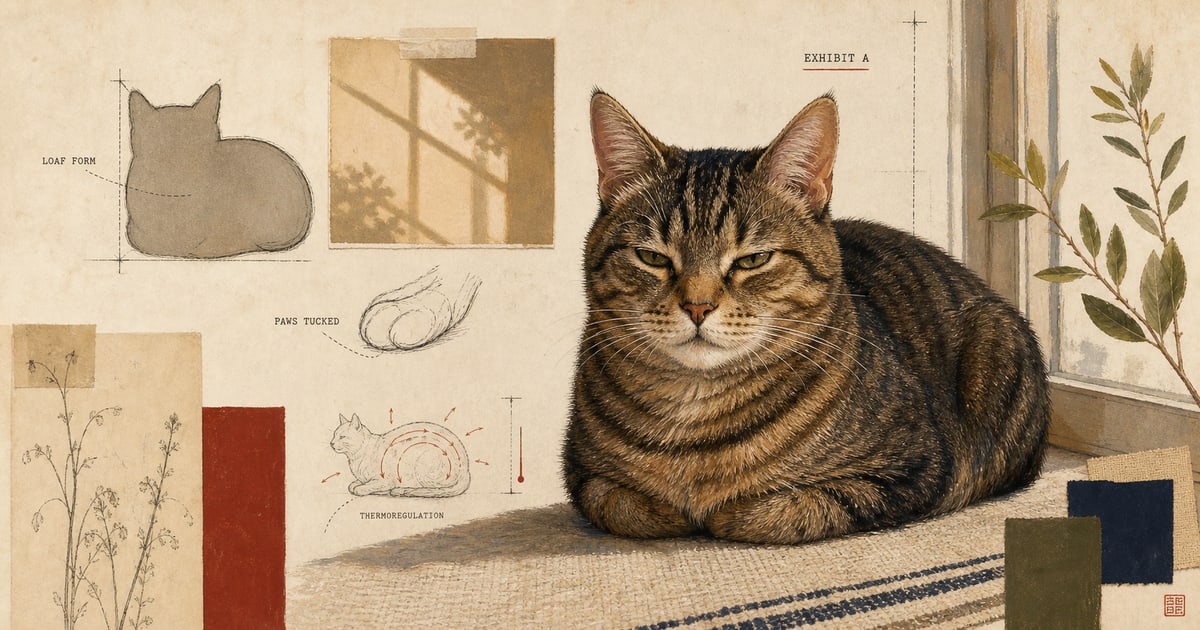
The loaf responds to this directly. Four paws tucked under the body, tail wrapped around, reduces exposed surface area and cuts convective heat loss from the extremities: the paws and lower legs carry less insulating subcutaneous fat than the torso, so tucking them inward is the sensible thing. Cats are doing applied thermodynamics on your couch. The mechanism is not conscious. Your hand reaches for a hot drink when you are chilled without you deciding to do it. The cat’s body reaches for the loaf position by the same logic.
Thermoregulation explains where the cat loafs. It does not fully explain the posture, because cats also loaf when the ambient temperature is adequate: warm afternoons, heated rooms, climates inside the thermoneutral range. For that, you need the alertness continuum.
The Loaf Is Not a Sleep Posture
A cat in full rest looks different from a loafing cat. Full rest means lateral, limp, paws extended, belly potentially exposed. The animal has abandoned preparedness in favor of full recovery. The loaf does none of that. A loafing cat maintains active muscle tone in the hindquarters. The spine stays upright. The ears continue to rotate and track sounds independently while the eyes are half-closed. The cat can go from loaf to standing in under a second because the legs are already under the body, load-bearing.
Behavioral veterinarians read the loaf as a middle state on the security scale: comfortable enough to rest, not comfortable enough to be defenseless. A cat that rolls over and exposes its belly has declared the environment safe. A cat that sprawls fully sideways has made the same declaration. The loaf is the holding pattern before that declaration: present, watchful, organized, not on alert but not off it either.
In a wild context, this calibration matters. A small predator whose hunting depends on burst speed from a standing start cannot afford to fully switch off. A medium-sized carnivore that is also prey for larger animals cannot afford to be caught in a recovery position. The loaf keeps the body coiled: resting without the cost of sprawling, alert without the cost of standing. Domestic cats have no credible threats in their home environment and prey that amounts to approximately one fly per season. The posture persists because evolution does not retire useful solutions simply because the original problem has been resolved.
When a cat begins loafing more than usual, with a more hunched back than its typical compact shape, veterinarians flag it as a potential signal of abdominal discomfort: the posture reduces movement of the core and minimizes stretching of the abdominal wall. The difference is visible. A comfort loaf is upright and contained. A pain loaf is tucked inward and closed. They look similar on the outside and feel very different.
What the Naming Reveals
We did not stop at the loaf. We generated a taxonomy. The meatloaf (standard). The airplane loaf (legs extended behind, mid-transition). The smug loaf, the emergency loaf, the sky loaf, the submarine loaf. None of these are scientifically distinct from one another. The ears are in different places. The expression is different. The posture is the loaf.
Dogs do not receive this treatment. Nobody has named seventeen variants of a golden retriever lying down. The golden just lies down, and we understand that, and we move on.
The loaf gets named because it makes the cat look like a manufactured object. A warm rectangle with opinions. A small appliance with fur. And something about the gap between “this is a living predator with a 38.5°C core temperature and African wildcat ancestry” and “this looks like something that belongs on a bread board” is the central comedy of the human relationship with cats specifically. We anthropomorphize dogs. We objectify cats. Dogs get credited with feelings. Cats get named after baked goods. The cats, resting in this posture since before Homo sapiens existed, have taken no position on either interpretation.
What is actually interesting about the loaf naming is not the names but the impulse behind them. When something becomes legible, we name it. The loaf became legible because it strips the cat of its usual performance of being an animal: no hunting, no grooming, no vocalization, no motion. Just the cat, compact and present, occupying a space it has decided belongs to it. The loaf is the cat at its most settled. The naming is humans trying to metabolize that, because an animal sitting quietly and doing nothing is somehow one of the more unsettling things a domestic cat can produce.
The Loaf as Portrait Reference
The loaf is one of the better reference poses to send an artist, and not just for compositional reasons.
The face is forward and readable. The body is simplified: a clean, compact silhouette without extended limbs competing for the composition. Watercolor handles the soft contained volume well. Pencil sketch has room to work on expression and fur detail when the body is not demanding equal attention. The typical challenges of photographing cats (the motion, the turned head, the closed eyes) are less present when the cat has decided to hold still indefinitely.
But beyond the practicalities, what a loaf portrait captures is something specific about how cats inhabit rooms. Dogs arrive. Cats settle. The loaf is the settled version: the animal that has already decided where it belongs and stopped needing to demonstrate it. There is a quality of presence in the loaf that is harder to catch in action shots and more honest than posed portraits. The cat is just there, the way it is actually there: watching, organized, thermally satisfied, doing nothing in particular with great conviction.
If your cat has a consistent loafing spot (a kitchen chair, the arm of the couch, a blanket that now exists primarily as loafing infrastructure), mention it in the order notes. The spot informs the palette and the light without becoming the subject. The cat frames itself. The artist decides how much of the frame to keep.
Digital portraits start at $24.99, with proofs in 2 to 3 business days and unlimited revisions. If the loaf photo is there, start here.
Sources
- Lauren R. Finka, “Conspecific and Human Sociality in the Domestic Cat”, Animals, 2022.
- S.L.H. Ellis et al., “Environmental Aspects of Domestic Cat Care and Management: Implications for Cat Welfare”, Animals (MDPI), 2017. (Thermoneutral zone data.)
- National Research Council, Nutrient Requirements of Cats, National Academies Press, 2006.
- MSD Veterinary Manual, “Social Behavior of Cats”.
Welcome perk
Free expedited delivery on your first portrait
Get your digital proof in 1-2 business days instead of 2-3, free on your first portrait. Normally a $10 upgrade.
No spam. Just the perk and the occasional new style or guide.
Check your inbox for your code.