
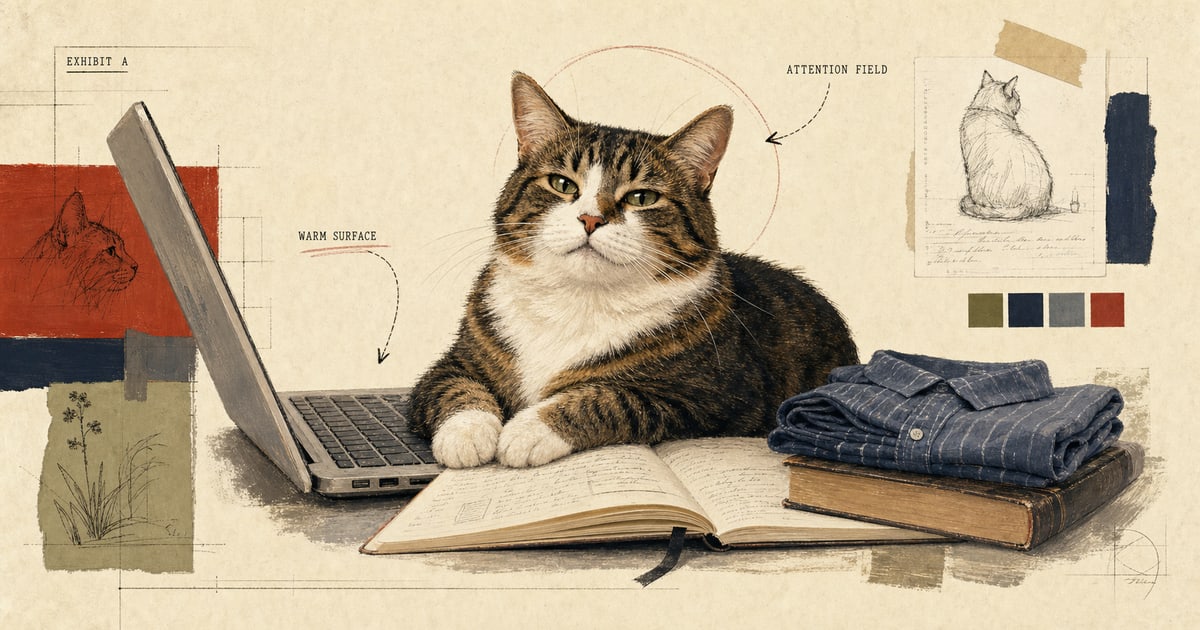
Cats do not sit on the thing you are using because they respect your schedule.
They sit on the laptop, the book, the tax form, the folded shirt, the one sheet of paper with wet ink, because those objects are where the human’s attention is pointed. Also, sometimes they are warm. Also, sometimes they smell like you. Also, sometimes the cat is a cat and the answer is simply: because available.
The mistake is assuming there must be one reason.
Cat behavior is rarely that tidy. A laptop can be a heat pad, a scent object, a social location, and a lever for making you stop typing all at once. It is a Swiss Army knife of inconvenience.
Cats are excellent at choosing places where several rewards overlap. Warmth, attention, familiar scent, and a flat surface. It is prime real estate.
Attention Has a Location
Cats can be sensitive to human attention.
In a 2019 study on cat sociability, researchers found that cats spent more time near attentive humans than inattentive humans. That does not mean cats are plotting against your spreadsheet with laboratory precision. It does mean they notice when human attention is available, and some cats change their behavior around that.
Your laptop is where your face goes. Your hands go there. Your eyes go there. Your voice goes there too.
From the cat’s point of view, the object may be socially loaded.
If sitting on it makes you look at the cat, touch the cat, speak to the cat, or move the cat, the behavior worked. Even annoyed attention is still attention. Cats are not reviewing the tone notes afterward.
This is the operant-learning problem hiding inside the joke. If the cat sits on the keyboard and a human immediately interacts, the keyboard has become a social button. You may think the interaction was negative because you said “please stop helping.” The cat may only register that the human rejoined the room emotionally.
Warmth Helps
Cats are heat-seeking professionals. Sun patches, fresh laundry, cable boxes, and laptops all have obvious appeal. The exact temperature preferences of domestic cats vary by context, coat, body condition, age, and health, so we should not turn warmth into a universal explanation.
But it is fair to say that a warm, flat object near a favorite human is a strong pitch.
The cat did not choose productivity. The cat chose infrastructure.
Warmth also helps explain why the behavior can seem weirdly targeted. The laptop you are using is warmer than the closed one. The fresh laundry is warmer than the laundry that has reached emotional room temperature. The book in your lap is warm because you are holding it. The cat is not anti-literacy. Probably.
Scent Makes Objects Familiar
Cats use scent in social and spatial ways.
They rub facial and body scent glands on objects, people, and places. A book you handle every night or a sweater you wore all day may smell familiar and safe. Sitting on it may not be a message to you at all. It may just be the cat placing themselves on a known surface in a known room near a known person.
Laundry has power because it is warm sometimes, soft often, and personally implicated.
You thought it was a pile of shirts. The cat saw a family archive.
Scent is also why replacement objects do not always work immediately. You can buy the cat a beautiful bed, but the cardboard box, sweater, or open suitcase may smell more like the household and feel safer. The cat is not rejecting interior design. The cat is reading a different set of values.
Why This Belongs in a Portrait
The object matters.
Not every portrait needs a prop. Many are strongest as classic busts with the pet’s face, coat, and expression carrying the piece.
But if your cat has a signature object, include it in the reference set. The laptop they conquered. The book they used as a bed. The quilt they claimed. The cardboard box that defeated all purchased furniture.
Objects can make a portrait feel lived in. They move the artwork from “beautiful cat” to “that is Oliver, who interrupted every call for six years.”
Those details can help the story. They can also be edited down when the portrait needs to feel cleaner. That is the advantage of a custom portrait making specific visual decisions instead of a template flattening everything into generic cuteness.
Digital portraits start at $24.99, with a proof in 2 to 3 business days and unlimited revisions. Start your portrait here.
The best prop is the one that explains something without stealing the painting. A laptop corner, a book edge, a quilt color, or a familiar chair can be enough. You do not need every charger, coffee mug, and invoice preserved with historical rigor. Future scholars will manage.
How to Photograph the Evidence
Take the photo before moving the cat.
Use natural light if possible. Step back enough to show the full pose. Then take one closer face photo, because the funny laptop sprawl may not show eye color or whisker detail well enough for the final portrait.
Good reference combinations:
- one environmental photo with the cat on the object
- one close-up of the face
- one side photo showing markings
- a note explaining whether the object should appear in the portrait
If the cat is sitting on something visually ugly but emotionally perfect, say so. The artist can keep the idea without preserving every cord, crumb, and badly placed charger.
If you want the object included, photograph it clearly once without the cat too. That gives the artist color, shape, and texture information without asking the cat to hold a pose. Cats generally do not accept art direction unless it was their idea first.
The cat is not sabotaging you.
Probably.
The cat is choosing warmth, scent, attention, and status inside the tiny empire of your desk.
Which, to be fair, was clearly theirs.
Sources
- Kristyn R. Vitale and Monique A. R. Udell, “The quality of being sociable: The influence of human attentional state, population, and human familiarity on domestic cat sociability”, Behavioural Processes, 2019.
- Lauren R. Finka, “Conspecific and Human Sociality in the Domestic Cat”, Animals, 2022.
- Cats Protection, “Why do cats like sitting on things?”
Welcome perk
Free expedited delivery on your first portrait
Get your digital proof in 1-2 business days instead of 2-3, free on your first portrait. Normally a $10 upgrade.
No spam. Just the perk and the occasional new style or guide.
Check your inbox for your code.