
On September 23, 1870, a Missouri lawyer stood up in a courtroom in Warrensburg and gave a closing argument for which the actual legal case has been almost entirely forgotten.
The case was about a dog named Old Drum, a foxhound shot by a neighboring farmer who claimed the dog had been killing his sheep. The dog’s owner sued. George Graham Vest, representing the plaintiff, decided that the facts of the matter were less compelling than the principle behind them, and he delivered what became one of the most-quoted speeches in American legal history. He never mentioned the specific dog. He talked about dogs.
“The one absolutely unselfish friend that a man can have in this selfish world, the one that never deserts him, the one that never proves ungrateful or treacherous, is his dog.”
The jury awarded damages. The speech was reprinted across the country. Vest went on to become a United States Senator. Old Drum got a bronze statue in 1958.
The speech worked because it was saying something that felt obvious to almost everyone who heard it, which is the condition required for a piece of rhetoric to travel. Not that it was saying something new. That it was finally saying something everyone already knew.
Why Loyalty, Specifically
Dog quotes are about a lot of things. Companionship. Simplicity. Acceptance. The philosophical inadequacy of humans by comparison. But the dominant theme, the one that appears from Homer to the internet, is loyalty.
This is not an accident. It reflects something real about the history.
Dogs have been domesticated for somewhere between 14,000 and 40,000 years depending on which genetic analysis and which definition of domestication you use. The precise number is still being argued. What is not in dispute is that dogs were the first domesticated animal, predating agriculture, and that they co-evolved with humans across a period long enough that the relationship has shaped both species at a biological level.
During most of that time, the relationship was practical. Dogs hunted with humans, guarded settlements, provided warmth, and disposed of refuse. There was no cultural industry producing dog content. The relationship was simply there, embedded in daily survival, in the way that reliable things become invisible.
When people began writing about dogs, they were writing about an animal they had already been living with intimately for thousands of years. The loyalty they described was not a projection onto an unfamiliar creature. It was an observation about something they had been depending on and watching carefully for longer than civilization had existed.
Argos and Why the Scene Still Works
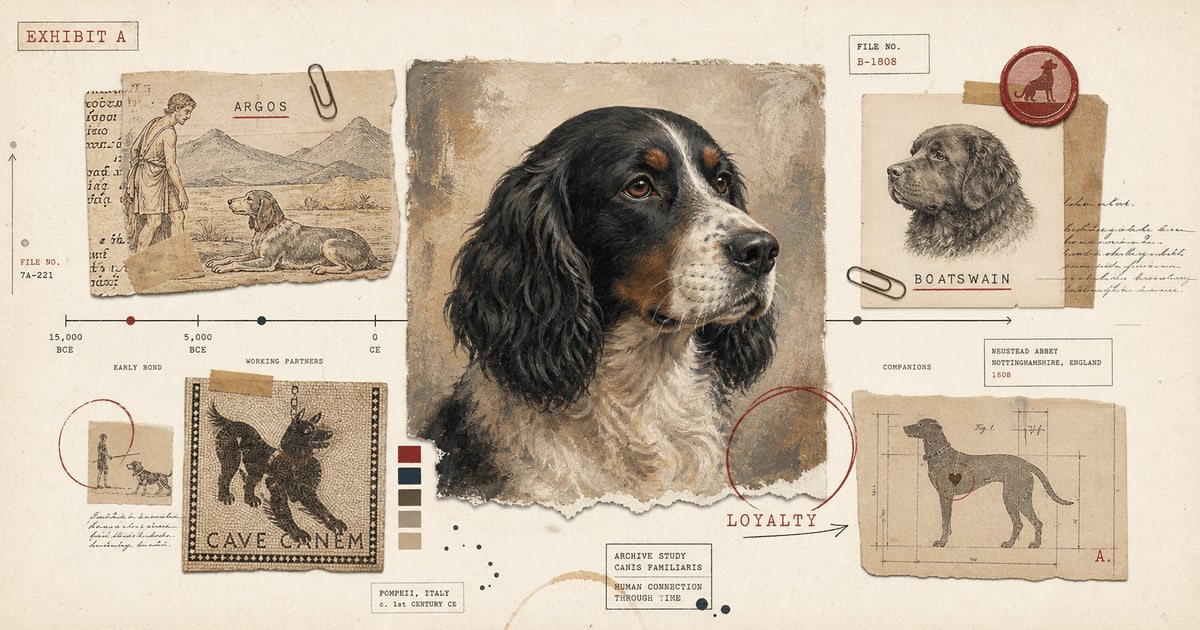
Homer’s Odyssey, composed somewhere around the 8th century BC, contains one of the oldest and still most effective loyalty scenes in any literature. Odysseus returns to Ithaca after twenty years, disguised as a beggar. He is not recognized by the people who should know him best. His house is full of men eating his food and competing for his wife.
His dog, Argos, is lying on a dung heap outside the door. Old, infested with fleas, ignored by everyone. When Odysseus approaches, Argos raises his head, wags his tail, and dies. He has waited twenty years. He recognizes his person in disguise when no one else does. Then he is done.
The scene has survived roughly 2,800 years of cultural change intact. It still works. The reason is that it asks nothing of the reader by way of explanation. You either recognize the moment or you don’t, and almost everyone who has had a dog recognizes the moment.
Homer was not making a philosophical argument about canine fidelity. He was using a piece of lived experience as shorthand for a feeling that resisted direct expression. That shorthand has been passed forward from writer to writer ever since, which is how a detail from an ancient Greek epic ends up structuring a modern greeting-card section.
Byron and the Backhanded Compliment
Lord Byron’s epitaph for his Newfoundland dog Boatswain, written in 1808, is more complicated than it appears and funnier than it is usually given credit for.
The famous lines praise the dog for “beauty without vanity, strength without insolence, courage without ferocity, and all the virtues of man without his vices.” This is not, when you read it slowly, a simple tribute to a dog. It is a list of ways humans fall short. The dog provides the contrast that makes the human failure visible. Byron is writing about his dog and insulting his contemporaries with the same pen.
This technique appears so often in dog writing that it has become its own genre. The dog is loyal: humans are not. The dog loves unconditionally: humans do not. The dog holds no grudges: humans are professionally accomplished at holding grudges. The dog requires no explanation or justification: humans require both and usually produce neither adequately.
Most dog quotes, when you strip the sentiment down to its structure, are about human disappointment wearing the costume of canine affection.
That is not a criticism of the quotes. The comparison is often accurate. But it explains why dog quotes travel so reliably across cultures and centuries. They are not just about dogs. They are about what people find difficult in each other and recognize, perhaps enviously, in another species.
The Science of What “Loyalty” Actually Is
This is where things get interesting, because “loyalty” is not a scientific term.
Behavioral researchers studying the dog-owner relationship use the word “attachment.” The Hungarian ethologist József Topál and his colleagues at the Hungarian Academy of Sciences adapted Ainsworth’s Strange Situation procedure, a tool developed to measure attachment bonds in human infants, to dogs and their owners in the late 1990s. The results showed that dogs display the behavioral markers of secure attachment: proximity-seeking, distress at separation, use of the owner as a safe base for exploration, and quick recovery of normal behavior when the owner returns.
These are the same markers used to identify attachment bonds in human children. The parallel is close enough that researchers have argued, with some care, that the dog-owner relationship functions as an interspecific attachment relationship, not just a behavioral analogy.
What gets culturally described as “loyalty” is, at the behavioral level, primarily this: an attachment bond expressed through consistent proximity-seeking, strong preference for a specific person over others, and a secure-base effect in which the presence of that person measurably reduces stress responses.
Dogs are not loyal in the way that a soldier is loyal to a country, through conscious obligation to an abstraction. They are loyal in the way that an infant is loyal to a mother: through a deep, biological, experience-shaped bond to a specific individual. The bond is real. It is physiologically measurable. It is not, in the philosophical sense, a chosen commitment.
The language of loyalty imposes a moral framework onto what is, underneath the language, a social attachment system. The two things are not identical, but the gap between them is smaller than critics of dog sentiment usually acknowledge. A bond that produces proximity-seeking, distress at separation, and reduced fear in the attached individual’s presence is doing something meaningful. The fact that we call it loyalty rather than attachment is a difference of vocabulary, not a difference of fact.
Why “Man’s Best Friend” Arrived When It Did
It is interesting that the phrase “man’s best friend” became widespread in the 19th century. Dogs had been living with humans for thousands of years before that. The sentiment was not new. The specific cultural prominence of the loyalty framing was.
Research on the history of how dogs appear in proverbs and written language suggests that for most of recorded history, dogs appear in a much less flattering light. Ancient and early medieval proverbs often use “dog” as an insult: low, scavenging, unclean. The biblical term is generally unflattering. Medieval heraldry uses dogs but the dog is typically a symbol of fidelity in a heraldic sense, a formal quality, not a warm domestic virtue.
The shift toward dogs as emblems of warm loyalty tracks the shift toward dogs as pets rather than working animals, which accelerates in the 18th century in Europe and continues through the 19th. As dogs moved indoors and became companions rather than tools, the human emotional investment in them changed, and the language changed to match.
Vest’s 1870 speech is a product of this cultural moment. The sentiment was already widespread. He gave it a legal stage and a memorable formulation. Essentially, he said what people already believed in the context where it would do the most work.
What the Quotes Get Right
The loyalty framing oversimplifies. It borrows moral vocabulary to describe behavioral biology. It sometimes tips into sentiment so thick it is hard to see through. Some dog quotes are genuinely unreadable.
And yet the core observation keeps surviving, because the core observation is grounded in something real: the dog-human relationship is old, deep, and marked by a degree of mutual orientation that has very few parallels in human relationships with other animals. Dogs watch us. They track us. They organize their behavior around us in ways that researchers working in canine cognition consistently find surprising in their sophistication.
The word “loyalty” is an imprecise translation of all that behavioral and neurological reality into human emotional language. It is not wrong. It is a shortcut that compresses thousands of years of coevolution and a robust body of attachment research into a single word that most people understand immediately.
The quotes persist because the subject is strong enough to survive weak language. Any honest account of what dogs actually do in relation to the people they are bonded to sounds, when you write it out in plain terms, like a loyalty story. Attachment, proximity-seeking, safe-haven behavior, reduced physiological stress in the presence of one specific person, recognition and preference that outlasts years of separation. If that is not loyalty, the word needs its definition reconsidered.
Old Drum is still out there in bronze in Warrensburg, Missouri. The case he died for is remembered because of the speech it inspired. The speech is remembered because it named something true, if not in the language a scientist would choose.
That tends to be how it goes with dogs. They earn the sentiment. We just keep failing to find language precise enough to deserve them.
Sources
- George Graham Vest, “Eulogy of the Dog”, trial speech, Warrensburg, Missouri, 1870.
- Homer, The Odyssey, Book 17, Argos scene, Perseus Digital Library translation.
- Lord Byron, “Epitaph to a Dog”, Newstead Abbey, 1808, Wikisource.
- József Topál et al., “Attachment Behavior in Dogs (Canis familiaris): A New Application of Ainsworth’s (1969) Strange Situation Test”, Journal of Comparative Psychology, 1998.
- Marta Gácsi et al., “Human Analogue Safe Haven Effect of the Owner: Behavioural and Heart Rate Response to Stressful Social Stimuli in Dogs”, PLOS ONE, 2013.
- Amelia Soth, “Man’s best friend, Wikipedia: etymology and history of the phrase”, Wikipedia, on the shift in dog-related language and proverbs.
Welcome perk
Free expedited delivery on your first portrait
Get your digital proof in 1-2 business days instead of 2-3, free on your first portrait. Normally a $10 upgrade.
No spam. Just the perk and the occasional new style or guide.
Check your inbox for your code.