A border collie named Chaser, raised by a retired psychology professor in Spartanburg, South Carolina, learned 1,022 object names over three years. Not categories. Individual names: a specific plush animal was “blue” and a different one was “AC/DC.” She could retrieve any one of a thousand objects on command, identify a new object she had never seen before by reasoning that the unfamiliar name must refer to the unfamiliar thing, and parse verb from noun in a command to understand whether she was supposed to paw the item, put her nose on it, or carry it. Her researchers stopped at 1,022 objects not because Chaser had reached her limit, but because Pilley, who trained her four to five hours a day for three years, had reached his.
The reason this matters: when your dog brings you something at the door, it may not be grabbing randomly. It may know what it is holding.
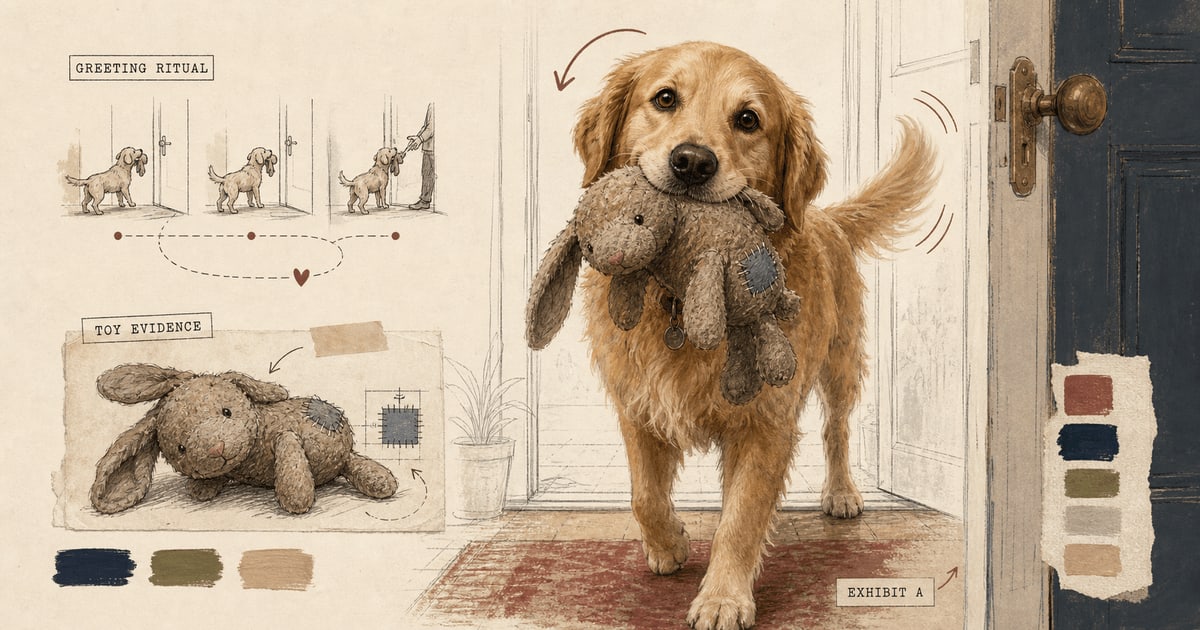
We have assembled the evidence of the doorway ritual for years without pressuring the theory behind it. The tail at full amplitude. The full-body vibration. The mouth full of the same wrecked rabbit, the same bald tennis ball, the same rope toy that has survived things rope toys were never designed to survive. We interpret this as gift-giving, as loyalty, as the dog attempting to communicate love in the only material vocabulary available. Those interpretations are not wrong. They are doing less work than the data allows.
Here is what is actually happening.
Your arrival is a high-arousal event. The dog has been at a certain emotional equilibrium for hours, and you walking through the door ends it abruptly. The energy needs somewhere to go. Niko Tinbergen and Konrad Lorenz, working in the mid-20th century, described what they called displacement behavior: when an animal faces competing drives that cannot both be expressed simultaneously, it redirects into a secondary action. The behavior is not fake or confused. It is the nervous system choosing an outlet under pressure. Nail-biting at airport security. Cleaning the counters before a difficult conversation. Your dog picking up whatever is nearest to the door. A 2023 paper in PLOS ONE confirmed that displacement behaviors in dogs appear specifically in high-arousal, ambiguous social contexts, precisely the conditions of a homecoming.
The toy is not a gift. It is a pressure valve. That is not a deflating interpretation. It means your arrival creates a state large enough to require active management. You are, neurologically speaking, an event.
Retrievers Were Built for This Moment
For certain breeds, the picture is more layered. Labrador retrievers, golden retrievers, Chesapeake Bay retrievers. These dogs were refined over centuries to carry game from water to hand without damaging it. Soft mouth, object drive, a constitutional predisposition to pick things up and bring them to people. A genome-wide association study on dog behavioral genetics found significant neurological gene variants linked to retrieving-type behaviors that differ sharply between gun-dog breeds and others. When a golden meets you at the door with a toy, it is not improvising. It is doing what it was built to do, at the emotional pitch the build anticipated.
This is why the behavior maps so clearly onto breed lines. A border collie presenting an object may be doing something closer to referential communication, demonstrating an item it knows, the way Chaser demonstrated vocabulary. A terrier meeting you at the door with nothing but its full attention is doing terrier things: terriers were not bred to carry, they were bred to locate and dispatch, and they bring those instincts to the greeting with complete conviction. The absence of a toy greeting is not reduced affection. It is a different set of original instructions.
There is also a practical dimension that gets less attention than it deserves. A dog with its mouth full cannot mouth your hand. For a dog at the edge of over-arousal (not aggressive, just too excited to be careful), an occupied mouth is its own solution. Whether or not anyone trained this consciously, those dogs that happened to grab something before greeting received calmer human responses: no yelp, no withdrawal, no correction. The behavior that worked was the behavior that persisted.
What the Chemistry Actually Shows
What none of the mechanical explanations fully account for is oxytocin. Nagasawa and colleagues, measuring hormone levels during dog-owner interactions, found elevated levels in both dogs and their owners. The same bonding hormone involved in human infant attachment. The loop Nagasawa documented is specific to domestic dogs. Wolves raised by humans do not produce it. Dogs do, and they appear to have co-evolved the capacity for it alongside humans: dogs that gazed at people released bonding chemistry in people, which increased care toward the dog, which selected for more gaze-seeking dogs. The mechanism has been running for somewhere between fifteen thousand and forty thousand years.
The specificity matters. Nagasawa’s team tested wolves that had been raised by humans from infancy, socialized to people, and living in close contact with them. The wolves did not produce the loop. Only domestic dogs did. This is not about familiarity with humans. It is about a trait that was selected during domestication itself, probably as part of the same cluster of changes that made dogs tolerant of human proximity, responsive to human social cues, and capable of reading human pointing gestures in ways that wolves cannot. The dog that brings you a toy is the product of several thousand generations of animals selected specifically for living alongside people. The toy greeting is one small visible output of that whole invisible process.
Learned behavior explains why the ritual persists: if the first toy greeting made you laugh, kneel down, and start a game, the association was filed. But conditioning explains the maintenance, not the origin. The dog reached for the bunny before it knew it would work. The reaching was the affect. The learning was just the filing system.
The bunny is not the point. It is what the dog puts in its mouth while everything else is happening.
If your dog greets you with the same object consistently (the same battered rabbit, the same tennis ball that has lost the dignity of felt), that toy has years of this ritual attached to it. It is biographical information, not a prop.
A portrait that includes it makes a different claim than one without it. Not “here is a dog” but “here is Milo, and this is what Milo needed to be holding when you came home.” Photograph the toy separately, in good light, for the artist’s reference. The greeting photo captures the emotion, a close face shot provides the portrait detail, and the separate toy photo gives the artist the texture and wear pattern without asking the dog to hold a pose. Digital portraits start at $24.99, proofs in 2 to 3 business days. Start here.
The subject is still the dog. The toy is just how the dog was explaining itself.
Sources
- John W. Pilley and Alliston K. Reid, “Border collie comprehends object names as verbal referents”, Behavioural Processes, 2011.
- Kuhne, F. et al., “Appeasement function of displacement behaviours? Dogs’ behavioural displays exhibited towards threatening and neutral humans”, PLOS ONE, 2023.
- Ilska, J. et al., “Genome-Wide Association Studies Reveal Neurological Genes for Dog Herding, Predation, Temperament, and Trainability Traits”, Frontiers in Veterinary Science, 2021.
- Miho Nagasawa et al., “Oxytocin-gaze positive feedback between humans and dogs”, Science, 2015.
- John W. S. Bradshaw, Anne J. Pullen, and Nicola J. Rooney, “Why do adult dogs play?”, Behavioural Processes, 2015.
Welcome perk
Free expedited delivery on your first portrait
Get your digital proof in 1-2 business days instead of 2-3, free on your first portrait. Normally a $10 upgrade.
No spam. Just the perk and the occasional new style or guide.
Check your inbox for your code.