In 2017, a research team in Budapest published a study showing that dogs who slept after a learning session performed better on memory tests than dogs who stayed awake. The improvement in performance correlated with specific patterns of neural activity during sleep, the same kind of memory consolidation mechanics observed in humans. The dogs were not just resting. They were processing.
This is worth saying at the start because it reframes what sleeping dogs look like. The dog on your couch, paw extended perpendicular to the rest of its body, spine at an angle that seems to defy skeletal anatomy, is not simply switched off. It is engaged in neurological housekeeping that mammals, including humans, have been doing for hundreds of millions of years. The ridiculous position is incidental. The process happening inside it is not.
Dogs Sleep a Lot, and That Is the Point
Adult dogs sleep an average of twelve to fourteen hours a day. Puppies and seniors sleep more, sometimes eighteen or twenty. This is not laziness in any meaningful sense. Dogs are polyphasic sleepers, meaning their sleep is distributed across multiple bouts throughout the day and night rather than consolidated into one long stretch, the way human sleep is ideally organized. A dog’s sleep cycle runs roughly twenty minutes, compared to a human’s ninety-minute cycle.
This polyphasic pattern has a practical consequence: dogs fall asleep quickly and can appear to transition from alert to fully asleep in under a minute. It also means they enter different sleep stages faster than humans do. The paw twitches you see during a nap, the soft whimpers, the leg movements that look exactly like running in place, those happen during REM sleep, the stage in which dreaming occurs.
REM sleep in dogs produces brain activity patterns nearly identical to those seen in dreaming humans. Matthew Wilson and Kenway Louie at MIT tracked rats navigating mazes, then monitored their neural activity during sleep. The same patterns reappeared during REM, showing that the animals were replaying the experience. The architecture of mammalian brains is similar enough across species that dogs are widely accepted to do the same thing. Dr. Deirdre Barrett, a psychologist at Harvard Medical School, has described dogs as likely dreaming about the activities and relationships that filled their day. The dog running in its sleep may be running the same route it ran that morning.
Whether dogs have rich subjective dream experiences, in the way humans report dreams as felt narratives, is not something neuroscience can currently answer. What research can establish is that the same neural infrastructure for dreaming is present and active. The sleeping dog twitching on the floor beside you is doing something specific with that twitching.
What Sleep Positions Actually Reflect
There is no authoritative scientific dictionary that maps every sleep position to a psychological state. Anyone who tells you a specific paw configuration indicates a specific emotion is guessing with confidence, which is different from knowing. That said, certain positions do correlate with physiological conditions that have real implications.
The curled position, where the dog tucks legs under the body and draws the tail around toward the nose, is the most ancient mammalian sleep posture. It conserves heat by minimizing the body surface exposed to air. Dogs who curl in cold environments, or on hard or unfamiliar surfaces, are doing straightforward thermoregulation. Dogs who curl habitually even in warm, comfortable settings may simply prefer the shape, or may feel more secure with the body closed and protected. In genuinely anxious or unfamiliar environments, curling is the defensive sleep posture.
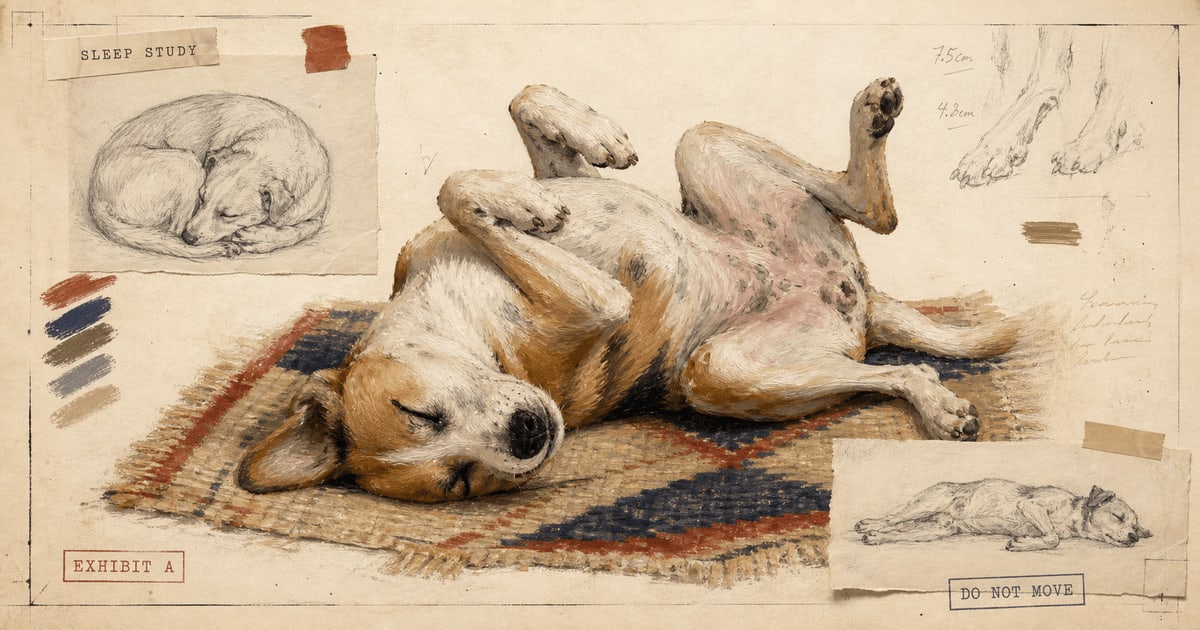
The belly-up position is the opposite of defensive. The dog’s abdomen is exposed, the legs are loose and pointed in various directions that suggest the skeleton has given up negotiating. The belly carries relatively sparse fur in most breeds, and exposing it to the air can help with heat dissipation in warm environments. But the thermoregulation angle is secondary to what the posture reveals structurally: a dog sleeping on its back has made no attempt to protect its vital organs or maintain a posture that allows rapid movement. This position requires a baseline of security. An animal that feels threatened does not sleep like an overturned table.
The side-sleeping position is common in dogs who are fully relaxed and comfortable, as opposed to just briefly resting. The limbs are extended, the body is loose, the breathing tends to be slow and deep. This is often when REM sleep occurs, when the twitching and vocalizing happen. A dog who regularly sleeps on its side in a given spot is telling you something about how it feels in that spot.
The sprawl, sometimes called the Superman position, front legs extended forward and hind legs behind, is common in puppies and in dogs who overheat easily. The belly contact with a cool floor aids temperature regulation. High-energy dogs often collapse into this position immediately after exertion and transition from it into deeper sleep.
The pretzel, the category in which your dog appears to be testing whether vertebrae are optional, happens most often on soft surfaces that support eccentric angles. Couches, dog beds, and piles of clean laundry (not scientifically validated but observed repeatedly) provide enough support for positions that would be structurally impossible on hardwood. Most of these are harmless. A sudden change in sleep position, unusual restlessness, or apparent difficulty getting comfortable is worth veterinary attention, since changes in sleep behavior can reflect pain, musculoskeletal issues, or in older dogs, cognitive changes.
The Memory Piece
The Budapest research is worth returning to. Kis et al. in 2017 found that sleep spindles, brief bursts of neural activity in the non-REM stage, correlated with learning performance in dogs. Dogs who showed more spindle activity during post-learning sleep retained more of what they had learned. This is the same mechanism found in human memory research. Sleep is not recovery from experience. It is, in part, the consolidation of experience.
This means the dog who learned three new commands on Tuesday morning and then slept for three hours on Tuesday afternoon was not wasting the afternoon. The afternoon was part of the Tuesday curriculum.
It also means that when a dog is sleeping in whatever spectacular configuration it has chosen, something is being organized and stored inside that improbable stillness. The dog with one paw on the coffee table and its chin on the floor is processing. It is just doing so in a way that makes you want to take a photo.
On Sleeping Portraits
A sleeping dog shows something that an alert portrait cannot: the private geometry of an animal that trusts the room completely. The soft mouth, the slack paws, the specific curl of the tail around the body, the way the ears fall when nobody is watching. These details are part of who the dog is, and they are only visible when the dog is not performing anything.
Sleeping reference photos work well for portraits when they include enough of the face to establish likeness, and when the light is not the yellowish indoor glow of a phone camera at eleven at night. Natural light near a window changes everything. If your dog naps in a reliable spot with decent light, that is the photo. Send a clear awake photo alongside it if you want the eyes to be accurate, and let the artist use both.
The sleeping portrait is not second best. Sometimes it is the most accurate version of the animal you lived with.
Sources
- Kis A. et al., “The interrelated effect of sleep and learning in dogs (Canis familiaris): An EEG and behavioural study”, Scientific Reports, 2017.
- Iotchev I.B. et al., “EEG Transients in the Sigma Range During non-REM Sleep Predict Learning in Dogs”, Scientific Reports, 2017.
- Kis A. et al., “Developmental features of sleep electrophysiology in family dogs”, Scientific Reports, 2021.
- Woods H.J. et al., “A functional linear modeling approach to sleep-wake cycles in dogs”, Scientific Reports, 2020.
- Barrett D., commentary on animal dreaming, Harvard Medical School, widely cited in popular science reporting on dog REM sleep.
Welcome perk
Free expedited delivery on your first portrait
Get your digital proof in 1-2 business days instead of 2-3, free on your first portrait. Normally a $10 upgrade.
No spam. Just the perk and the occasional new style or guide.
Check your inbox for your code.