Wolves, even wolves raised by humans from birth and socialized to people over years, do not stare at their handlers the way domestic dogs stare at their owners. This is not a minor detail. It is the whole story in one sentence.
The dog’s capacity for sustained, relaxed eye contact with a human is not a universal feature of social predators. It is a specific adaptation, probably selected for during the tens of thousands of years dogs spent living alongside people. The domestic dog became something wolves are not: an animal for whom looking at humans is, neurologically speaking, rewarding.
Understanding what that means, and what the research actually shows, requires resisting the temptation to explain away a complicated finding in either direction. Dog owners often want the stare to mean more than it does. Skeptics want it to mean less. The science lands somewhere in the middle, which is the place where interesting things usually live.
What the Nagasawa Study Actually Found
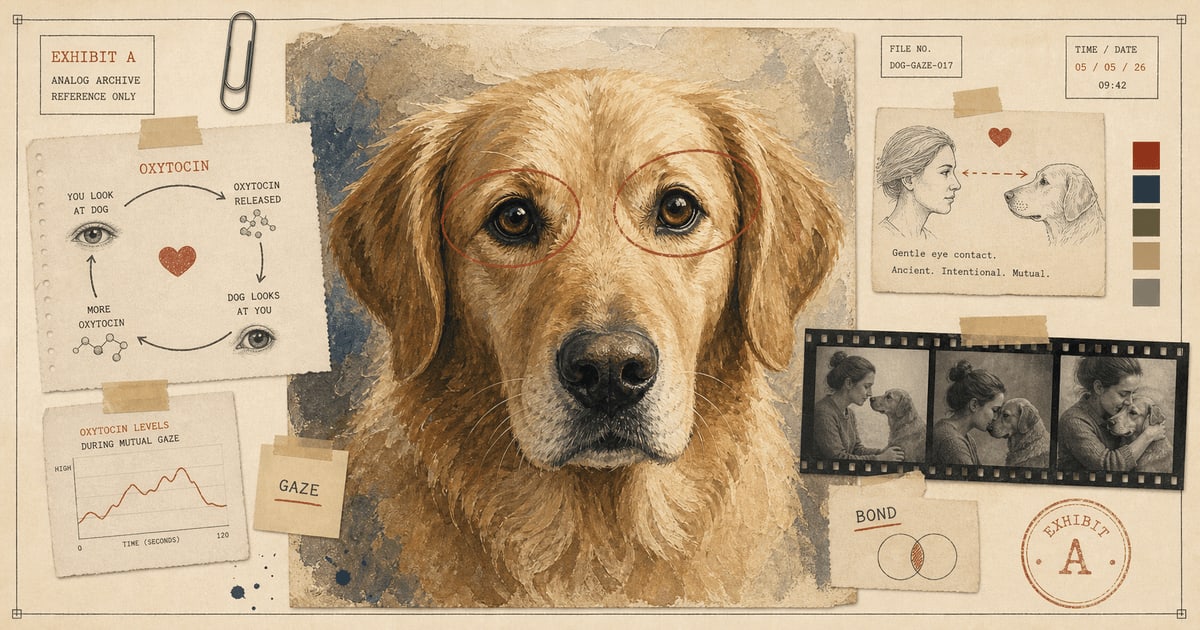
In 2015, Miho Nagasawa and colleagues published a study in Science that should have settled more arguments than it did. The study measured urinary oxytocin concentrations in dogs and their owners before and after interaction. The experimental condition included sustained mutual gaze: dog and person, looking at each other.
Oxytocin rose. In both parties. The same hormone that facilitates bonding between human mothers and newborn infants was circulating in a person and an animal who had been sitting and looking at each other. The researchers also found that when they administered oxytocin nasally to dogs, those dogs spent more time gazing at their owners, which in turn raised the owners’ oxytocin. A positive feedback loop, running in both directions.
Then they ran the same experiment with wolves and their human handlers. Wolves who had been raised by people, socialized to humans, living in close proximity to them. The loop did not activate. The wolves didn’t hold the gaze, the oxytocin didn’t spike, and the bond-building feedback that functions in dogs simply was not present.
This is where the wolf comparison becomes important. It tells us that this capacity for gaze-mediated bonding is not just what happens when any large mammal spends time around people. It is something that was shaped in dogs specifically. The study’s authors suggest this gaze-oxytocin loop may be one of the mechanisms by which the human-dog bond was built and maintained across generations.
What oxytocin is not, though, is a synonym for love. It is a hormone involved in social bonding and affiliation, and its presence doesn’t prove any particular emotional interior. What the study demonstrates is something more interesting and more modest: mutual gaze between a dog and its owner activates a neurochemical system associated with attachment. The look means something, physiologically. It is not decoration.
The Anatomy That Made It Possible
In 2019, Juliane Kaminski and colleagues published a complementary finding in the Proceedings of the National Academy of Sciences. They dissected the facial muscles of dogs and wolves and found a meaningful anatomical difference: dogs have a specific muscle, the levator anguli oculi medialis, that wolves largely lack. This muscle raises the inner corner of the eyebrow, producing what gets described colloquially as “puppy dog eyes.”
The behavioral data matched the anatomy. Dogs produced this eyebrow movement more frequently and with higher intensity than wolves. The highest-intensity movements were produced exclusively by dogs. When dogs raised their inner brows, humans responded: they made eye contact, they leaned in, they reached out. The dog that looked back at you did not only look at you because of its brain chemistry. It looked at you with a face built, over thousands of years of selection pressure, to make you look back.
We did not decide to love dogs like family. Somewhere along the line, in a process nobody planned, the dogs that got fed were the ones that could hold a human’s gaze. The rest is consequence.
What Different Stares Mean
None of this means every stare is a bonding event. Dogs look at people for many reasons, and reading the situation requires paying attention to more than the eyes.
The soft social stare is the one Nagasawa was measuring. It comes with a relaxed body, a loose mouth, blinking, possibly a slow wag. The dog may shift its gaze between you and something nearby: the door, a toy, the cabinet where treats are stored. This stare is often conversational in structure. The dog is checking in, asking a question, or keeping tabs on the most interesting thing in the room.
The resource stare is different. A dog guarding food, a toy, a sleeping spot, or personal space may stare with stillness and intensity: body frozen, mouth closed, head level or lowered, no blinking. This is not a bonding signal. It is a warning. Leaning into it and narrating it for social media is a predictable way to have a bad afternoon.
The attention stare is the one most owners know best. Something is wanted. The bowl is empty. The leash is there and you have not moved toward it. The dog has been waiting for a walk since approximately eleven this morning and has now decided to communicate this through sustained visual contact. This stare is learned: if looking at the leash hook produces a walk, the dog will look at the leash hook. If looking at you when you are eating produces a piece of cheese, the dog will look at you when you are eating. Dogs are excellent at converting small human responses into reliable mechanisms. That is not manipulation. It is learning, which is what intelligent animals do.
The alert stare, directed at a window or doorway rather than at you, indicates that the dog has detected something: a sound, a smell, a visual stimulus outside its resolved area. These stares are usually accompanied by stillness and lifted ears.
The body gives you the translation. Eyes alone are not the whole message.
What This Does to Portraits
The eyes are where most owners recognize their dog first. Not the coat, not the breed silhouette, not even the markings. The look.
One dog looks expectant. Another looks solemn. Another appears to have harbored a quiet grievance since early morning. A portrait that captures the right expression in the eyes carries the animal’s personality in a way that technically correct rendering of fur cannot replicate on its own. If the eyes are wrong, the portrait feels wrong, even if everything else is accurate. If the eyes are right, the rest of the painting follows.
The best reference photo for a portrait is the soft social stare: the dog looking at the camera, face relaxed, the kind of look that actually happens in your house. If the photo was taken during tension, guarding, or extreme excitement, it may preserve the anatomy but lose the feeling. Send the photo where the eyes feel like your dog at home.
Sources
- Nagasawa M. et al., “Oxytocin-gaze positive loop and the coevolution of human-dog bonds”, Science, 2015.
- Kaminski J. et al., “Evolution of facial muscle anatomy in dogs”, PNAS, 2019.
- Johnston A.M. et al., “Uncovering the origins of dog-human eye contact: dingoes establish eye contact more than wolves but less than dogs”, Animal Behaviour, 2017.
- Gácsi M. et al., “Human Analogue Safe Haven Effect of the Owner”, PLOS ONE, 2013.
Welcome perk
Free expedited delivery on your first portrait
Get your digital proof in 1-2 business days instead of 2-3, free on your first portrait. Normally a $10 upgrade.
No spam. Just the perk and the occasional new style or guide.
Check your inbox for your code.