
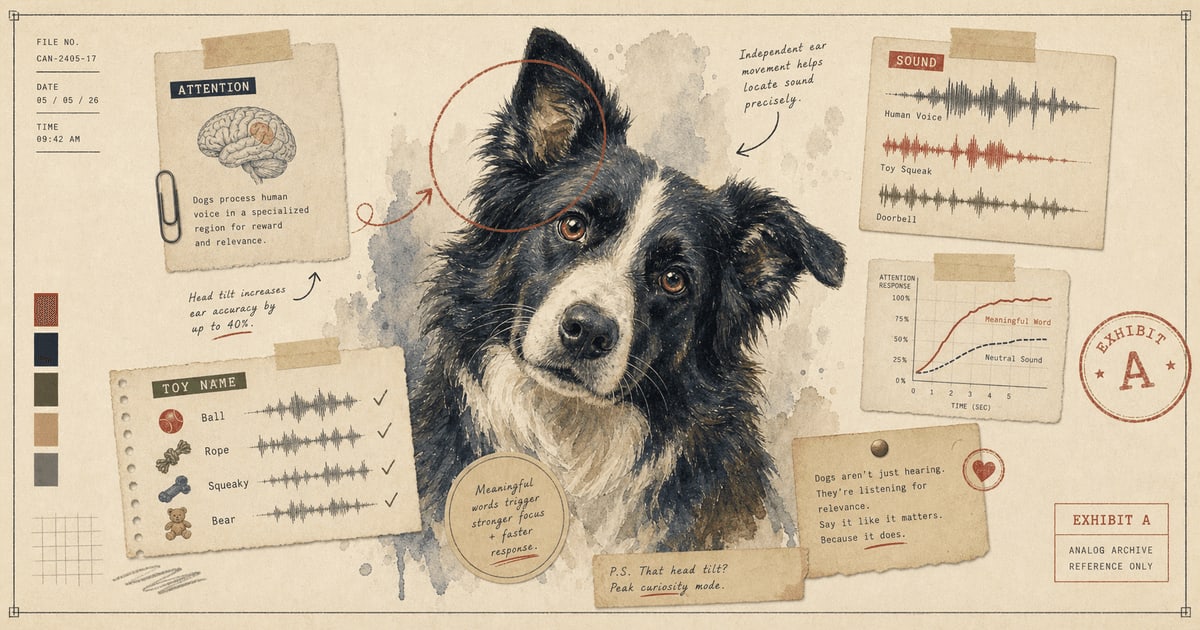
There is a small group of dogs, scattered around the world, who know the names of dozens of toys. Not in the vague way that most dogs know “ball” or “rope,” but with genuine accuracy: you say the name, they retrieve the correct object from a pile of others. Researchers call them Gifted Word Learners, which is a title that sounds like it was handed out at a ceremony. In experiments, these dogs tilt their heads during verbal tests about 43 percent of the time. Dogs without this unusual word knowledge tilt their heads during the same tests about 2 percent of the time.
That number is why the head tilt became a scientifically interesting behavior rather than just a reliable way to make adults stop whatever they were doing.
The Study That Changed the Framing
In 2021, Andrea Sommese and colleagues at the Family Dog Project published a paper in Animal Cognition examining head tilting in dogs during object-label tests. They compared typical family dogs with a small group of gifted word learners, observing what happened when owners asked dogs to fetch familiar toys by name.
The gifted dogs tilted. The typical dogs mostly did not. And the direction of the tilt was consistent: each gifted dog tended to tilt the same way, test after test, across several months of observation.
Two things are notable here. First, the tilt correlated with meaningful verbal stimuli, not just any sound. The gifted dogs were not tilting at background noise or random commands; they tilted when they heard the names of objects they actually knew. The behavior appears to be connected to processing something cognitively significant. Second, the consistency of direction suggests the tilt reflects stable neurological patterns, not random postural fidgeting.
This does not mean dogs who tilt a lot understand more words than dogs who do not. The sample was unusual. Gifted word learners are rare, and the study’s own authors are careful about overgeneralizing. What it suggests is that, at least in some dogs under some conditions, head tilting may be a behavioral correlate of meaningful cognitive processing.
The honest summary: dogs that know the names of things tilt their heads when they hear those names. We do not fully understand why. Several theories are competing, and none has decisively won.
Three Theories, One Still Standing
The most entertaining theory about the head tilt belongs to psychologist Stanley Coren, who proposed that the tilt is about vision, not hearing. A dog’s muzzle projects from its face and blocks the lower portion of a human’s face. Dogs, like humans, are attentive to facial expressions, especially around the mouth. Tilt the head, and the muzzle shifts out of the line of sight.
Coren surveyed hundreds of dog owners about their dogs’ breed type and head tilt frequency. The result was suggestive: 71 percent of owners of dogs with longer muzzles reported frequent head tilting, compared with 52 percent of owners of flat-faced dogs (pugs, bulldogs, that category of animal that breathes like it is filing a complaint). Flat-faced dogs have less muzzle to obstruct the view, and they tilt less. This is not a controlled laboratory study, and survey data from dog owners is about as reliable as any self-reported data, but the correlation is plausible enough to take seriously.
The auditory theory holds that dogs tilt to better localize sound, changing the angle of their ear pinnae to pick up where something is coming from. This is physiologically reasonable. Ears work differently at different angles. Whether this is actually why dogs tilt, in any specific instance, has not been established cleanly.
The brain lateralization angle is more recent. Research on dog cognition has found that dogs process familiar human speech with a right-hemisphere bias, and that this processing is lateralized, meaning different kinds of language (praise words, meaningful words, tone) are processed in different hemispheres. Sommese’s finding that gifted dogs tilt consistently to one side fits this picture: if the tilt reflects which hemisphere is doing the heavy lifting, you would expect consistency of direction. You would not expect random alternation.
None of these three theories is mutually exclusive. A behavior can be multi-determined. Dogs almost certainly did not read the scientific literature before developing their head tilts.
The Reinforcement Problem
There is a fourth factor that any honest account of dog behavior has to include: humans reward the tilt.
Every time a dog tilts its head and a person smiles, softens their voice, makes a high-pitched noise, or reaches for a treat, the behavior gets reinforced. Dogs are good at noticing what produces warm responses. The tilt does not need to have started as a social performance for it to become one. A behavior that originates in auditory processing or visual adjustment can, through a few hundred repetitions, acquire a second career as a reliable way to make the humans act right.
So a dog’s head tilt may be, all at once: a postural adjustment that helps it hear or see more clearly, a correlate of meaningful cognitive processing, a lateralized response to familiar stimuli, and a learned signal for soliciting attention. Behavior that seems simple is usually not.
This is one of the more frustrating features of behavioral science: the explanations that feel satisfying tend to be the ones that reduce a behavior to a single cause. The head tilt is about hearing, full stop. The head tilt is about vision, full stop. Clean, memorable, and probably incomplete. The honest answer is that the tilt belongs to a family of orienting and attending behaviors that dogs use in social and communicative contexts, and it is shaped over time by both biology and experience. Two dogs in the same household can tilt for related but different reasons, and neither of them is wrong about it.
The Consistent Direction
One detail from Sommese et al. is easy to overlook and worth naming explicitly: the gifted dogs did not tilt differently depending on where the owner was standing. The tilt direction was stable regardless of spatial position, which means the behavior was not primarily about orienting toward the sound source. It was about something internal: the processing, not the localization.
Your dog, if it has a preferred tilt direction, may be showing you something about how its brain handles certain kinds of input. This is not a diagnostic. It is a structural quirk, the way right-handedness is a structural quirk. The tilt is not a window into deep cognitive capacity. But it is probably not nothing, either.
What Happens When Dogs Do Not Tilt
It is worth saying plainly: many dogs tilt infrequently or not at all. This does not indicate a cognitive deficit, emotional distance, or disinterest in the person talking to them. Some dogs respond to meaningful stimuli by becoming very still, by orienting their whole body, by intensifying their gaze, rather than by any visible head movement. The outward behavior is a poor proxy for the internal response.
The Sommese study found a correlation between the head tilt and a specific kind of word knowledge in a specific group of unusual dogs. It did not find that tilting predicts comprehension in typical dogs, or that the absence of tilting indicates the absence of processing. A dog can understand “walk” perfectly well and react with a full-body sprint to the door without tilting once. The tilt is one output of a system that has many possible outputs.
For a portrait, the consistent tilt matters practically: a dog with a signature lean has a signature angle. One ear lifts higher from the left. One eye opens wider from the right. The expression in that particular direction looks curious, alive, caught mid-thought, while the same face from the other direction can look flat. If your dog has a recognizable tilt, keep it in the reference photo. It is part of the face, functionally, not just compositionally.
Sources
- Sommese A. et al., “An exploratory analysis of head-tilting in dogs”, Animal Cognition, 2021.
- Coren S., “Why Does My Dog Tilt His Head When I Talk to Him?”, Psychology Today, 2013.
- Ratcliffe V.F. and Ramsay D.A.H., “Discrimination of Emotional Content from Novel Human Facial Expressions and the Occurrence of Dog ‘Head Tilting’”, cited in Sommese et al., 2021.
- Boros M. et al., “What Does That Head Tilt Mean? Brain Lateralization and Sex Differences in the Processing of Familiar Human Speech by Domestic Dogs”, Animals, 2025.
Welcome perk
Free expedited delivery on your first portrait
Get your digital proof in 1-2 business days instead of 2-3, free on your first portrait. Normally a $10 upgrade.
No spam. Just the perk and the occasional new style or guide.
Check your inbox for your code.