
In 1998, József Topál and colleagues adapted a standard psychological test originally developed to assess attachment in human infants and ran it with dogs. The Strange Situation Procedure, designed by developmental psychologist Mary Ainsworth in the 1960s, works by briefly separating an infant from its caregiver in an unfamiliar environment, then watching what happens when the caregiver returns. It was built to measure the quality of the attachment bond.
When Topál’s team ran this on dogs, the dogs responded the way securely attached infants respond. In the presence of the owner, they explored the room, investigated objects, and tolerated brief interactions with a stranger. When the owner left, their behavior changed: exploration decreased, distress increased. When the owner came back, their behavior settled again. The owner was not just a food source. The owner was functioning as what attachment researchers call a secure base: a point of psychological safety from which exploration becomes possible.
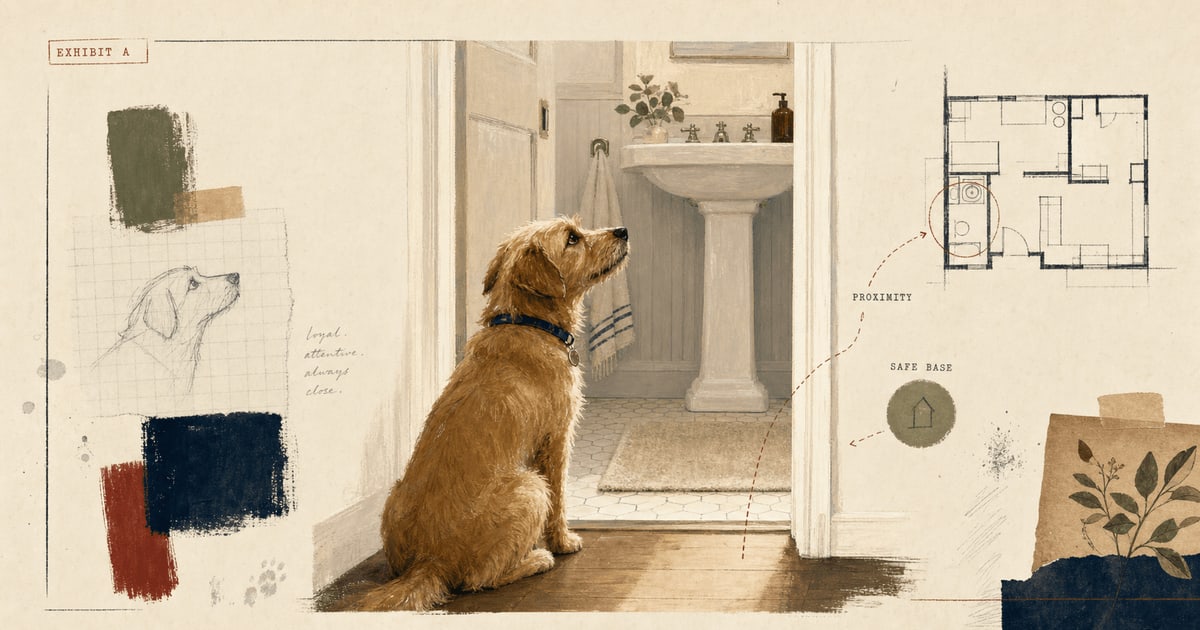
That is why your dog follows you into the bathroom. Not because it wants to watch. Because you are the secure base, you have moved, and the base should move with you.
What the Secure Base Effect Actually Means
Attachment theory, applied to dogs, is sometimes written off as sentimental anthropomorphism: projecting human psychological categories onto animals for emotional reasons. The skepticism is reasonable on principle. On evidence, it does not hold up well.
The secure base effect was tested rigorously by Horn et al. in 2013 in a PLOS ONE study. Dogs were placed in problem-solving situations and given access to their owner, a stranger, or no person at all. When the owner was present and encouraging, dogs tried harder and longer to solve the problem. When the stranger encouraged them, the effect was smaller. When no person was present, it was smaller still. The owner’s presence changed what the dog was willing to do, not because of direct reinforcement, but because of the emotional architecture of the relationship.
This maps closely onto how the secure base functions in human attachment. A securely attached toddler in a park full of interesting things will venture out to explore, periodically return to the parent, then venture out again. The returns are not driven by hunger or immediate need. They are driven by the need to re-anchor to the base before going further. Watch a dog at a dog park and you may see the same pattern: sniff, run, play, circle back to the owner, make contact, leave again. The owner is the fixed point around which the dog organizes its movement through the world.
Following you into the bathroom is, structurally, the same behavior. You moved behind a door. The base is now behind a door. The dog prefers the base to be accessible.
What Normal Shadowing Looks Like
Most dogs who follow their owners closely are not in distress. This is a distinction that gets lost when people use the phrase “separation anxiety” loosely, as though any following behavior is pathological.
Normal shadowing looks like this: the dog follows you from room to room, settles near you when you stop moving, shows mild interest when you leave a room, and resumes normal activity within a few minutes of you being out of sight. The dog may lie outside a closed door. It may get up when you move. It does not damage anything, does not vocalize excessively, does not refuse to eat when you are absent.
Some breeds are structurally inclined toward this. Dogs bred to work closely with humans, herding dogs, hunting companions, retrievers, many terriers, were selected over generations for attentiveness to their handler’s movements. The border collie who watches your every move from across the room is not having an anxiety episode. It is doing something its genetics have been tuned for over centuries.
The following also gets reinforced, often inadvertently. You go into the bathroom. The dog follows. You speak to it, pet it, or laugh at its presence. The next time, the dog follows again. You have, with entirely good intentions, taught the dog that following you into small rooms produces warmth and social contact. This is how most household rituals get built. Not through deliberate training, but through accumulated response.
Where Normal Ends and Distress Begins
Separation-related disorder is something different, and the research on it is fairly clear on what distinguishes it from ordinary closeness.
The clinical picture involves behaviors that occur specifically in the owner’s absence: destructive behavior, elimination inside the house when the dog is otherwise house-trained, excessive vocalization (barking, howling, whining that goes on long after departure), pacing, drooling, or attempts to escape confinement. The dog is not misbehaving or making a point. It is experiencing something close to panic.
Gácsi et al., in a 2013 study on the safe haven effect, measured both behavioral and physiological responses in dogs facing stressful social encounters. Owners’ presence did not eliminate the stressor, but it changed how the dog responded to it: behavior was more organized, heart rate patterns showed less acute stress. This is the regulatory function of the attachment relationship, the same function that explains why anxious humans do better in a stressful medical procedure when someone they trust is in the room. The nervous system is not working alone. It is working in a social context.
A dog with true separation-related disorder is experiencing the regulatory support of the attachment relationship as chronically absent whenever the owner leaves. The distress is not about the bathroom. It is about the baseline insecurity that makes any departure feel like a crisis. This is treatable, and if your dog’s behavior in your absence sounds like the clinical picture above, it is worth consulting a veterinary behaviorist rather than attributing it to devotion.
The Household Social Model
Dogs model their households. This is not metaphor. Research on dog cognition consistently shows that dogs build mental representations of their social environment: who is in the group, what the routines are, who moves where when, what sounds and sequences predict which outcomes.
In a multi-person household, dogs often track the movements of multiple people and calibrate their responses accordingly. The person the dog follows most closely is usually the person the dog has identified as its primary attachment figure, though this is not always the person who feeds the dog or provides the most overt affection. The attachment figure is identified through patterns of interaction, through who is present at moments of stress, through whose presence most reliably produces the safe-base experience.
This means following behavior tells you something about the dog’s social map. Which room has the most social density right now? Where is the person who organizes the dog’s experience of safety? Answering those questions is what a pack animal does in a household of two or three people and some furniture. The bathroom is not special. It just happens to be where you went.
A portrait of a dog who was known for following, who padded after someone from room to room for years, carries that quality best when the expression is close-ranged and attentive. Not anxious, not frantic, but oriented toward the viewer. The kind of face that was always nearby, always checking in, always aware of where you were in the house. That is a different portrait than one of a dog who slept in another room and came when called. Both are real. The first one is a specific kind of company that people feel deeply when it is gone.
Sources
- Topál J. et al., “Attachment behavior in dogs: A new application of Ainsworth’s Strange Situation Test”, Animal Behaviour, 1998.
- Horn L. et al., “The Importance of the Secure Base Effect for Domestic Dogs”, PLOS ONE, 2013.
- Gácsi M. et al., “Human Analogue Safe Haven Effect of the Owner: Behavioural and Heart Rate Response to Stressful Social Stimuli in Dogs”, PLOS ONE, 2013.
- Rehn T. et al., “Links between an Owner’s Adult Attachment Style and the Support-Seeking Behavior of Their Dog”, Frontiers in Psychology, 2017.
- Mariti C. et al., “Intraspecific attachment in adult domestic dogs: Preliminary results”, Applied Animal Behaviour Science, 2014.
Welcome perk
Free expedited delivery on your first portrait
Get your digital proof in 1-2 business days instead of 2-3, free on your first portrait. Normally a $10 upgrade.
No spam. Just the perk and the occasional new style or guide.
Check your inbox for your code.