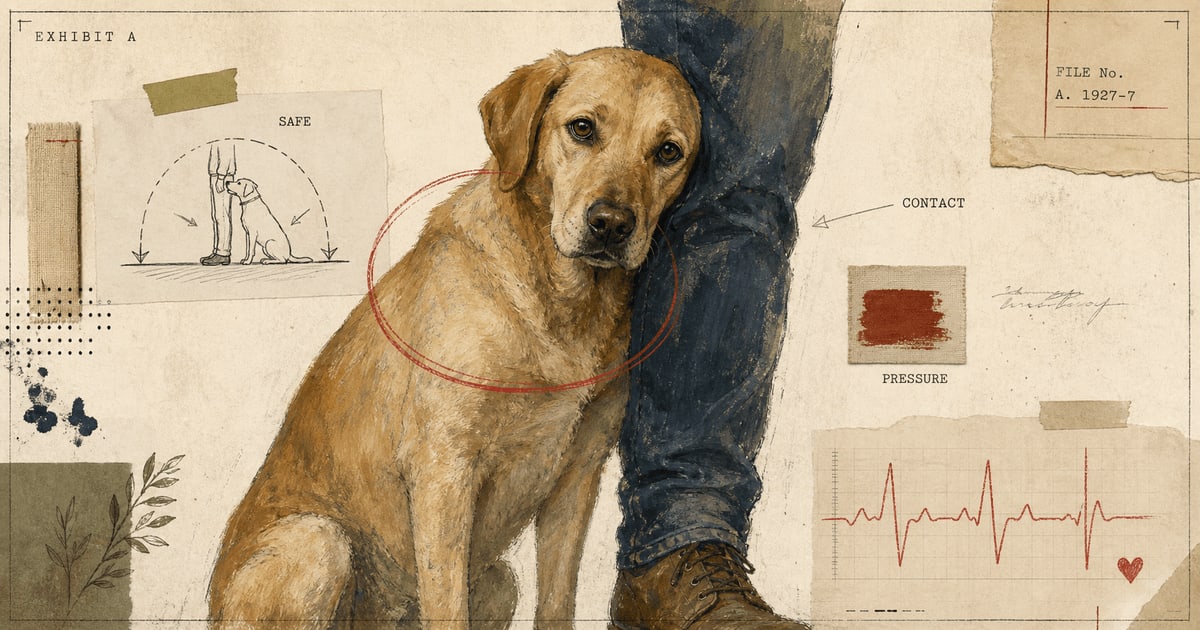
In 2013, Marta Gácsi and colleagues at the Research Centre for Natural Sciences in Budapest put dogs into a mildly stressful situation: a stranger approached in a threatening way. Some dogs faced this with their owner present. Some faced it alone. The researchers measured behavior and heart rate.
The dogs with their owners nearby showed significantly less pronounced heart rate elevation than the dogs alone. The owner’s presence buffered the physiological stress response. The study, published in PLOS ONE, described this as the “safe haven” effect: owners function as a source of emotional security for their dogs in the way that an attachment figure does in the classic Bowlby model of human attachment bonds.
This is the operating context for the lean.
When a dog presses their body against yours, they are usually doing the simplest version of what that study describes: moving toward a reliable social partner. Not as a power demonstration. Not as a status claim. As contact with something that, from their behavioral history, is associated with safety, predictability, food, warmth, walks, and the particular smell of home.
The lean is proximity-seeking expressed in a form that has mass.
The Old Theory and Why It Died
For a long time, popular dog-training culture ran on dominance theory. The story went that dogs were constantly negotiating for rank, that any behavior interpreted as pushy was a bid for status, and that the correct human response to leaning, jumping, or physical contact-seeking was correction, not reciprocation.
The science moved on and the theory did not.
Contemporary canine behavior research has largely abandoned rank-based explanations for the ordinary social behaviors that pet dogs display toward their owners. The dominance framework was borrowed from early research on captive wolf packs, and it was applied to domestic dogs in ways that were both factually dubious and practically counterproductive.
Dogs are not wolves. The wolf behavior it was borrowed from turns out to be an artifact of stress in captive conditions. Feral dog societies look much less like rigid hierarchies than the theory assumed. And domestic pet dogs, living in human households with no resource competition worth mentioning, are not running constant rank negotiations when they press their shoulder into your leg.
What they are doing, in most cases, is exactly what the attachment research describes: seeking contact with someone they are attached to.
What the Attachment Research Actually Shows
József Topál and colleagues at the Hungarian Academy of Sciences were among the first to formally adapt Ainsworth’s Strange Situation Procedure to the dog-owner relationship. The Strange Situation is the classic developmental psychology tool for assessing attachment in human infants: you observe how the infant behaves when separated from the caregiver and when the caregiver returns.
When applied to dogs in the early 2000s, the results were striking enough to attract sustained research attention. Dogs showed the characteristic behavioral profile of an attached individual: proximity-seeking to the owner, distress when separated, reduced exploration when the owner was absent, and a quick return to normal behavior when the owner returned.
The parallel to infant attachment was close enough that researchers began using the term “attachment bond” for the dog-owner relationship, which is not a metaphor. It is a structural description. Dogs appear to form a specific emotional bond with particular people, one that functions differently from their relationships with strangers and includes the secure base and safe haven components that define attachment in Bowlby’s framework.
The lean is one physical expression of that bond in operation.
Context Changes Everything
The lean is not one thing. The same physical behavior carries different meanings depending on the situation the dog is in and the rest of their body language.
A dog leaning into you at home during a quiet evening is not the same event as a dog leaning into you at the vet, in a crowd, during a thunderstorm, or while an unfamiliar person tries to approach. The physical action overlaps, but the underlying state is different.
A relaxed lean looks like this: the muscles in the dog’s body are loose, not rigid. The breathing is normal. The mouth is soft, possibly slightly open. The tail is hanging in its natural position or moving gently. The dog is willing to shift or move away from you; they are leaning toward you by choice, not bracing against you for support.
A stress lean looks different: the muscles are tighter. The tail may be tucked or held low and stiff. The ears may be back or pinned. There may be lip licking, yawning, or whale eye (the whites of the eyes visible because the dog is turning their head away while keeping their gaze fixed). The dog may be pressing harder and not moving easily. They may be trying to position you between themselves and the thing that is worrying them.
In the stress version, the lean is still a request, but the request is more urgent. The dog is not feeling affectionate. They are asking for help with a situation that is too large for them to manage alone. In both cases, the useful response is to pay attention to the whole picture rather than the single behavior in isolation.
The Oxytocin Angle
Physical contact between dogs and humans has measurable biological effects on both parties. Research by J.S.J. Odendaal and R.A. Meintjes, published in The Veterinary Journal in 2003, found that positive dog-human interaction was associated with increases in oxytocin, beta-endorphin, dopamine, and other neurochemicals in both humans and dogs.
Nagasawa’s 2015 study in Science looked at the same oxytocin system through the lens of mutual gaze, finding that the gaze loop between dogs and their owners activated the same bonding chemistry that operates between human mothers and infants. The physical contact version of this is less studied in terms of specific hormonal measurement, but the mechanism is plausible: touch is one of the primary stimuli for oxytocin release across social mammals, and dogs who seek physical contact with their owners are, among other things, operating on that chemistry.
This is worth knowing because it is not a one-way street. The lean that your dog initiates is doing something real to your nervous system. The calm you feel when a dog leans on you is not entirely a story you are telling yourself. It is, at least in part, a measurable physiological response.
Why Big Dogs Lean More
Large and giant breed dogs lean with a frequency and conviction that can seem disproportionate to any obvious emotional need. A 130-pound dog leaning against your leg with the specific gravity of a side table is not just proximity-seeking. It is proximity-seeking at a scale that creates structural engineering questions.
Part of this is simply breed temperament. Mastiffs, Saint Bernards, Great Danes, Rottweilers, and similar breeds have been selected over many generations for human-oriented social behavior, and body contact is one of the ways that social orientation expresses itself in large dogs. They did not get the memo that their size makes this impractical.
But the behavior also appears more in large dogs partly because it is more physically possible for them. A dog who would lean if they could often cannot, in any meaningful way, if they weigh nineteen pounds. The impulse toward contact is probably distributed more evenly than the behavior suggests.
When the Lean Is Something Else
A small number of lean behaviors are worth distinguishing from the attachment-motivated version.
Dogs who are anxious about being alone sometimes escalate contact-seeking into a persistent, difficult-to-interrupt pattern. If your dog leans heavily whenever you prepare to leave, follows you from room to room refusing to settle, and shows clear distress when separation actually happens, that is not just affection. It may be a sign of separation anxiety, which responds to behavioral intervention, not just reassurance.
Dogs who are in pain sometimes lean or press their bodies against people or objects as a response to discomfort, particularly when the pain involves the hind end, abdomen, or back. If a leaning pattern appears suddenly in a dog who was not a leaner before, or intensifies without obvious social cause, it is worth a veterinary check.
These are the exceptions. The vast majority of dog leaning is what it looks like: a social animal maintaining contact with a member of their social group.
The Portrait Dimension
The lean is one of those behaviors that is emotionally vivid and physically awkward to photograph well.
Photographs of a dog leaning against your leg tend to include the underside of an arm, a patch of floor, whatever you were wearing that day, and the expression of someone who did not know they were about to be part of a composition. The feeling is real. The reference is complicated.
For portrait purposes, the cleanest solution is to separate the emotional information from the technical information. A lean photo, even a blurry one taken from the wrong angle, can tell an artist something important: how the dog holds their body in a moment of contact, the tilt of the head when they press close, the quality of ease in a familiar situation. A separate, cleaner photo of the dog in good light gives the artist the anatomy they need.
For memorial portraits in particular, the lean is often what owners say they miss most. Not a trick. Not a dramatic pose. The weight of the dog against their leg on an ordinary evening. That is a feeling a portrait can work toward, even if no single photograph captures it perfectly.
Tell the artist what the lean felt like. The physical description is useful. “He always pressed his full weight into me” or “she would just rest her head on my knee and stay there” gives the artist more than a pose reference. It gives them the emotional center of the piece.
Sources
- Marta Gácsi et al., “Human Analogue Safe Haven Effect of the Owner: Behavioural and Heart Rate Response to Stressful Social Stimuli in Dogs”, PLOS ONE, 2013.
- József Topál et al., “Attachment Behavior in Dogs (Canis familiaris): A New Application of Ainsworth’s (1969) Strange Situation Test”, Journal of Comparative Psychology, 1998.
- Therese Rehn et al., “Links between an owner’s adult attachment style and the support-seeking behavior of their dog”, Frontiers in Psychology, 2017.
- J.S.J. Odendaal and R.A. Meintjes, “Neurophysiological Correlates of Affiliative Behaviour between Humans and Dogs”, The Veterinary Journal, 2003.
- Miho Nagasawa et al., “Oxytocin-gaze positive loop and the coevolution of human-dog bonds”, Science, 2015.
Welcome perk
Free expedited delivery on your first portrait
Get your digital proof in 1-2 business days instead of 2-3, free on your first portrait. Normally a $10 upgrade.
No spam. Just the perk and the occasional new style or guide.
Check your inbox for your code.