
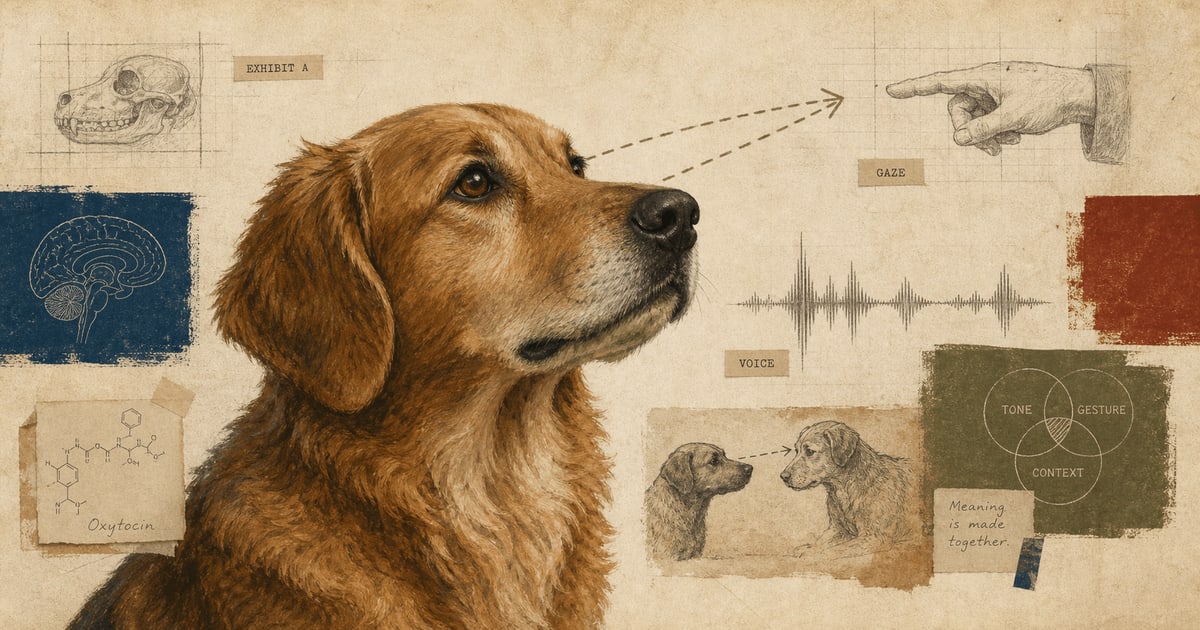
In 2002, Brian Hare and colleagues at Harvard published a paper in Science that opened a decade of argument about what domestic dogs actually know. The question they were testing sounds almost rude: can dogs follow a human pointing gesture to find hidden food? Chimpanzees, when tested, performed poorly and often below chance. Wolves raised by humans performed poorly. The dogs were not only good at it; they were so reliably good that the researchers had to ask whether this was something dogs learned individually from living with humans or something that had been shaped into the species by domestication.
The answer they proposed was domestication. Dogs had been selected, across thousands of years, for the specific ability to read human communicative signals. The paper argued that this was not general intelligence. It was social cognition tuned to one specific partner. Dogs were, in a meaningful sense, specialized for humans.
This did not prove that your dog understands you the way another adult human understands you. It proved something more specific: that dogs have been built by evolution and domestic history to read the particular signals that humans produce. Not language. Not intention. Gesture, gaze, posture, voice, and the behavioral patterns of a specific person in a specific household.
People experience this as understanding. In a functional sense, they are right.
The Pointing Study and What Came After
The Hare 2002 paper produced a cottage industry of follow-up research, some of which replicated and extended the findings and some of which complicated them. The main complication was that pointing-following in dogs turned out to be messier than the initial study suggested: performance varies with breed, individual history, training, and the specific type of pointing gesture used. A finger point at shoulder height is not the same cue as a leg point or a body orientation. Dogs that follow one type may not follow another.
Ádám Miklósi and his colleagues at the Family Dog Project in Budapest, who have produced some of the most rigorous work in this area, found that dogs were also sensitive to human gaze as a communicative cue, could use human attention to guide their behavior, and showed referential looking, the behavior of looking back at a human when confronted with a problem they cannot solve. Referential looking is interesting because it implies something: the dog is treating the human as an informational resource. Whether this involves anything like a theory of mind is a genuinely unresolved question that the field has not settled.
What is settled is that dogs attend to human faces in ways that most other animals do not. A 2016 imaging study by Attila Andics and colleagues, also published in Science, scanned awake, trained dogs in an MRI and found that dogs processed familiar words and praise-intonation in partly distinct brain regions, and that the combination of a praising word with praising intonation activated reward circuitry differently than either alone. The dogs were not just hearing pleasant noise. They were processing semantic content and vocal tone separately and then combining them, which is a more complex operation than anyone had assumed.
This does not mean the dog understands the grammar of the sentence “Do you want to go for a walk.” It means that when you say those words with a certain tone, after reaching toward the leash, the dog has integrated several converging signals and has a high-confidence read on what is coming next. You can call that understanding. It is not wrong.
What Attention Plus History Actually Builds
The phrase that does the most work in this subject is not “empathy” or “intelligence.” It is “attention plus history.”
A dog that has lived with one person for several years has accumulated thousands of observations about that person. The specific sound of their walk in different footwear, which means something about how much time is available. The rate at which they open the refrigerator. The particular quality of the sigh that precedes sitting down for the evening versus the sigh that precedes a phone call that will last an hour. The difference between picking up keys casually and picking up keys while putting on a specific coat. The emotional texture of Mondays versus Sundays as expressed through movement and vocal tone.
None of this requires language comprehension. It requires attention over time applied to a consistent subject. Dogs are extraordinarily good at exactly this. The domestic dog’s attention toward human behavior is itself a selected trait; animals that paid more attention to their specific human and predicted that human’s behavior better were, historically, better fed, better protected, and more likely to reproduce.
What owners experience as “my dog knows when I’m sad” is typically this attention in operation. The dog has learned what normal looks like. When you are not normal, the dog notices. It may not know the reason. It knows you are different. Its behavioral response to that difference, sitting closer, becoming quieter, watching more carefully, is a social response to detected change. It is not human empathy. It is also not nothing.
The Emotional Detection Research
The question of whether dogs can actually detect human emotional states, rather than just unusual behavioral patterns, has accumulated some genuine evidence.
Natalia Albuquerque and colleagues published a study in Biology Letters in 2016 showing that dogs could integrate emotional information from both the face and the voice, across both human and dog emotional expressions. The dogs were shown paired images of faces alongside a vocalization, and they preferentially looked at the face that matched the emotional valence of the sound. This is cross-modal emotional recognition: the dog is not just learning to respond to “angry face” as a visual stimulus but is integrating audio and visual emotional cues into something that functions like emotional detection.
The same year, Miho Nagasawa and colleagues published work in Science on the oxytocin-gaze loop: when dogs and their owners gaze at each other, both species show increases in oxytocin, the hormone associated with social bonding in mammals. The effect was larger for dogs that gazed at owners more. The researchers described this as a “positive feedback loop” that may have been co-opted from the mother-infant bonding system during domestication. This is the biological machinery of the bond made visible in a blood test.
None of this proves that dogs experience emotion the way humans do. The study of animal consciousness remains genuinely contested, and overclaiming in either direction (dogs are like humans, or dogs are just stimulus-response machines) distorts both the science and the animal. What the evidence supports is that the human-dog bond has measurable physiological dimensions, that dogs detect and respond to human emotional signals with some sophistication, and that the response is stronger with familiar individuals.
The dog may not know why you are upset. The dog knows that you are different from normal, and the dog has a well-developed set of social behaviors for staying close to a person who is different from normal. Whether that constitutes empathy is a philosophical question the data cannot fully answer. Whether it changes the room is not.
The Limits Worth Keeping
The honest middle position is uncomfortable because it does not resolve into a satisfying story. “Your dog understands you” is too simple. “Your dog is just pattern-matching” is too reductive and functionally wrong in its implication that the pattern-matching is trivial.
Dogs can follow human gaze, pointing, and body orientation to find objects. They can integrate word meaning and vocal intonation. They can detect emotional signals cross-modally. They form bonds with specific humans that involve oxytocin, preferential attention, and behavioral adjustment. They accumulate individual knowledge about a specific person that is more detailed and contextual than the knowledge they have about strangers.
What they cannot do is follow complex linguistic reasoning, understand the content of a conversation they are not part of, or experience the full emotional complexity of human consciousness. They understand the room. They do not understand the situation.
That is not a diminishment. It is a description of what the bond actually is: a genuine cross-species social relationship that works because dogs are very specifically built to make it work, and because thousands of years of domestication selected for exactly this outcome.
Your dog has studied you the way a good researcher studies a subject: with sustained attention, over a long time, with careful observation of pattern and deviation. The fact that your dog did this while also sleeping sixteen hours a day speaks to an efficiency that humans should probably respect.
What the Portrait Catches
A pet portrait is, among other things, an image of this dynamic made visible. The expression that makes people want a portrait is usually the expression where the relationship is present: the head tilt, the steady gaze, the dog watching from the doorway with one ear slightly raised, the face that looks like it is listening to something you said three sentences ago and has not decided yet whether to take it seriously.
That expression happens when the dog is attending to you. It does not happen when the dog is startled, bored, or being held still for the camera with a treat elevated just out of frame. The reference photos that produce the most honest portraits are often taken when you are doing something else and the dog is watching you do it: you working at a desk, you reading, you in a chair across the room. The dog is in its observation mode, and that mode is exactly what the bond looks like from the outside.
If you have a photo where the dog is looking at you rather than the camera, include it. The face is usually softer, the ears are set differently, and the body language shows the animal doing what it was built to do: paying attention to the specific human it has learned the most about.
Sources
- Brian Hare et al., “The domestication of social cognition in dogs”, Science, 2002. DOI: 10.1126/science.1072702
- Attila Andics et al., “Neural mechanisms for lexical processing in dogs”, Science, 2016. DOI: 10.1126/science.aaf3777
- Natalia Albuquerque et al., “Dogs recognize dog and human emotions”, Biology Letters, 2016. DOI: 10.1098/rsbl.2015.0883
- Miho Nagasawa et al., “Oxytocin-gaze positive loop and the coevolution of human-dog bonds”, Science, 2015. DOI: 10.1126/science.1261022
- Ádám Miklósi et al., “A simple reason for a big difference: wolves do not look back at humans, but dogs do”, Current Biology, 2003. DOI: 10.1016/S0960-9822(03)00263-X
- Juliane Kaminski and Sarah Marshall-Pescini, eds., The Social Dog: Behavior and Cognition (Academic Press, 2014).
Welcome perk
Free expedited proof on your first portrait
Your proof in 1-2 business days instead of 2-3, free on your first portrait. Normally $10.
The code, then an occasional new style or guide.
Check your inbox for your code.