
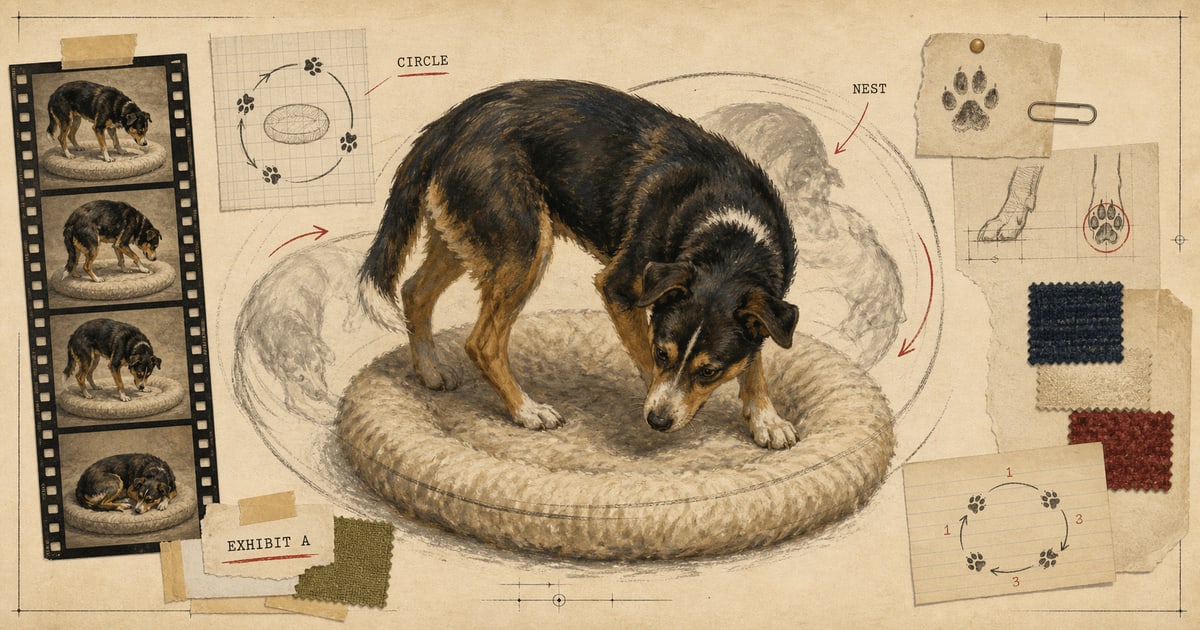
Wolves in Yellowstone spend about three to five seconds circling before they lie down. They do it in snow, on bare rock, on grass matted by their own previous sleeping. The surface does not matter. The circle happens anyway. In a study of captive wolf and dog resting behavior, Frank and Frank observed the same pattern across both species with essentially no variation by substrate. The bed does not need to be prepared. The animal prepares it anyway.
Your dog, turning twice on the memory foam orthopedic cushion you bought specifically because its hips were giving out, is doing something that hasn’t changed in forty thousand years. The cushion is irrelevant to the software running the behavior. The software predates the cushion by geological orders of magnitude.
This is what ethologists call a fixed action pattern: a behavior sequence that, once triggered, runs to completion regardless of whether the triggering conditions still apply. The dog approaches the sleeping spot. The sequence fires. The dog circles. The sequence does not check to see if there is actually any grass to flatten. That would require a kind of behavioral flexibility the motor program was never designed to have.
What the circling was for
Wild canids don’t sleep on anything that has been prepared for them. They sleep wherever they stop, and the quality of that spot determines a lot: warmth, concealment, drainage, the absence of biting insects or hidden rocks at kidney height. Before lying down, a circling canid is doing several things at once.
The most well-supported function is vegetation management. Grass, leaves, and light brush get compressed into a more insulating, more comfortable surface by repeated circular trampling. The circle creates a shallow bowl that retains body heat better than flat ground. This is not strategic thinking on the dog’s part. It is a motor pattern that, over many generations, produced better rest in animals that ran it and survived.
Secondary functions include hazard detection. A shallow check of the perimeter before settling exposes scorpions, snakes, or biting insects that might be lurking in the grass. The directional orientation of the final lie-down may also matter: wild dogs and wolves tend to orient with the wind, which keeps scent signals coming from in front of the sleeping animal. Any predator or rival approaching from upwind gets detected earlier.
Raymond Coppinger makes the point in Dogs: A Startling New Understanding of Canine Origin, Behavior & Evolution that domestic dogs are, behaviorally, fairly close to their wild relatives on most dimensions. The tameness is real, the threat-aggression is dampened, the social tolerance of humans is deeply ingrained. But the underlying motor library is largely intact. The circling behavior is conserved across every domestic breed that has ever been studied, from Chihuahuas to Great Danes, none of whom have needed to flatten grass in hundreds of generations.
The magnetoreception distraction
There is a 2013 study by Hart and colleagues in Frontiers in Zoology that measured the body-axis orientation of dogs during defecation under calm geomagnetic conditions. They found a preference for north-south alignment. The interpretation was that dogs may be sensitive to the Earth’s magnetic field.
This is a real finding, if a narrow one. It has been extended, in a lot of popular science writing, to the claim that dogs circle before lying down in order to align magnetically. This extension is not supported. The Hart study was about defecation posture, not sleep posture, and the mechanism behind the defecation alignment is not understood well enough to generalize it to other behaviors. The circling explanation does not need magnetoreception, because the flatten-the-bed hypothesis explains the behavior adequately on its own, with strong cross-species support.
It is the kind of finding that sounds irresistible to headline writers and circulates for years past its expiration date. The honest position is: dogs may detect magnetic fields in some contexts, and this is interesting, but it does not explain why your dog circles before lying down.
What foxes, coyotes, and wolves do
The behavior is not unique to domestic dogs. Foxes circle before lying down in nearly identical fashion. Coyotes do the same. Captive wolves at wildlife facilities have been observed circling consistently before resting. The conservation of the behavior across the family Canidae strengthens the case that this is old machinery, not something dogs developed during domestication.
Alexandra Horowitz, in Inside of a Dog, describes pre-sleep circling as one of the clearest examples of behavior that reveals the evolutionary history running underneath the domestic surface. She is right that it has a particular resonance because it is so visible and so apparently unnecessary. The dog is not, as far as anyone can tell, trying to do anything strategic. It is simply running an ancient program in an environment for which that program was never designed.
That is also true of a lot of what dogs do every day. Scratching at the carpet after burying a treat. The eye-contact-then-glance-away of a dog trying not to escalate a stare. The head-tilt in response to a high-pitched sound. Most of dog behavior has roots that long predate the leash and the dog bed and the orthopedic cushion. The circling is just unusually visible because it happens every time, right in front of you, and it is obviously pointless in context.
When the circling goes on too long
One to three rotations is the standard range. A dog that settles after two circles is doing exactly what the behavior calls for. A dog that circles eight, ten, fifteen times and still cannot seem to commit to lying down is usually dealing with something other than ancestral instinct.
Orthopedic pain is the most common cause. Arthritis, hip dysplasia, and intervertebral disc disease all make the act of lying down uncomfortable. The dog circles longer because it is searching for an angle that hurts less, and it keeps searching because none of the angles work very well. If a dog that previously settled quickly starts circling extensively, especially if it also shows stiffness when getting up, reluctance to use stairs, or changes in gait, that is a veterinary conversation.
Vestibular disease, which affects the inner ear and creates disorientation and balance problems, can cause compulsive circling that has nothing to do with bedtime routines. This is typically sudden in onset and often accompanied by a head tilt, abnormal eye movements, and obvious difficulty walking. It looks alarming and often resolves on its own, but it needs a vet to rule out more serious neurological causes.
Cognitive dysfunction syndrome in older dogs can also produce new and repetitive behaviors, including circling, as part of the general disorientation and behavioral change that comes with canine dementia. If an older dog develops new circling patterns or seems generally confused about familiar routines, that is worth mentioning.
The one-to-three circle version of the behavior is as old as the dog. The ten-circle-and-still-can’t-settle version is telling you something.
What the circle ends in
The pre-sleep circle usually terminates in one of two positions. The curled-nose-to-tail posture, which conserves heat and protects the abdomen, is the more ancient of the two. Wolves and wild canids default to it in cold conditions. The chin-on-paw flat-sprawl is the warmer-environment version, and domestic dogs use it more often because most of them live in heated houses where conserving body heat is not the primary concern.
Both positions end the same way: the dog exhales, the muscles release, and within thirty to sixty seconds the animal is asleep. The circling precedes this with a kind of focused preparation that, if you watch it often enough, starts to look like ritual. The program runs, the body finds its angle, and the ancient sleep sequence completes.
A dog performing this ritual in your living room is, in a specific and literal sense, doing something that canids were doing long before there were living rooms. There is something worth paying attention to in that. An animal that has been so thoroughly reshaped by domestication, that reads your face and follows your gaze and senses your mood before you’ve announced it, is still running the same pre-sleep sequence that its wild relatives use in the snow.
The curled sleeping pose is one of the most expressive subjects for a custom pet portrait, partly because it catches the animal in a moment of complete trust. A dog that circles and settles in your presence is a dog that considers your space safe enough to perform its most ancient bedtime routine. That is not nothing.
Sources
- Hart, V., Nováková, P., Malkemper, E. P., et al. “Dogs are sensitive to small variations of the Earth’s magnetic field.” Frontiers in Zoology 10, no. 80 (2013).
- Coppinger, R., and Coppinger, L. Dogs: A Startling New Understanding of Canine Origin, Behavior & Evolution. Scribner, 2001.
- Horowitz, A. Inside of a Dog: What Dogs See, Smell, and Know. Scribner, 2009.
- Frank, H., and Frank, M. G. “Comparison of problem-solving performance in six-week-old wolves and dogs.” Animal Behaviour 30, no. 1 (1982): 95-98.
- Mech, L. D., and Boitani, L., eds. Wolves: Behavior, Ecology, and Conservation. University of Chicago Press, 2003.
- Berns, G. How Dogs Love Us: A Neuroscientist and His Adopted Dog Decode the Canine Brain. New Harvest, 2013.
Welcome perk
Free expedited proof on your first portrait
Your proof in 1-2 business days instead of 2-3, free on your first portrait. Normally $10.
The code, then an occasional new style or guide.
Check your inbox for your code.