
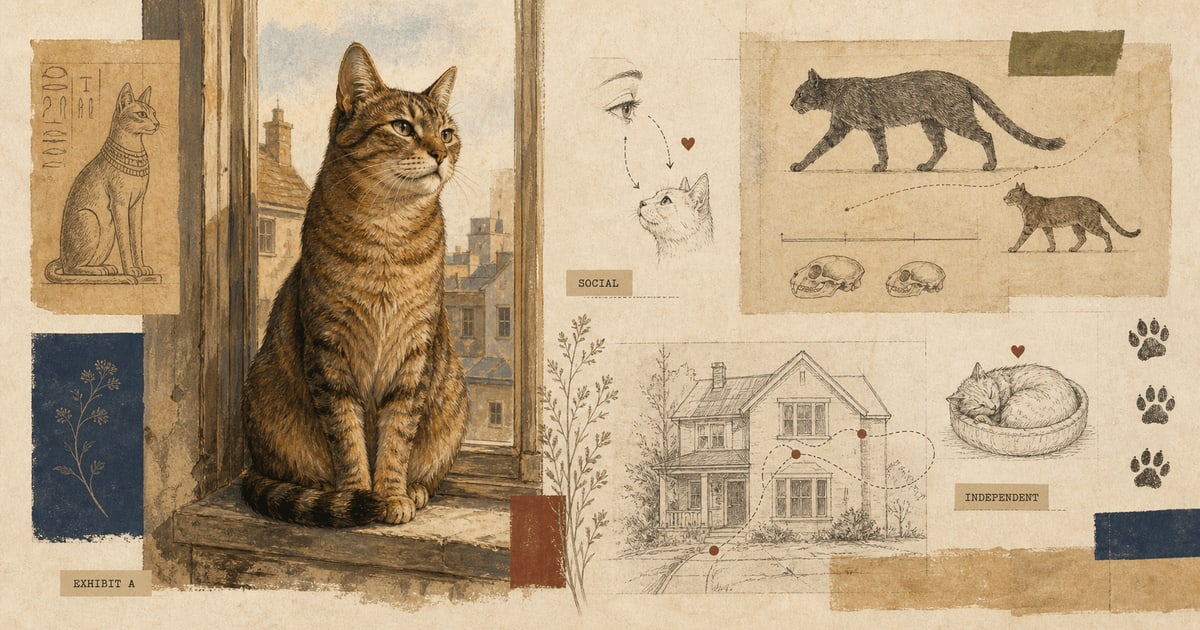
There is a study from 2019 in Current Biology where researchers put cats and their owners through a version of the Ainsworth Strange Situation, the attachment test originally designed for human infants. The results were not supposed to be interesting. Cats were assumed to be indifferent, and the experiment was expected to confirm this politely and professionally. Instead, 64.3 percent of the cats showed secure attachment behavior toward their caregivers: they explored more when the owner was in the room, showed distress when the owner left, settled when the owner returned. The researchers described the pattern as “similar to that seen in children and dogs.”
The paper got some coverage, which is how a lot of good science gets buried. The headline read “Cats love their owners too!” and the comment sections filled with people arguing about whether this was confirmation of something they already believed or a betrayal of something they needed cats to be.
What nobody wanted to say, because it is less fun, is that the study mostly revealed something about the humans. The cat was just being a cat. The humans were the ones who had built a whole mythology about what that meant.
How the Mythology Got Started
Cats did not domesticate on the same terms as dogs. Dogs were actively shaped for partnership across thousands of years: herding, guarding, hunting, hauling, assisting. This required animals that were cooperative, responsive, and oriented toward human approval. The domestication pressure was intensive and directional. Dogs that worked with humans reproduced. Dogs that did not were less useful and left fewer descendants.
Carlos A. Driscoll and colleagues, in their 2007 Science paper on the Near Eastern origins of cat domestication, described a much looser process. Cats, genetically descended from Felis silvestris lybica, moved toward human settlements because those settlements attracted rodents. The cats that tolerated human proximity got access to easy prey. The humans who tolerated cats got fewer rodents in the grain. The relationship was commensal: beneficial for both, obligating neither.
Michael J. Montague and colleagues confirmed in 2014 genomic work in PNAS that domestic cats show some selection signals in behavior and reward-related genes, but remain morphologically and behaviorally close to their wildcat ancestors. They were not rebuilt the way dogs were rebuilt. The domestication changed some things at the edges and left most of the animal alone.
The practical consequence is that cats retained their solitary-hunter architecture. They stalk, ambush, and kill alone. They do not inherently need to coordinate with a group to get food. Their communication repertoire reflects this: cats use far less social signaling than pack animals, and most of what passes for “meowing” is a behavior they developed specifically for humans, not for each other. Adult cats almost never meow at other adult cats in the wild.
When humans saw this and compared it to dogs, the comparison wrote itself. Dogs perform affection loudly and publicly. Cats perform affection in a lower register, at their own discretion, on a schedule nobody else controls. The humans who needed an explanation called it independence. The cats were just being small solitary predators who had learned that staying near the grain pile paid off.
What the Research Actually Shows About Attachment
The Vitale et al. 2019 attachment study was not alone. Lauren R. Finka, in a 2022 paper in Animals on conspecific and human sociality in domestic cats, reviewed the broader evidence and found that cats vary considerably in their social preferences, with some showing strong, consistent human-oriented behavior and others being more selective or context-dependent. The variation is real and it is large. But the variation is not between “bonded” and “independent” as if these were categories. It is a spectrum, and most cats land somewhere in the middle.
Cat affection tends to work through proximity rather than performance. A cat that sits in the same room but not on the lap may be as bonded as a cat that drapes itself across your chest. A cat that rubs its head against your ankles when you come through the door is marking you with its facial glands, which in cat social chemistry is a significant gesture. A slow blink from a relaxed cat is a signal meaning, more or less, “I am comfortable enough with you that I am willing to close my eyes near you,” which given that cats are small prey animals with a history of being eaten by everything, is not a trivial communication.
People miss cat affection constantly because they are measuring it against dog standards. The dog standard is: greet loudly, maintain contact, demonstrate enthusiasm at all times. The cat standard is: choose to be in the same room, make deliberate contact on the cat’s terms, allow itself to be observed sleeping. These are different standards. Neither is lesser. But the dog standard is louder and the human brain is calibrated toward louder.
Where the Symbol Came From and What It Cost
Once a cultural shortcut is convenient, it spreads. The “independent cat” became a container for a remarkable range of human ideas that had nothing much to do with cats. Cats became associated with mystery, femininity, witchcraft, urban solitude, intellectual aloofness, artistic temperament, and eventually internet disdain. The exact contents of the container shifted by century and by culture, but the container itself stayed the same: here is an animal that does not need you, which means something about freedom, dignity, or threat depending on who is doing the interpreting.
Medieval European church authorities associated cats, especially black cats, with witchcraft and the devil, with predictable results for the cat population. This was not about cats. It was about the cultural work that a symbol of female independence and nighttime autonomy was being asked to do in a particular social context. The cats just got caught in the machinery.
The modern version is more benign but not entirely honest. When people say “cats are independent,” they sometimes mean their specific cat is fine with being left alone for long stretches, which may be true. They sometimes mean their cat doesn’t perform affection in ways they recognize, which is a perception problem. And sometimes they mean something they need the cat to represent: a self-sufficient creature that doesn’t require approval, doesn’t perform for anyone, maintains dignity regardless of circumstance. That is a lot of freight for a ten-pound animal who has been known to get its head stuck in a paper bag.
The symbol is convenient. The actual cat is more specific. An anxious cat is not stoic. A cat that destroys furniture when left alone is not demonstrating independence; it is demonstrating distress. A bonded cat who follows you from room to room is not being needy by cat standards; it is being social by cat standards. Flattening all of this into “cats are independent” papers over the individual animal and can make owners miss real stress or real need.
Painting the Actual Cat
This matters for cat portraits because the symbol pulls hard toward one image: upright, formal, slightly distant, with an expression that suggests the cat is considering whether you are worth its time. That can be exactly right.
It can also be completely wrong for a specific cat.
If your cat sleeps on your head, greets you at the door with a sound like a small, broken kazoo, or sits on your keyboard with the focused intent of someone who has read the corporate espionage manual, the marble-statue portrait is not honest to that animal. It is honest to the symbol.
A good portrait earns its elegance from the actual animal. Tell the artist what kind of social creature you have: whether the cat follows at a dignified distance or demands contact; whether the face in repose looks watchful or relaxed or slightly exasperated; whether the energy is regal or floppy or somewhere in between. A custom portrait made from that kind of specific reference can be both beautiful and true, which is harder than just beautiful, and worth the difference.
The best cat portrait is not the one that proves cats are independent. It is the one that proves this cat was known.
The cats became symbols of independence because they did not behave the way people expected. The best portraits remember that the symbol is not the animal. The animal is the specific creature on the specific windowsill, looking out at whatever it is cats look at when they appear to be thinking about something we will never quite understand.
Sources
- Carlos A. Driscoll et al., “The Near Eastern origin of cat domestication”, Science, 2007. DOI: 10.1126/science.1139518
- Michael J. Montague et al., “Comparative analysis of the domestic cat genome reveals genetic signatures underlying feline biology and domestication”, PNAS, 2014. DOI: 10.1073/pnas.1410083111
- Kristyn R. Vitale et al., “Attachment bonds between domestic cats and humans”, Current Biology, 2019. DOI: 10.1016/j.cub.2019.08.036
- Lauren R. Finka, “Conspecific and Human Sociality in the Domestic Cat”, Animals, 2022. DOI: 10.3390/ani12030298
- John Bradshaw, Cat Sense: How the New Feline Science Can Make You a Better Friend to Your Pet (Basic Books, 2013).
Welcome perk
Free expedited proof on your first portrait
Your proof in 1-2 business days instead of 2-3, free on your first portrait. Normally $10.
The code, then an occasional new style or guide.
Check your inbox for your code.