
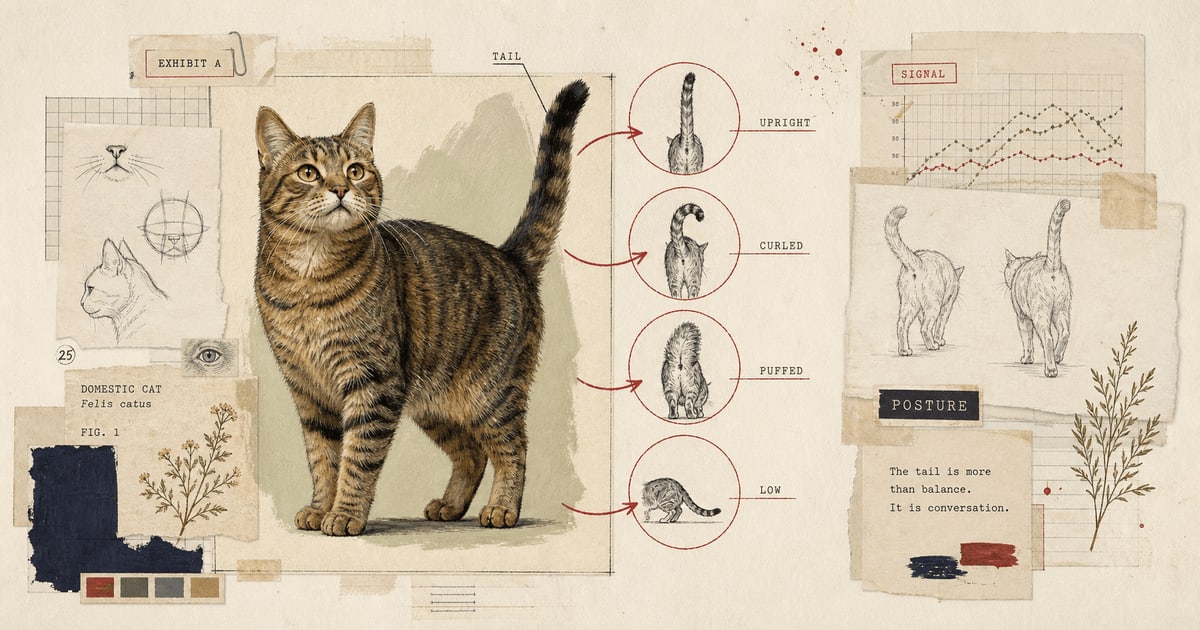
A cat is a fairly quiet animal compared to a dog. Most of what a cat communicates moment to moment is written in posture, ear angle, eye state, and tail. The tail is the most legible of those for a human observer because it is long, mobile, and usually visible.
Most cat-tail charts on the internet over-promise. They turn a continuous behavioral signal into a fixed dictionary, often with cartoonish certainty. The real picture, drawn from the ethology literature compiled in Sarah Brown and John Bradshaw’s The Behaviour of the Domestic Cat (CABI, 2nd ed., 2012) and Charlotte Cameron-Beaumont’s foundational thesis work on feline visual signaling, is more interesting and more useful.
The short answer: a small number of tail positions carry reliable meaning in context. A larger number carry partial or context-dependent meaning. None of them mean anything in isolation from ear position, body posture, and pupil state.
The Upright Tail With a Slight Hook
If you look at archival footage of African wildcats (Felis silvestris lybica), the ancestor of the domestic cat as established in Carlos Driscoll and colleagues’ 2007 Science paper on Near Eastern cat domestication, you will rarely see a confident vertical tail held during social greeting. The signal is essentially absent in adult wildcat-to-wildcat interactions.
In domestic cats, the upright tail, often with a small forward hook at the tip, is one of the most reliable affiliative signals in the species’ repertoire. Cameron-Beaumont’s work in the late 1990s, summarized in Bradshaw’s Cat Sense (Basic Books, 2013), treated this as a domestication-linked signal: a posture that became more common as cats began living in higher densities around humans and other cats, where some way to advertise non-hostile intent had survival value.
When your cat walks toward you with the tail straight up and the tip slightly curved, that is as close to an unambiguous greeting as cats get. It is also the position most people miss because they are looking at the face.
The Low or Tucked Tail
A tail held low against the back legs, or tucked under the belly, is fear or strong unease. Bradshaw treats this as part of a coordinated defensive posture: lowered body, ears flattened or rotated back, pupils often dilated, weight shifted slightly backward. International Cat Care describes the same constellation in their behavior resources.
The important point is that a low tail by itself is not always fear. A cat walking calmly across a room may carry the tail low simply because that is its current resting posture. Context decides. If the rest of the body is loose and the ears are forward, the low tail is neutral. If the body is compressed and the ears are sideways or back, the low tail is part of a defensive signal that should be respected.
This is one place where the dictionary approach fails. The same tail height can mean two different things depending on what the ears are doing.
The Puffed Tail and Piloerection
A tail that is twice its normal diameter, with the hair standing on end, is piloerection. This is involuntary, sympathetic-nervous-system-driven, and signals high arousal in a defensive context. Sometimes the whole back goes up at the same time, producing the classic Halloween-cat silhouette.
Piloerection serves the same function in cats that it serves in many mammals: making the animal look larger to a potential threat. The cat is not necessarily about to attack. The cat is trying to avoid a fight by looking like a more expensive option. The most likely outcome is that the cat will hold the posture for a moment and then retreat if given the chance.
The practical implication is that a piloerect cat is not in a mood to be picked up, petted, or photographed close-up. Giving the animal space and a clear escape route is the correct response.
The Flicking or Lashing Tip
A tail held mostly still but with the last few inches twitching is focused arousal. This is the cat-watching-prey posture, or the cat-watching-the-other-cat-across-the-room posture. The body is usually otherwise still or slightly tensed. The eyes are locked on something specific.
A fuller, slower lash that involves more of the tail is irritation. A cat being petted past the point it wants to be petted will often produce exactly this signal a few seconds before swatting. Ignoring it is one of the more common ways humans get bitten by cats they otherwise have good relationships with. The tail is telling you to stop. The cat does not feel that it should have to escalate, but it will.
Bradshaw notes that this signal is particularly important for people who have trouble reading subtler feline cues. The lashing tail is usually the second or third warning, not the first.
The Quivering Vertical Tail
A cat standing near a vertical surface with the tail held straight up and quivering rapidly is producing a urine-marking posture, usually without actually spraying. Both male and female cats can do this, and neutered cats can too. The quivering is the motor preparation for spraying, sometimes complete, sometimes performed without urine delivery.
In multi-cat households, this is often directed at specific locations the cat has marked before. In single-cat households, especially in cats that are otherwise well-adjusted, the quiver-without-spray can be a greeting display, particularly when the human first walks in the door. It looks alarming the first time you see it and is usually nothing to worry about as long as no urine actually appears. The AAFP and ISFM Feline Environmental Needs Guidelines (Ellis et al., 2013) treat marking behaviors as part of normal feline communication that should not be punished but can be managed if the spraying is actually happening.
If a previously non-spraying cat begins to spray, that is a vet visit. The most common medical cause is lower urinary tract disease, which the Cornell Feline Health Center covers in detail.
How Tail Position Changes a Portrait
Most cat portraits we see at the studio are taken with the cat sitting or lying down, where the tail is curled around the body or flat against the floor. These are calm, posed compositions and they work well.
The portraits that feel most alive often involve a tail in a more telling position. A cat walking forward with the upright greeting tail is a very different image from the same cat sitting in profile. A cat with the lashing-tip focus is reading as a hunter, even if the rest of the body is still. A loafing cat with the tail wrapped tightly around the feet reads as more contained than the same cat in a relaxed sprawl with the tail loose.
If you have a choice of reference photos, pick the one where the tail is doing something specific. Even subtle differences carry through into the painting. Our post on what to tell the artist covers how to flag tail position when you submit a photo, and the order page walks through the upload step.
Sources
- Bradshaw, John, Cat Sense: How the New Feline Science Can Make You a Better Friend to Your Pet (Basic Books, 2013).
- Brown, Sarah L. and Bradshaw, John W. S., The Behaviour of the Domestic Cat (CABI, 2nd ed., 2012).
- Driscoll, C. A., et al., “The Near Eastern origin of cat domestication”, Science, 2007.
- Ellis, S. L. H., et al., “AAFP and ISFM Feline Environmental Needs Guidelines”, Journal of Feline Medicine and Surgery, 2013.
- International Cat Care, “Body Language of Cats”.
Welcome perk
Free expedited delivery on your first portrait
Get your digital proof in 1-2 business days instead of 2-3, free on your first portrait. Normally a $10 upgrade.
No spam. Just the perk and the occasional new style or guide.
Check your inbox for your code.