
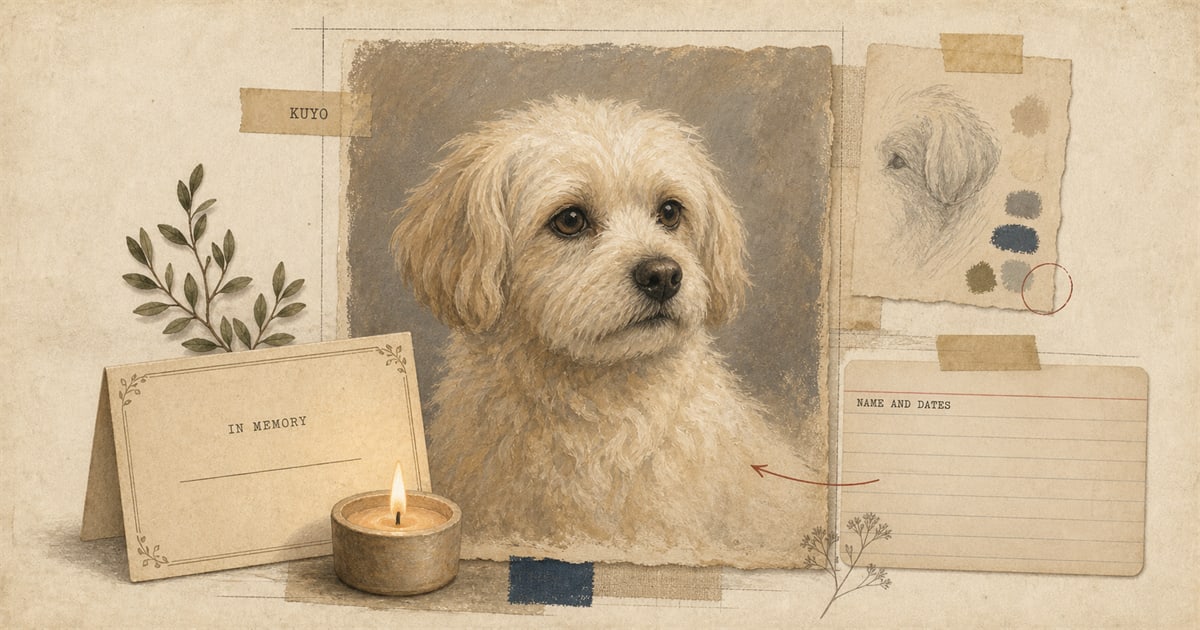
A common assumption sits underneath most memorial planning: the more somber an image looks, the more sincerely it honors what was lost. Bright, playful, or stylized reads as failing to take the loss seriously. Muted and realistic reads as respectful. Japanese Buddhist memorial practice, which has treated animal death as a genuine occasion for ritual for centuries, does not agree with that assumption, and there is real documentation behind the disagreement, not just sentiment.
That matters directly for anyone weighing whether an anime portrait, with its bright color, expressive linework, and cel-shaded finish, can function as an actual memorial for a pet rather than a decoration that happens to look cheerful. The honest answer is yes. Not because a study proved stylized memorial images help people grieve. No such study exists, and this article will not pretend otherwise. The answer holds for a narrower, better-supported reason: nothing in how grief actually works requires a memorial to look a particular way, and an entire living memorial tradition already treats gentle, even bright, imagery as serious rather than careless.
Grief stopped requiring a goodbye a while ago
For most of the twentieth century, the clinical model of healthy grief held that mourning meant loosening an attachment and eventually letting go of it. Staying connected to someone who had died, through memory, ritual, or objects, was treated as a sign the process hadn’t finished. In 1996, Dennis Klass, Phyllis Silverman, and Steven Nickman published Continuing Bonds: New Understandings of Grief and overturned that model with a well-supported claim: maintaining an ongoing connection to the dead is a normal and adaptive part of grieving, not evidence that something is stuck. A companion post on this site covers that research in full, including the pet-specific studies that followed it. The short version is enough here: there is no correct emotional register a memorial has to hit, and no schedule it has to follow, to count as real.
There’s a second, related idea worth naming directly. In 1989, the researcher Kenneth Doka coined the term disenfranchised grief, for loss that isn’t fully recognized as legitimate by the people or institutions around the person grieving. Pet loss is one of the most commonly cited real-world examples in the literature that followed, including a 2012 paper by Millie Cordaro in the Journal of Mental Health Counseling examining pet loss specifically through that lens. Grief over an animal already runs a higher risk of being quietly dismissed than grief over a person. A memorial that looks unusual next to a formal, realistic portrait doesn’t need to clear some higher bar to count. It needs to be honest about what the animal actually was to the person who lost it.
What a Buddhist temple does with a broken needle
Japan gives a concrete answer to what a non-somber memorial actually looks like in practice, and the scale of it is worth stating plainly. The religious studies scholar Barbara Ambros, in Bones of Contention: Animals and Religion in Contemporary Japan, published by the University of Hawai’i Press in 2012, documents a pet-related economy exceeding a trillion yen, thousands of businesses built specifically around pet funerals, and more than 900 pet cemeteries nationwide, roughly 120 of them run directly by Buddhist temples, where memorial rites for animals have become a routine part of temple life. This is not a fringe practice. It is a documented, sizeable part of how a country handles animal death, institutional in a way few Western memorial customs for pets have ever been.
Kuyō, the general Japanese Buddhist term for a memorial or dedication rite, isn’t reserved for people. One of the clearest examples is hari-kuyō, a rite roughly 400 years old, observed on February 8 in the Kantō region and December 8 in Kansai. Participants bring their broken sewing needles to a temple and press them gently into a block of soft tofu or konnyaku jelly, not to fix them, but to thank them for their service and let them go, in what practitioners describe as a spirit of tenderness and gratitude, rather than simply throwing them out with the trash. That is a real, dated, calendar-scheduled ritual, for an object that carries far less emotional weight than a companion animal, and it is treated as a legitimate rite rather than a whimsical one. It is direct evidence that, in the tradition anime’s visual language grew out of, gentleness and seriousness are not opposites. A memorial can be soft and still be meant.
What the research does not say
It would be easy to round this off into a tidier claim than the evidence supports: that Japanese practice proves stylized imagery is good for grieving, or that an anime portrait will help someone heal faster than a realistic one would. No study has tested that, comparing grief outcomes for stylized or joyful memorial imagery against somber or realistic imagery, specific to pets or otherwise. That gap was checked for directly while researching this piece, and it came up empty. Saying otherwise would mean inventing a finding that doesn’t exist.
What the evidence actually supports is narrower, and it’s still enough to answer the original question honestly. Continuing bonds research removed the requirement that a memorial follow a particular emotional register or timeline to count as legitimate grieving. Japanese memorial practice, independently and for entirely different reasons, demonstrates as a matter of documented cultural fact that gentle, even bright, imagery is not treated as careless inside a serious memorial tradition. Neither of those is a psychology experiment proving stylized art heals better than realistic art. Together, they remove the only real objection to the idea that an anime portrait could be a memorial: the assumption that seriousness requires solemnity. That assumption doesn’t hold up, whether you’re looking at the clinical literature on grief or at four centuries of what Japanese temples actually do with tofu and broken needles.
What this looks like as an actual portrait
On the practical side, a memorial portrait, in any style, works by keeping something specific intact: the exact tilt of an ear, a particular expression, a coat pattern only that animal had. That part doesn’t change with style. What changes is the visual language doing the remembering. Watercolor keeps a soft glow. Pencil sketch narrows everything to the face. Anime holds one expression still, with the crisp linework and cel-shaded color the style is built for, the same tool the medium developed for making a single held look carry weight.
This site’s own style guide already reflects a narrower version of that judgment. It rates anime’s fit for a memorial as a style that works with a personal mood, a step apart from watercolor and pencil sketch, which it rates a top pick for memorial work in general. That’s not a contradiction of anything above. It’s a more honest claim than a blanket recommendation would be: anime isn’t the default choice for a memorial the way watercolor or pencil sketch are, but it’s a legitimate one for a pet whose personality was loud, playful, or vivid enough that a quiet, muted style would have undersold them.
Memorial portraits are a common request at the studio, and a few things are treated as standard rather than as upgrades. A pet’s name and the dates it lived can be added to any portrait at no extra charge. A portrait can be made from an older photo or an imperfect one, since a memorial commission often works from whatever photo exists rather than the sharpest one available. The full guide to commissioning a memorial portrait covers the practical side of choosing a photo and a style in more detail. The order form doesn’t ask which style is the correct one for grief. That was never a question with one right answer.
The seriousness was never in the sadness
So: can an anime portrait be a memorial? Yes. Not on the strength of a study that doesn’t exist, but on the strength of two things that are real. Grief no longer requires severing a bond, or hitting a particular tone, to count as finished or sincere. And in a tradition anime’s own visual grammar descends from, a broken sewing needle gets carried to a temple once a year and pressed into tofu, gently, on purpose, because gentleness was never the opposite of taking something seriously. A portrait that holds your pet’s face still, bright linework and all, is doing the same basic thing. It is doing it with a different pair of hands.
Sources
- Klass, D., Silverman, P.R., & Nickman, S.L. (eds.), Continuing Bonds: New Understandings of Grief, 1996
- Wikipedia, “Disenfranchised grief”
- Cordaro, M., “Pet Loss and Disenfranchised Grief,” Journal of Mental Health Counseling, 2012
- Ambros, B.R., Bones of Contention: Animals and Religion in Contemporary Japan, University of Hawai’i Press, 2012
- Wikipedia, “Hari-Kuyō”
Welcome perk
Free expedited delivery on your first portrait
Get your digital proof in 1-2 business days instead of 2-3, free on your first portrait. Normally a $10 upgrade.
No spam. Just the perk and the occasional new style or guide.
Check your inbox for your code.