
Charles Willson Peale began a portrait of his infant daughter Margaret in 1772, the same year she died of smallpox. Four years later, in 1776, he added a portrait of his wife Rachel to that same canvas, grieving beside the crib. He returned to the painting once more in 1818 and retouched it again, forty-six years after the first brushstroke. The Philadelphia Museum of Art, which now owns the work under the title Mrs. Peale Lamenting the Death of Her Child, records all three dates on its own collection page. Mother and daughter were never in the same room for the making of that image. One of them was already gone before her likeness existed at all.
Peale did not treat the result as lesser for it. John Adams saw the finished 1776 composition and wrote that he was moved by it. In 1782, Peale hung the painting behind a curtain with a warning label, so visitors to his gallery would not stumble across a dead child’s portrait unprepared. A culture does not curtain off and label, with a warning, an image it finds fake or embarrassing. It reserves that treatment for an image that feels almost too true to look at without bracing for it first.
People who ask for a portrait combining two pets who died years apart sometimes carry a quiet worry that the request is somehow dishonest, that a real portrait requires its subjects to have shared a room, a leash, a lap, at the same point in time. History does not support that worry. Painting has been assembling subjects who never overlapped since well before photography existed to make the question feel new.
A technique built for exactly this
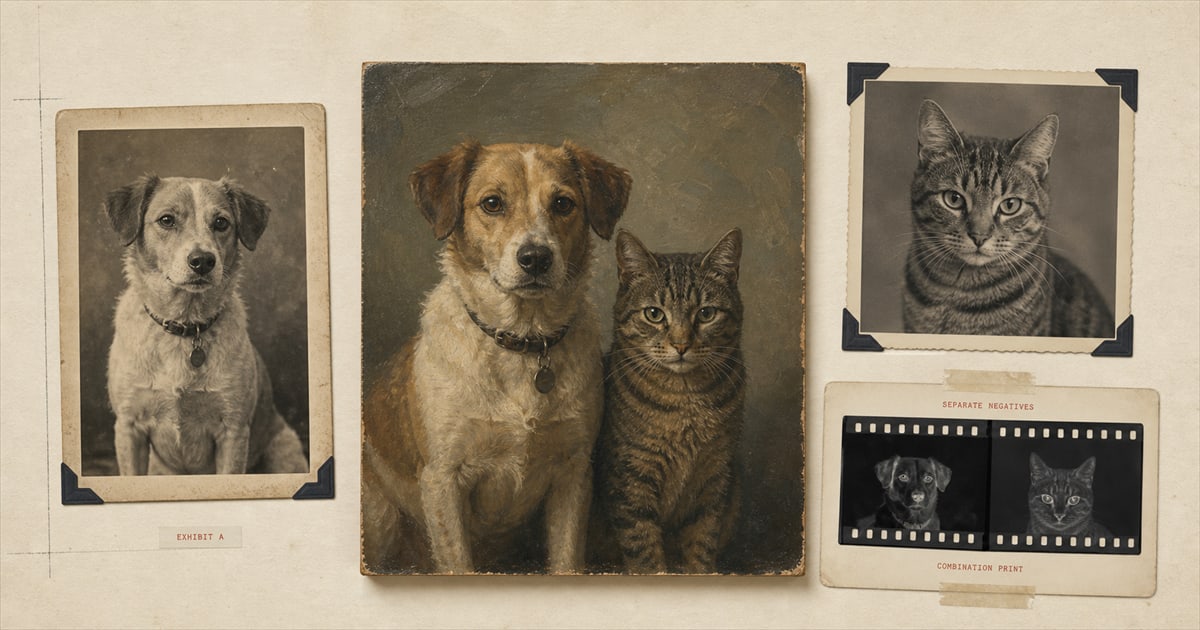
Photography got its own version of the same idea within twenty years of its invention. The English photographer Henry Peach Robinson developed what he called combination printing, physically joining several separate negatives into one finished photographic print. He was publishing on the method in the British Journal of Photography by 1860, defending it against critics who considered a composed photograph less legitimate than a single exposure. His argument was that combination photography demanded as much of the photographer as painting demanded of the painter.
He titled that 1860 defense “Composition NOT Patchwork,” which tells you the argument was already underway before he wrote a word of it. Photography historians now describe combination printing as an early form of photomontage, a label that wouldn’t exist as a movement name for another sixty years. The fight in the pages of the British Journal of Photography was never really about darkroom technique. It was about whether a picture assembled from separate exposures could still be trusted to mean what it showed, the same question a multi-pet portrait raises for some people today.
His best-known combination print, Fading Away (1858), was built from five separate negatives and shows a young woman dying of tuberculosis, surrounded by her family. Some of Robinson’s contemporaries believed, when they first saw it, that they were looking at a photograph of an actual death as it happened. They were not. They were looking at a technically composited image that read, to the people standing in front of it, as completely real. That confusion is the point worth keeping. A picture assembled from parts that were never in the same place at the same moment can still land as one true image, if the person making it understands what the image is trying to say.
Painted families were never that literal either
Before Robinson, and well before Peale, British painters had already spent most of the eighteenth century producing what art historians call the conversation piece, a genre Tate dates to roughly 1725 through the later 1700s: small, informal group portraits, usually of families or friends, set in a domestic interior or a garden, frequently shown interacting with each other and with the household’s pets. Tate’s own glossary entry for the genre describes exactly this, families and pets sharing a composed, intimate scene. What the historical record does not establish is that every sitter in every conversation piece posed together at the same sitting. Painters worked from individual sessions, memory, and earlier studies constantly. A finished family scene was often an assembly job before it was ever a single afternoon in a garden.
None of this proves every eighteenth-century group portrait was secretly a patchwork, and it would overreach to say so on the evidence available. What it does establish is that a composed group, built up in stages, was never treated as a lesser category of family portrait. It was simply one of the ordinary ways family portraits got made.
What actually changes when the subjects never met
A portrait carries a different claim than a photograph does. A photograph documents a moment: two specific bodies occupying the same space at the same second. A portrait, painted in 1776 or made digitally now, represents something else, how the people who loved both subjects want to remember them, together, regardless of what the calendar allowed.
Peale’s painting is not dishonest about Margaret and Rachel. It is honest about something a straightforward group photograph could never have captured in the first place: that a mother went on loving and picturing her daughter for decades after the child was gone, and that the painting itself grew alongside her, the way memory does. The technical fact that the two figures were painted four years apart does not undercut that honesty. It sits at the center of what the painting is actually about.
A portrait of two pets who died years apart works on the same principle. The dog who died in 2019 and the cat who died in 2024 never shared a room the way the finished piece shows them sharing one. What the piece gets right instead is that they shared a home, a person, a run of years, and now share a place on a wall where someone who loved them both can see them side by side.
The gap between the two deaths isn’t incidental to what the portrait is doing, either. A portrait made the same month as both losses would be holding two griefs that were fresh and roughly the same size. One made after a dog died in 2019 and a cat died in 2024 is holding two griefs experienced at different points in a person’s life, possibly in different apartments, possibly with different people around to help. Putting the two animals on one canvas doesn’t erase that five-year gap. It puts the person who said goodbye in 2019 and the person who said goodbye in 2024 into the same frame too, whether or not either of them realizes that’s what they’re looking at.
Composing it well takes real information, not just two photos
The one technical requirement is that the artist needs enough to work from for each animal separately: at least one clear reference photo per pet, ideally showing the head and true coloring under decent light, since the two images will never be blended from a single source shot. At Pet on Canvas, orders combining pets from different photos and different years go through the same digital proof and revision process as any other commission, and our guide on composing a multi-pet portrait covers how to choose poses and framing when the source photos don’t match. Each additional pet in a combined portrait adds $20 to the base price, and the canvas goes to print only after the digital proof is approved.
Peale kept returning to his painting for forty-six years because the people in it kept mattering to him at every point along the way, not only at the moment he first picked up a brush. A portrait made from two photographs taken years apart is doing the same slow, ordinary work: catching up, on canvas, to a love that never stopped just because the timing never lined up.
Sources
- Philadelphia Museum of Art. Collection record for “Mrs. Peale Lamenting the Death of Her Child” (Charles Willson Peale). philamuseum.org
- Robinson, H.P. “Composition NOT Patchwork.” British Journal of Photography, 7(121), p.190, 1860.
- Harker, Margaret F. Henry Peach Robinson: Master of Photographic Art, 1830-1901. B. Blackwell, 1988.
- Tate. “Conversation piece” (art term glossary entry). tate.org.uk
Welcome perk
Free expedited delivery on your first portrait
Get your digital proof in 1-2 business days instead of 2-3, free on your first portrait. Normally a $10 upgrade.
No spam. Just the perk and the occasional new style or guide.
Check your inbox for your code.