
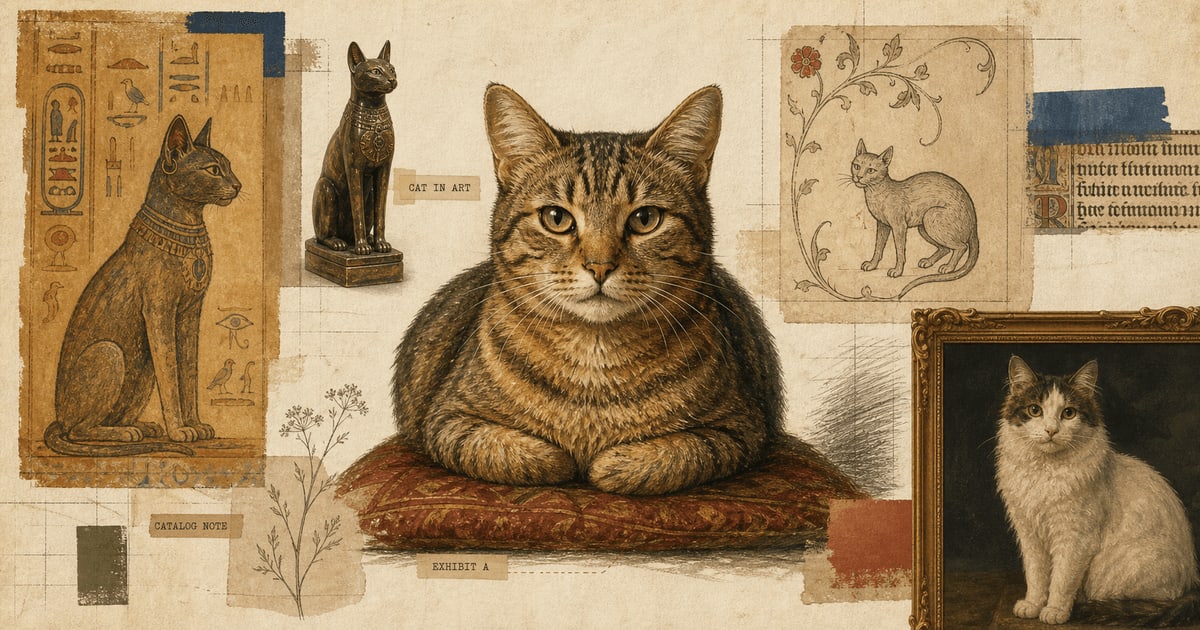
Sometime around 600 BC, an Egyptian sculptor produced a bronze figure of a cat now known as the Gayer-Anderson cat, named for Major Robert Grenville Gayer-Anderson, the British officer who acquired it in the 1930s and bequeathed it to the British Museum. The cat is about thirteen inches tall. It sits in perfect formal posture: weight forward on straight front legs, ears up, eyes wide open, wearing a ceremonial pectoral necklace and a scarab beetle headdress. The expression on its face is the same expression cats wear when they have decided the best response to a question is no response at all.
The sculptor got something exactly right. Not because the cat is photorealistic, it is not, but because the posture is accurate in a specific psychological way. The cat is present without being available. It is watching without offering to explain what it sees. It is completely composed in a situation that requires nothing from it.
That quality has made cats useful to artists across four millennia and made them profoundly annoying to work with across the same period.
What Egypt Actually Did With Cats
The association of cats with ancient Egypt is so well established that it risks becoming a cliché, which would be unfortunate because the actual history is more interesting than the cliché. Cats were not continuously worshipped for the entirety of Egyptian civilization, sacred from the first dynasty onward. The picture is more specific than that.
The domesticated cat’s association with the goddess Bastet became prominent during the Late Period, roughly the first millennium BC. Bastet was originally depicted as a lioness, a fiercer and more aggressive deity, and was gradually softened into a domestic-cat form, becoming associated with protection, fertility, and household welfare. Herodotus, visiting Egypt around 450 BC, described cat funerals and the grief rituals of households when a cat died, including the shaving of eyebrows, which was the Egyptian mourning gesture.
The number of cat burials from the Late Period is extraordinary. Some sites around the city of Bubastis, the center of Bastet’s cult, yielded mummified cats by the hundreds of thousands. Many of these were votive offerings rather than beloved pets, produced and sold as part of religious commerce, but they still document a culture that found the cat worth commemorating in permanent form.
The Gayer-Anderson cat may have been a cult statue, a votive gift, a temple furnishing, or a personal commission. The British Museum’s uncertainty about its exact function is itself informative: the boundary between sacred object and treasured possession was not cleanly drawn in Egyptian cat culture, any more than it is now.
The Difficult Medieval Period
European cats had a considerably rougher time.
The medieval church’s ambivalence about cats is well documented. They appear in manuscript marginalia in roles ranging from household pest-controller to sinister companion to comedy relief. The famous thirteenth-century poem from the Exeter Book, written from the perspective of the cat itself, is affectionate and observational. But by the fourteenth and fifteenth centuries, cats had become entangled with beliefs about witchcraft, nocturnal transgression, and demonic association in ways that periodically resulted in organized cat killing, particularly around religious festivals.
Pope Gregory IX’s 1233 papal letter Vox in Rama described alleged heretical practices that included venerating a black cat, which contributed to the association of cats with devil worship in popular culture. The historical damage to European cat populations from this period is genuinely difficult to assess; the sources that record organized cat killing are often polemical, and the actual scope and frequency are unclear.
What is clear is that cats continued to appear in European art throughout this period, and they continued to carry ambivalent meaning. In Jan van Eyck’s Arnolfini Portrait (1434), there is no cat, but the domestic interior contains all the visual vocabulary of the period, and cats appear in similar Flemish domestic paintings as markers of household life. In Leonardo da Vinci’s studies, there are careful drawings of cats in motion. In Hieronymus Bosch’s nightmare imagery, cats appear as agents of chaos. The same animal, same century, completely different symbolic register.
This instability is not a failure of medieval art to make up its mind. It is an accurate reflection of the cat’s actual cultural position: simultaneously useful, beloved, feared, and uncontrollable.
The Dutch Interior and the Cat’s Domestic Upgrade
Northern European painting of the seventeenth century is where cats get something close to a reputational rehabilitation, not through explicit statement but through placement.
In the domestic genre scenes of painters like Gabriel Metsu, Jan Steen, and Pieter de Hooch, cats appear as natural features of the household interior, present at meals, seated by hearths, involved in the small transactions of daily life. They are not sacred. They are not demonic. They are just there, which in the context of seventeenth-century Dutch painting is a form of high compliment. The Dutch interior genre was fundamentally about the dignity of ordinary domestic life. Putting a cat in it was putting the cat in the same moral frame.
Jan Steen’s The Sick Child (around 1660-1665) includes a cat watching from a chair with the focused attention of someone who has correctly identified the most interesting object in the room. It is painted accurately, which in Steen’s work often signals that the object is being taken seriously. The cat is not allegorical. It is just a cat in a household where a child is ill.
That shift, from symbol to resident, marks the beginning of the modern approach to cats in domestic art.
From Residents to Subjects
Photography in the nineteenth century did something unexpected to animal imagery. When you can record an animal’s actual face, an artist’s symbolic interpretation of catness becomes less interesting than a specific cat’s actual expression.
The Impressionists contributed to this. Édouard Manet’s Woman with Cats (1880) and his cat sketches show cats observed rather than composed. The animals are not posed to mean something. They are caught in the act of being specific.
By the twentieth century, cats in Western art had largely escaped the allegorical weight of their earlier history. They were characters rather than symbols. That opened the door to cat portraiture in the modern sense: commissioned work aimed at capturing not “the cat” in the Bastet sense but this cat, the one who lives here, who sleeps in that exact folded position, whose eyes are this particular shade of amber-green in afternoon light.
The market for individual pet portraits, including cats, grew significantly through the twentieth century as photography democratized the archive and custom printing, and later digital art, lowered the cost of commissioned work. What had been available only to wealthy owners in previous centuries became accessible to anyone with a phone full of decent reference photos.
What Cat Art Keeps Getting Right and Wrong
The long history of cats in visual culture has produced a few consistent lessons.
Over-softening destroys the subject. A cat made too sweet loses the quality that makes cats interesting: the sense that the animal has its own agenda, its own analysis of the situation, its own willingness to leave. A cat portrait that turns the animal into a plush toy has successfully painted something, but the cat is no longer in it.
The eyes are where the personality lives, but they need to be specific. Not generic “cat eyes,” which flatten into decoration. The actual eye shape of this cat: the particular way the pupil contracts in light, the tilt that makes the expression look either suspicious or merely thoughtful, the specific coloring that distinguishes Siamese eyes from Maine Coon eyes from the eyes of a fifteen-year-old domestic shorthair who has seen some things.
Posture carries authority independent of facial expression. The Egyptian sculptors knew this. A seated cat with weight forward, long neck, straight front legs, reads as composed and deliberate regardless of what the face is doing. That posture is still the same posture. It is still in the cats.
The fur texture matters and is often faked. Too-smooth fur reads as illustration rather than animal. The individual hairs catching light along the cheekbone, the slight irregularity of the coat, the subtle layering around the ruff: these are the details that make a painting read as real rather than as an approximation of real.
Commissions for cat portraits work best when the reference photos catch the cat’s actual expression rather than the cat posed for a photo. The Gayer-Anderson cat’s sculptor almost certainly observed living cats for a very long time before producing that bronze. The seated posture was not invented. It was remembered.
Sources
- British Museum, “The Gayer-Anderson cat,” collection entry and curatorial notes.
- Jaromir Malek, The Cat in Ancient Egypt. British Museum Press, 1993.
- Donald Engels, Classical Cats: The Rise and Fall of the Sacred Cat. Routledge, 1999.
- Kathleen Walker-Meikle, Medieval Pets. Boydell Press, 2012.
- Metropolitan Museum of Art, “Cat, Late Period,” collection entry.
- Susan J. Herring, “The Cat in the Egyptian Religious Practice,” Journal of the American Research Center in Egypt, 1985.
- Getty Museum, “Cats in Art from Antiquity to the Modern Era,” research publication.
Welcome perk
Free expedited delivery on your first portrait
Get your digital proof in 1-2 business days instead of 2-3, free on your first portrait. Normally a $10 upgrade.
No spam. Just the perk and the occasional new style or guide.
Check your inbox for your code.